Building Durable Climate Support Through Conversation
Molli Bennett argues that Canada’s climate challenge is not a lack of solutions but a lack of durable public support. Drawing on her experience in Alberta, she contends that traditional approaches grounded in debate and data often fail to shift attitudes because they provoke defensiveness rather than reflection. Instead, Bennett highlights deep canvassing—structured, empathetic one-to-one conversations that prioritize listening and shared experience—as a more effective way to reduce polarization and help people work through concerns about affordability, fairness, and economic security. Citing the Alberta Talks initiative, which trained volunteers to hold thousands of these conversations, Bennett shows how this approach can move participants toward greater support for renewable energy and climate action. She argues that although deep canvassing is time-intensive, sustained public engagement is essential infrastructure for climate policy, ensuring that solutions are backed by the durable public support needed to endure political and economic pressures.
Canada does not have a climate solutions problem. We have a public support problem.
I grew up in Alberta. My family has been here for generations, and like many Albertans, the oil and gas sector has directly benefited our quality of life. For many people, the idea of moving away from that feels frightening.
Fear is something most of us can relate to, even if we disagree about the risks we all face or the solutions we need.
When we care deeply about an issue, we bring passion to it. I certainly do. In my early work, that passion often showed up as debate and an effort to share the strongest possible facts. I emphasized economic opportunity. I stressed urgency. I tried to make the strongest possible case for climate action.
Even when conversations stayed polite, views rarely shifted in lasting ways.
I have seen this pattern not only in my own work, but across the climate movement and environmental organizations more broadly. Faced with urgency and high stakes, many of us default to argument and evidence, assuming stronger facts will close the gap. Often, the opposite happens.
For some people, data works. But if the goal is to build broad, durable support, something else is required. And the stakes for getting this right are high.
Support fractures when climate action is weighed against economic uncertainty, affordability, and perceptions of fairness. While people agree on the problem, many remain disengaged or conflicted about the solutions. This gap leaves clean energy policy vulnerable, especially when governments face competing economic or geopolitical pressures.
For climate solutions to endure, public support must be visible, resilient, and grounded in people’s sense of safety, security, and well-being. Bridging that gap requires more than evidence. It requires engagement that helps people work through uncertainty and see themselves in the path forward.
That is why Neighbours United uses deep canvassing to build durable public support for climate solutions.
Deep canvassing is a structured, values-based conversation method rooted in authenticity and compassionate curiosity. It starts by listening without judgment to why people feel the way they do about climate and energy policy. Often, what holds people back is not disagreement about the problem, but concerns about affordability, fairness, or security.
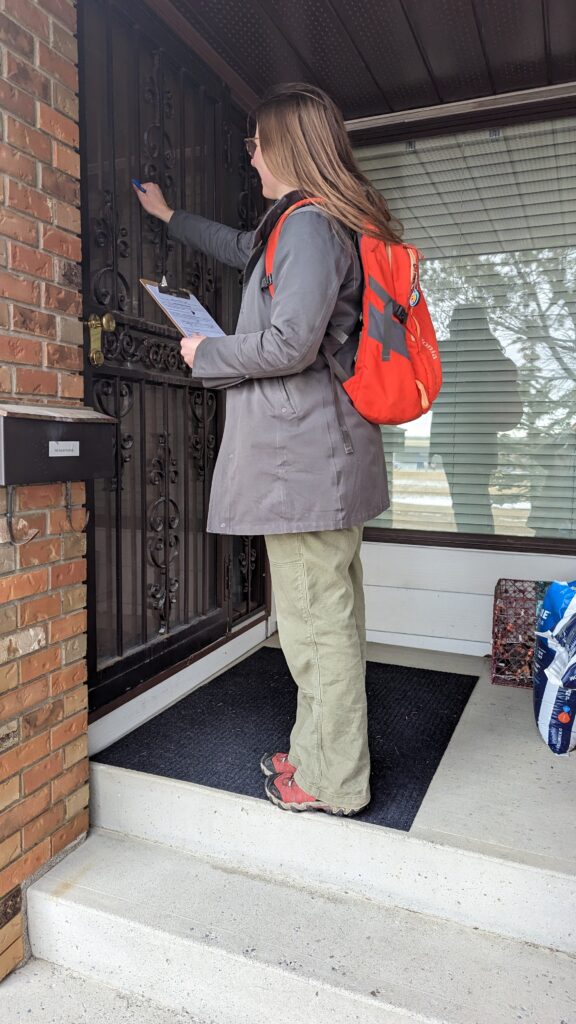
These one-to-one conversations typically last ten to twenty minutes, at the door or over the phone. Rural, small-town, and suburban Canadians are invited to share what matters most to them and where they feel conflicted. Canvassers share brief personal experiences in return, making the exchange human and reciprocal.
The purpose is not to debate, but to create space for reflection. Deep canvassing helps surface internal tension and work through it. The simple act of listening is powerful.
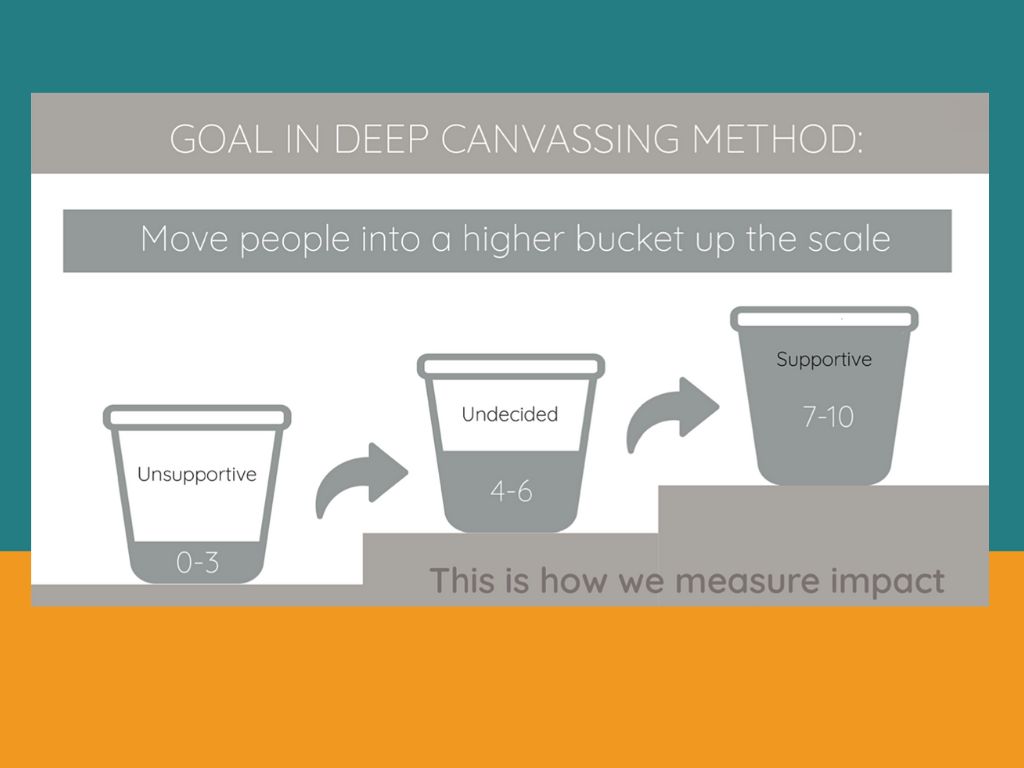
Academic research shows this approach produces more durable shifts in attitudes and behaviour than traditional outreach. Our experience mirrors those findings. Across our work, 1 in 3 people have resolved internal conflict and moved toward greater support for public action on issues like clean energy.
Why It Works
When people feel heard rather than judged, defensiveness drops. When lived experience is acknowledged, trust increases. And when people arrive at and articulate their own reasons for supporting change, those reasons tend to endure.
This approach does not ask people to abandon their identity or dismiss their past. In places like Alberta, where energy is closely tied to livelihood and pride, that distinction matters. Deep canvassing allows people to imagine a path forward without feeling that what came before is being erased or disrespected.
What It Looked Like in Alberta
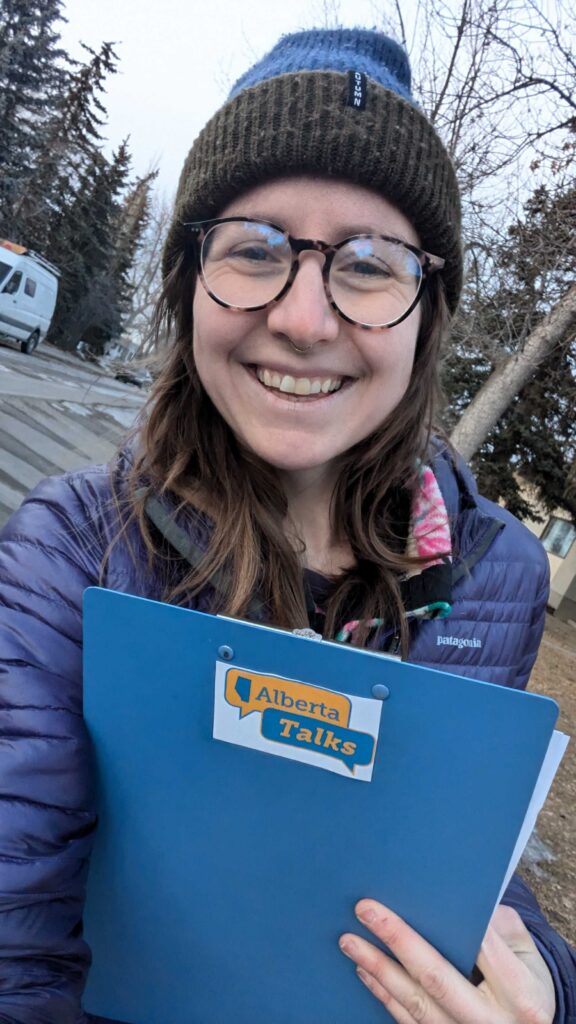
I led Alberta Talks, a public engagement project of the Alberta Environmental Network, under the mentorship of Neighbours United. The project tested whether deep, values-based conversations could shift public support in an energy-producing region where climate engagement is often assumed to be unproductive.
And it can!
Alberta Talks trained 11 organizers and more than 110 volunteers to hold nearly 3,000 structured, depolarizing conversations. Each included brief pre- and post-assessments to measure opinion change.
Participants shifted toward greater support for renewable energy and stronger public action on climate. In many cases, these shifts led to action. Hundreds of Albertans contacted their MLAs, and others spoke publicly at City Council.
Many conversations focused less on climate policy in the abstract and more on everyday concerns, including a perception of underfunded health care, crowded classrooms, and the rising cost of living. Rather than debating energy in isolation, we invited people to reflect on what strong public services require and how government priorities are set.
For some participants, this created space to reconsider a long-held assumption, that what is good for oil and gas companies is automatically good for Albertans. Through conversation, people were able to hold multiple truths at once: appreciation for the role energy has played in their lives, alongside questions about whether current outcomes were delivering the safety, stability, and well-being they wanted for their communities. Opening the door for alternative energy sources to be embraced.
What This Requires
Deep canvassing is effective, but it is not easy.
It requires time, training, and emotional skill. Conversations cannot be rushed. Volunteers need preparation and support. Organizations must prioritize depth over volume and accept that not every interaction leads to immediate change.
This work is often under-resourced and under utilized, yet without durable public support, even the strongest climate policies remain vulnerable to backlash, delay, or reversal, especially during periods of economic or geopolitical instability.
Resourcing deep engagement does not replace policy, technology, or regulation. It ensures those tools have the public buy-in they need to endure.

Why This Matters for Climate Leaders
If we are serious about implementing climate solutions at scale, public support must be treated as foundational infrastructure. Conversation is not soft work. Done well, it is disciplined, measurable, and demanding.
Canada does not lack solutions. What we lack is enough shared public agreement to carry those solutions forward.
Building that understanding takes more than evidence. It takes conversation designed to connect. When people can see how climate solutions relate to their own safety, security, and sense of place, support becomes more resilient. And when that support is visible across rural, suburban, and urban communities alike, governments are far better positioned to lead.
That is what deep canvassing has made possible in my work. And it is why investing in deep public engagement is not a “nice to have,” but a prerequisite for lasting climate action.