Closing the Climate Capital Gap: Why Equity in Climate Investing Is a Business Imperative

Amid the urgency to scale climate solutions, this article argues that who gets funded matters as much as what gets funded. It highlights the persistent underrepresentation of women, non-binary, and BIPOC founders in climate tech, showing how unequal access to capital, mentorship, and investment networks weakens both equity and innovation. Drawing on Spring’s equity-focused climate investing programs, the piece makes the business case for building founder readiness and investor capacity together. With measurable results, including diverse founder participation, new investor training, and capital deployed into women- and BIPOC-led ventures, it presents inclusive climate investing not as charity, but as a practical strategy for stronger companies, better returns, and faster climate progress.
The climate crisis demands innovation at unprecedented speed and scale. Yet the startup and investment ecosystems tasked with delivering that innovation remain strikingly homogenous. Women, non-binary, and Black, Indigenous, and People of Color (BIPOC) founders continue to be significantly underrepresented in climate startups and the venture capital that fuels them, despite the clear and consistent evidence that diverse ventures create stronger business outcomes. This imbalance isn’t just a social equity issue. It’s a missed economic and climate opportunity.

The Representation Gap in Climate Tech
Recent data underscores the severity of the problem. In 2023, only 7% of U.S. climate tech venture capital funding went to companies with female founders, and more than 90% of climate tech deals went to all-male founding teams. Women, non-binary founders, and BIPOC entrepreneurs face systemic barriers at every stage of the venture pipeline, including limited access to capital, mentorship networks, and investment education.
In Canada, these challenges are particularly pressing. Accelerating climate innovation is a national priority, yet many impact-driven founders, in particular those from underrepresented communities, lack access to the capacity-building support and capital pathways needed to become investment-ready and scale their solutions.
The result is a leaky pipeline: talented climate founders are building high-impact solutions, but structural inequities prevent many of them from accessing the resources needed to scale
The Business Case for Diversity in Climate Investing
The irony is that the data is unequivocal: companies with diverse leadership teams consistently outperform their peers. McKinsey and others have shown that diversity correlates with stronger financial performance, better decision-making, and greater innovation, all of which are exactly what the climate sector needs.
In climate investing specifically, diverse founders often bring lived experience, systems-level thinking, and market insights that unlock new solutions and customer bases. When capital flows primarily to homogenous teams, investors aren’t just perpetuating inequity, they’re also limiting their own returns and hindering opportunities for climate progress. Building a more inclusive climate economy isn’t charity. It’s smart investing.
Spring’s Equity Focussed Approach
Addressing this gap starts with a simple but powerful premise: equity in climate innovation requires equity in climate capital. It needs to be operationalized by focusing on ensuring equitable access to capital for those from equity-deserving groups.
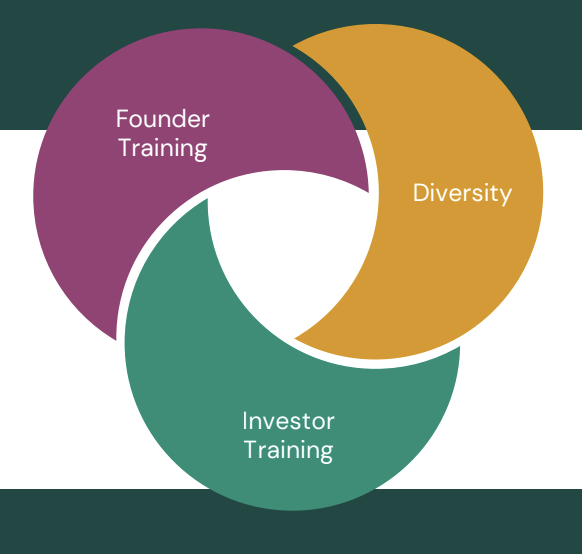
Rather than treating founders and investors as separate audiences, It’s important to intentionally work on both sides of the market, strengthening the pipeline while expanding who gets to participate in climate investing.
Within our firm, the approach came to life through the creation of two complementary programs.
Best Practice #1: Build Founder Readiness and Investor Capacity, Together
Invest Together in Climate Innovation was designed to bring equity squared into practice in the climate sector, for both founders and investors.
Sixteen climate ventures participated in a tailored investment readiness program, building the skills, materials, and confidence required to raise capital. They were then paired with a cohort of 24 investors from across Canada to collaboratively navigate the investment process through weekly, facilitated sessions.
The program culminated in five ventures advancing to due diligence, each receiving a comprehensive investment memo designed to enable real capital deployment.
Best Practice #2: Lower the Barrier to Entry for New Climate Investors
To address inequities on the investment side of the equation, Spring launched Foundations in Climate Innovation Investing, a week-long bootcamp that created a collaborative, accessible entry point into climate investing.
Participants gained practical knowledge, shared language, and confidence. They completed the program with a live deal screening where they applied their learnings in real time and increased their confidence in making future climate investments.
Best Practice #3: Make it a Commitment to Embed DEI in the Process
In order to strive towards an equitable future, it’s important to commit to measurement, reporting and goals. A DEI policy was created at the inception of the fund, embedding diversity analysis into the processes and procedures, alongside the impact and financial analysis. As an investor, Spring Impact Capital was an early signatory to the 2X Global Challenge, the 50-30 challenge, the SELI (Social Equity Lens Investment) framework, and the New Power Labs Fund Canada pledge.
Best Practice #4: Measure What Matters and Invest
These programs weren’t just well-intentioned—they delivered measurable outcomes:
Founder Impact (Investment Readiness Program)
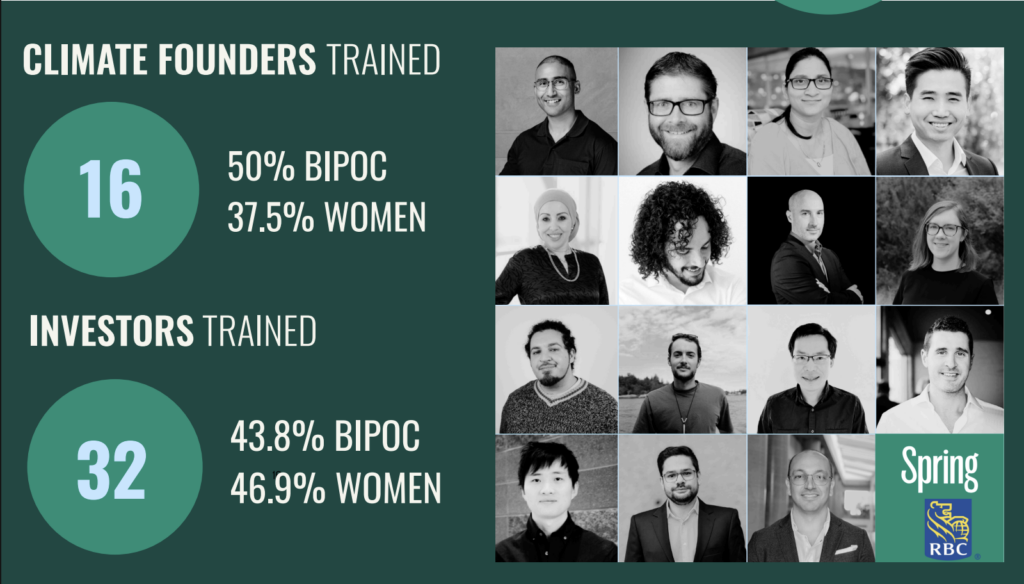
- 16 climate founders trained
- 50% identify as BIPOC
- 37.5% identify as women
Investor Impact (Invest Together & Foundations Programs)
- 32 investors trained
- 43.75% identify as BIPOC
- 46.88% identify as women
The initiative culminated in a virtual Invest Together Finale that brought together more than 160 attendees, including venture capital firms, climate innovation centers, and accelerators, demonstrating strong ecosystem appetite for a more inclusive model.
Most importantly, actual capital moved into climate solutions:
- $63K pooled investment into Genuine Taste, a woman- and BIPOC-led company
- $50K direct investment into Fireswarm, a woman co-led company, alongside $1M in catalyzed follow-on investment
Spring Impact Capital
- 9 investments made, $2.5m in total so far. 78% led by diverse teams, on average 48% of employees are female
Toward a More Inclusive Climate Economy
The systems that created a homogenous climate investment sector can be redesigned. Spring’s work shows that when founders are supported, investors are educated, and capital pathways are intentionally designed and structured for inclusion, the results benefit everyone: stronger companies, better investments, and climate innovations moving faster. As the climate sector continues to grow, the question is no longer whether diversity matters. The question is whether we’re willing to build the structures that allow it to thrive.Spring’s answer is clear—and the results speak for themselves.