Decarbonize Fast. Think Bigger.

What if reaching net zero isn’t enough to make our planet sustainable? Dr. Anne de Bortoli, Carbon Neutrality Research Lead at CIRAIG, Polytechnique Montréal, and a 2027 Clean50 honouree, argues that tackling climate change is essential, but only part of the environmental transformation we need. With seven of Earth’s nine planetary boundaries already breached, Anne explains why cutting emissions alone won’t protect ecosystems, freshwater resources, or human health. Drawing on her research, she challenges the idea that the environmental costs of clean technologies outweigh their climate benefits, while highlighting the need to address excessive consumption. For Canada, she makes the case for measuring the impacts of what we consume, reducing unnecessary resource demand, and ensuring a fair transition. Ultimately, Anne argues that decarbonization should be the foundation for a more sustainable future, not simply a low-carbon version of today’s problems.
Climate policy is under pressure just when we need to accelerate it. Reaching net-zero greenhouse gas emissions around mid-century remains essential. But as we work to rebuild momentum, shouldn’t we also ask a bigger question: what exactly are we trying to sustain?
We have become fluent in carbon footprints, carbon budgets and carbon neutrality. This focus is justified: a stable climate is fundamental to our future. Yet a world that reaches net zero while continuing to destroy ecosystems, disrupt freshwater systems and spread persistent pollutants would hardly qualify as sustainable. This is not a case for doing less on climate. It is a case for making climate action part of a broader, equally necessary transformation.
A stable climate is only part of a stable planet
Earth has more than one vital sign. The planetary boundaries framework identifies nine interdependent processes crucial to the stability and resilience of the Earth system. Climate change and biosphere integrity are considered two core boundaries. The other seven concern land systems, freshwater, nutrient cycles, novel substances, ocean acidification, atmospheric aerosols and stratospheric ozone. In 2026, seven of the nine boundaries are assessed as breached. This does not mean global collapse is imminent, even though local ecological breakdowns are already unfolding. But it shows that today’s global production and consumption systems, driven disproportionately by affluent populations, are pushing the Earth system beyond its safe operating space.
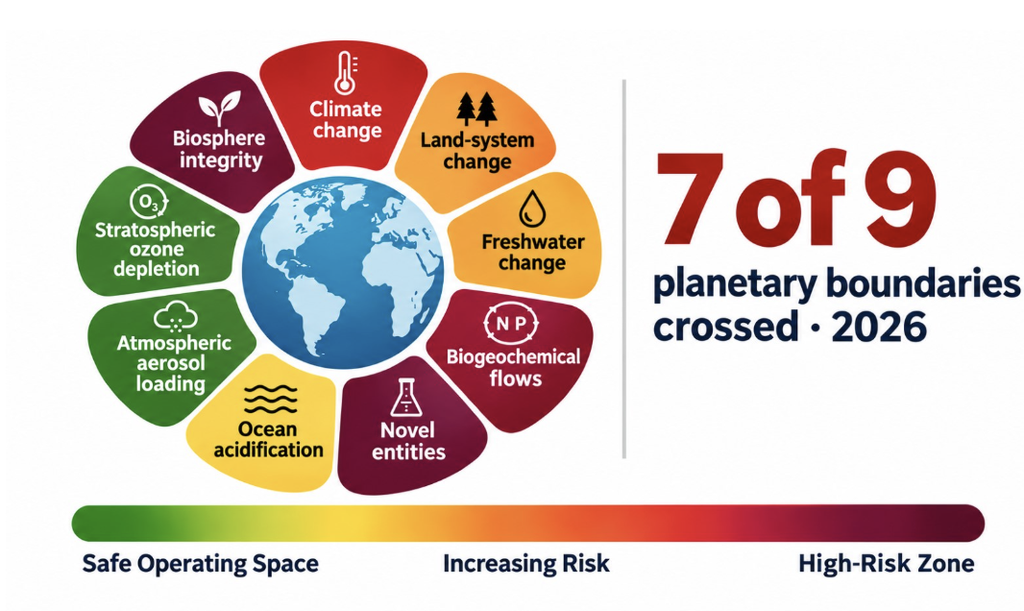
A 2025 study in Nature offers a sobering example. Even a scenario combining implementation of the Paris Agreement with healthier diets and more efficient food, water and nutrient use left several planetary boundaries transgressed in 2050. Climate action can bring enormous benefits, but it cannot solve every environmental problem on its own. That is why we must assess climate solutions across environmental dimensions.
The energy transition: global gains, unequal burdens
The energy transition itself provides a telling example. I work on life cycle assessment. One occupational hazard is pointing out that even promising technologies have environmental footprints. For instance, solar panels, wind turbines, batteries and power grids need metals. Extracting and processing these metals can deplete water resources, pollute ecosystems, and put nearby communities’ health at risk. These impacts are real, not footnotes. But does that mean the energy transition merely shifts environmental damage from smokestacks to mines? Our recent research suggests otherwise.
In a study currently under review, my colleagues and I examined prospective damages to human health and ecosystem quality from producing the metals needed for a net-zero energy system by 2050. Using International Energy Agency scenarios, we compared the additional metal-related damages of a net-zero pathway with the climate damages avoided by reducing direct CO₂ emissions from the energy system. Under the scenarios and assessment assumptions tested, avoided climate-related damages were approximately 400 times greater. And by mid-century, roughly three-quarters of projected damages associated with metal production came from sectors outside the energy transition.
These findings challenge a common argument against the energy transition: that its material requirements might undermine its environmental benefits. Yet a favourable global balance does not make every mining project acceptable. Local impacts can be severe, and deciding which trade-offs are justified requires more than global environmental assessments. This requires asking who bears the costs, who receives the benefits, and who gets a say.
The missing variable: how much do we actually need to live a good life?
The metals example points to a broader blind spot: the environmental pressures driven by consumption across the economy. We put enormous effort into forecasting future demand for vehicles, buildings, infrastructure and energy—and then figuring out how to supply it with fewer emissions. Meanwhile, AI-driven data centres are adding electricity demand to an energy system we already struggle to decarbonize.
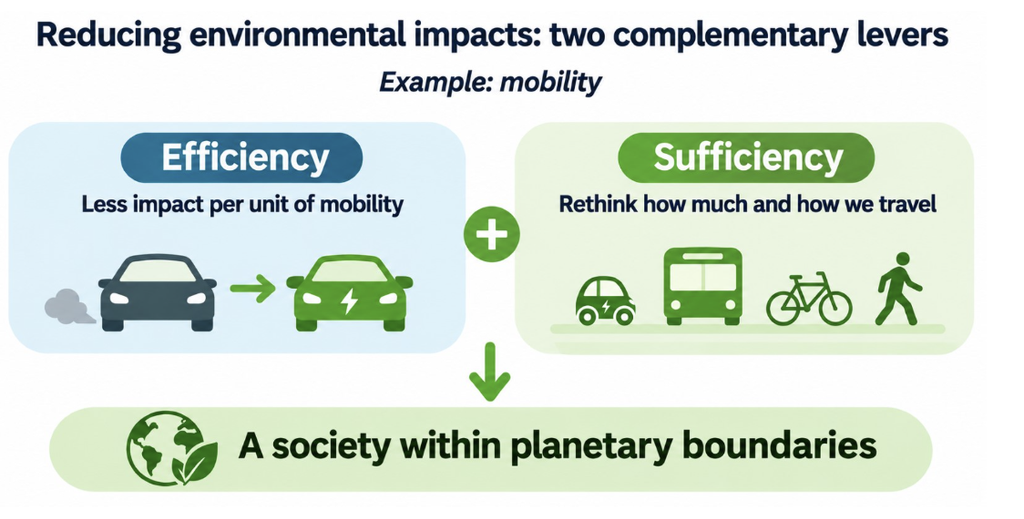
Could we provide better mobility with fewer, lighter cars? Comfortable housing with less energy and material? Goods and infrastructure that last much longer? These are questions about delivering well-being within planetary boundaries, not deprivation. The IPCC estimates that demand-side strategies—including infrastructure design, end-use technologies and changes in how services are delivered—could reduce emissions in major end-use sectors by 40–70% by 2050 compared with baseline scenarios.
Unlike efficiency, which focuses on reducing resource use per unit of service, sufficiency also questions how much we need to consume to live well. This is particularly relevant in affluent countries such as Canada, where our estimates put the consumption-based footprint at around 20 tonnes of CO₂-equivalent per person in 2022—roughly ten times an illustrative two-tonne benchmark for 2050. Geography and climate play a role, but our footprint also reflects choices about mobility, housing and consumption. Reducing these pressures requires more than the energy transition alone. Questioning these choices can be politically uncomfortable, but governments already shape them through zoning, transport networks, building standards and public investment.
What would a broader transition look like?
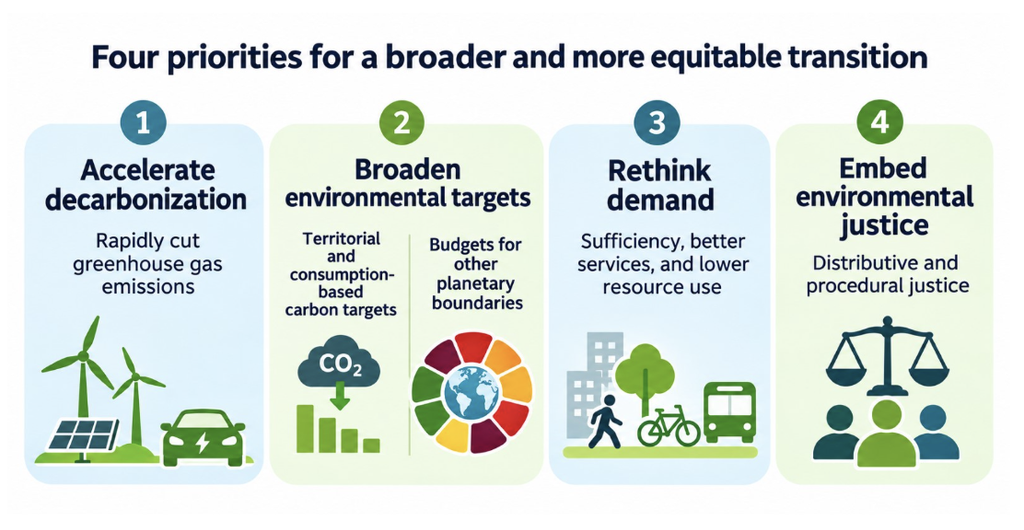
For Canada, I would start by broadening what we measure—and what we commit to. Territorial emissions targets remain essential under the Paris Agreement, but consumption-based targets could complement them by accounting for emissions embodied in trade. France has already adopted indicative consumption-based carbon budgets alongside territorial ones. Why not also explore budgets for other planetary boundaries, including freshwater and land-system change, while openly debating fair allocation?
Next, let’s make reducing excessive material and energy demand an explicit policy objective, not just an incidental benefit of efficiency improvements. That means exploring different ways to meet people’s needs, then creating the infrastructure and incentives to make those options attractive and accessible.
Finally, integrate distributive and procedural justice into environmental assessments and decision-making.
We can let inflation, scarcity and crises dictate how our lifestyles change, or plan transformations that protect well-being while reducing environmental pressure. The future is not a demand forecast we are condemned to satisfy. It is shaped by the cities we build, the services we organize and the expectations we normalize. We must decarbonize—and fast. Let’s make that effort the foundation for something better than a low-carbon version of today’s problems.