Houston, We Have a (Data) Problem! And Thus a Perception Problem…
Here’s What We’re Trying To Do at Clean50 To Fix That…
Two of the things that the Clean50 has built over the past 15 years is first, the ability to operate as a trusted connector – putting the right people in the right place at the right time is kind of core to the brand of both Delta and the Clean50 – and the second is a connection to a remarkable group of leaders from across, quite literally every segment of Canada’s “Clean Economy”.
So, we have a better vantage point than most as to the size and opportunity, including from some of the under-recognized portions of the clean economy, that on their own my not (yet) be large GDP contributors – but which are growing rapidly. And the size and scale – and the opportunity – is HUGE!
And so we’re working right now to convene a gathering of representatives from every part of the entire clean economy, with a view to rallying behind a single banner, so the entire clean economy can share with government, the media, and Canadians the incredible shared potential of this industry to drive our shared prosperity for the next 50 years – with increasing employment, growing GDP contributions (and none of those pesky / toxic downsides! )
To that end we’re hosting a full-day Summit next Wednesday, welcoming 72 senior executives from across Canada, and spanning just about every element of the clean economy, to answer the question “Are we stronger remaining exclusively in smaller sector silos? Or would working together to tell the much bigger story of our collective economic contribution move the needle more effectively for all of us?”
Tentatively called “CanCEA” (Canadian Clean Economy Alliance), we’ll be discussing the opportunities for the entire industry plus environmental advocacy groups to collaborate closely advance shared “asks” of government, while educating media, and Canadians about the reality of the contribution the clean economy already makes – and the expectation that can triple if Canada matches world-wide expected growth.
As much as carbon taxes were poorly sold by the government for years, and poorly understood by Canadians and naturally, then, deeply unpopular, cutting the carbon tax has cost Canadians a great deal in economic activity and jobs of which few are aware. The carbon tax incentivized both consumers and businesses to invest in becoming more efficient. Those investments drove jobs in construction clean tech, renewable energy and elsewhere. Already operators, consultants and sustainability professionals can point to numerous abandoned projects entirely as a result.
And now some are articulating for the erasure of even the industrial carbon tax. It’s certainly in the interests of anyone who care about the environment and climate change to resist that – but even more important for the hundreds of thousands of jobs and economic activity that are at least partly incentivized by investments to become more energy or resource efficient – and efficiency / productivity something Canada has lagged in over recent years.
SO HOW BIG IS THE CLEAN ECONOMY?
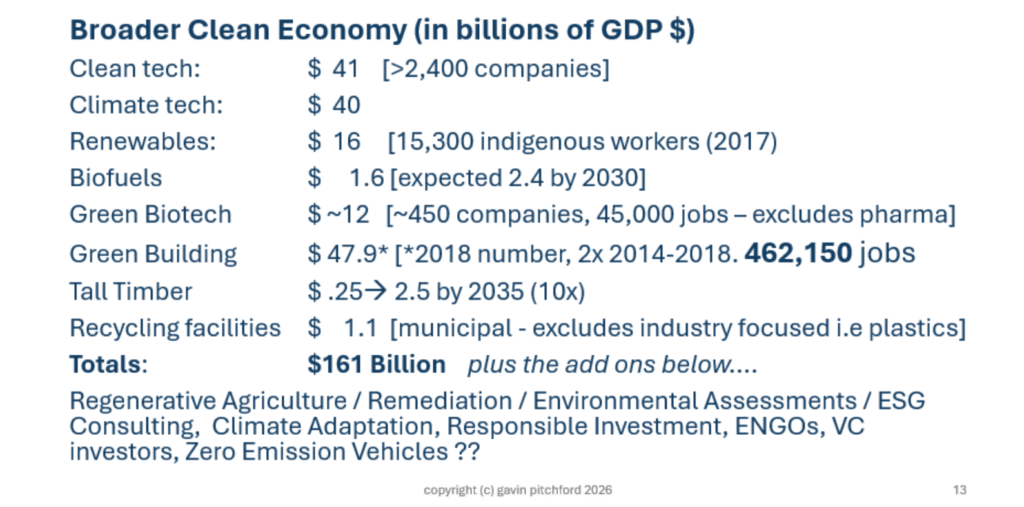
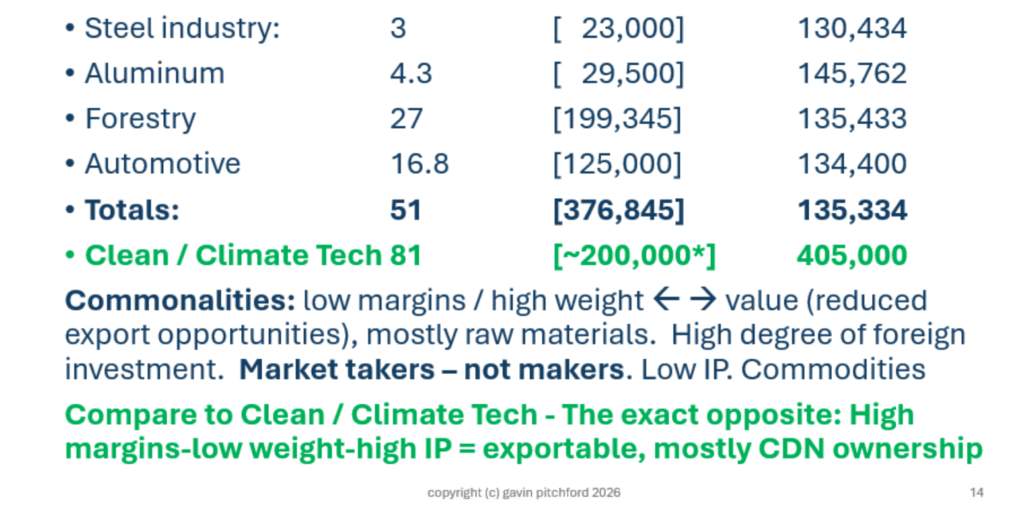
Research I have done – or rather, tried to do – suggests the clean economy in Canada is approximately $200 BILLION dollars in GDP. Via various sources, mostly StatsCan, I can track $161 Billion. But there’s a variety of industries whose numbers are essentially invisible and not a part of that total. (More on that later). Most people are shocked to hear the size of that number. Especially when compared to other industries they view as critical (i.e. steel – 4 billion, aluminum – 4 billion, automobiles – 16.8 bilion ) that are mere fractions of the total. The clean economy sector is literally 10 times the size of the auto sector.
And, for comparison’s sake, the petroleum industry is $160 Billion. So actually smaller, than the clean economy, even without the missing data.
Today, we – the Clean Economy players in Canada – do an absolutely terrible job telling the whole story to anyone, both sectorally and collectively, and as a result neither MPs nor Canadians have any idea just how big the industry is, how many jobs it drives, or properly understand the amazing potential for Canada going forward.
In contrast, MPs get regular and repeated visits from the oil and gas industry lobbyists, and they show up for the Minister of Natural Resources offices pretty much daily. But virtually no one from the renewables industry, and even fewer from the clean tech industry, show up, and so MPs are left with the wrong impression. The Canadian public even more so.
And because we’ve done a terrible job, when talking heads from Pathways go on CBC News and tell the interviewer that “Renewables and grid scale energy storage just aren’t ready”, the interviewer nods his head in agreement. Someone should tell California!!
The petroleum industry is dead set against anything which reduces our collective use of fossil fuels, and so slanders the alternatives (renewable energy, EVs, bio-plastics – you name it) incessantly and with impunity, but in the end, to our discredit, they’re essentially running unopposed. How else to explain Alberta’s tougher environmental regulations and stringent demands for more “clean-up” money for the solar industry than expected for an oil well?
And as a result, even Canadians and politicians who support climate action are left supporting the oil lobby as somehow a game-saver in the face of Trump, – and repeating PR falsehoods like ‘de-carbonized oil”, when the reality is far different – and the costs we bear in terms of clean up, health and beyond are enormous. The IMF says Canada provides more subsidies to the oil industry than any other country when all factors are considered, pegging that number at $81 billion a year – half of the fossil fuel industry’s GDP! (others peg the number in cash at 29 billion).
But ultimately Canadians are never going to support the transition until we provide them with a good reason to do so. And right now that’s a huge miss on our side. The biggest single critical resource in driving the clean economy is brain power. And as literally and objectively the best educated country in the world, with the right support and a decent strategy, we actually have the ability to outpace the world-wide growth in the clean economy. And so we should.
And hence our efforts. Our vision for this convening effort is that it’s just way past time to change all of that. So we’re gonna try…
In fact, the number of clean economy jobs dwarfs the number of those in the petroleum industry, and, even better, is widely dispersed amongst thousands of companies in ~15+ different sub-sectors – not all tied to a single price driven by OPEC. Which translates to much less risk for Canadians.
Ownership of clean economy players is almost 100% Canadian. There’s pretty close to zero pollution and no toxic leaks or abandoned wells leaching carcinogens into groundwater. The industry is widespread in terms of both markets and geography so no single community is exposed in the event of a downturn. So what’s not to love?! And why aren’t we?
And despite it’s potential to TRIPLE in size world-wide by 2035, the industry as a whole gets just a fraction of the average $29 Billion in subsidies offered to the oil and gas industry each year. Which – coincidentally – is virtually a perfect match to average profits of the petroleum industry.
Meaning that, incredibly, Canadian taxpayer paid subsidies are essentially all that makes the oil industry “profitable” – Worse, 36% of the ownership isn’t even Canadian! So we’re essentially gifting foreigners 10Of course that’s ignoring an estimated clean up bill of $270 billion – a number roughly equal to half of the Federal Budget spend. (I should add the Alberta government has 1.6 billion in clean up fees held in trust to cover that. So, to be fair, drop that unfunded, unsecured liability down to ~$268.4 billion.)
All of which is to say, Canada needs to double down on the future: Supporting the Canadian-owned clean economy, not propping up a dying 100+ year-old industry. But the fact Canada has not yet sufficiently seized this opportunity is all on us, not taking the time or making the effort to tell our clean economy story…
The time to change that has come…
If you’re interested in following CanCEA’s plans and progress, please email us via the “contact us” page…
Data challenges:
As but one example, “Green Building”. It’s a subset of the home building industry, the construction industry, private contractors – and not counted by any government body. CaGBC in 2018 estimated it at nearly 50 billion 6 years ago, For example, “Net zero” homes – built way above code – is neither tracked, nor differentiated from regular housing. StatsCan has no idea what the “green” component.
Another: Energy efficiency retrofit construction is reported as part of the regular construction total.
Arguably, both of these activities incentivized by increasing costs of fossil fuels, driven in part by carbon taxes.
It’s left to individual industry associations – where they exist – to track and report their numbers, and while some “green” industry groups exist, and can provide their clean economy contributions, but lots of others cannot.