In Budget 2026, Carney must play his electrification Trump card

Canada has big ambitions to become a clean-energy superpower, but is it putting its money where its mouth is? Ahead of the November 5 federal budget, Chris Severson-Baker, Executive Director of the Pembina Institute and a 2027 Clean50 and Clean16 honouree, argues that Canada’s focus on fossil fuel development is overshadowing opportunities to accelerate electrification. Drawing on his experience leading one of Canada’s foremost clean-energy research and advocacy organizations, and the Pembina Institute’s work advancing clean-energy policy, Chris outlines three priorities for federal investment. He makes the case for electrification as a strategy to create jobs, improve affordability, strengthen energy security and build a more competitive, resilient Canadian economy.
After 20 months and counting, the leader of our largest trading partner remains focused on bullying tactics and a strategy aimed at breaking the Canadian economy – highlighting the need for Canada to continue our urgent pursuit of national security and long-term economic resilience.
Central to this pursuit will be the development and implementation of our national electricity (or more accurately, electrification) strategy.
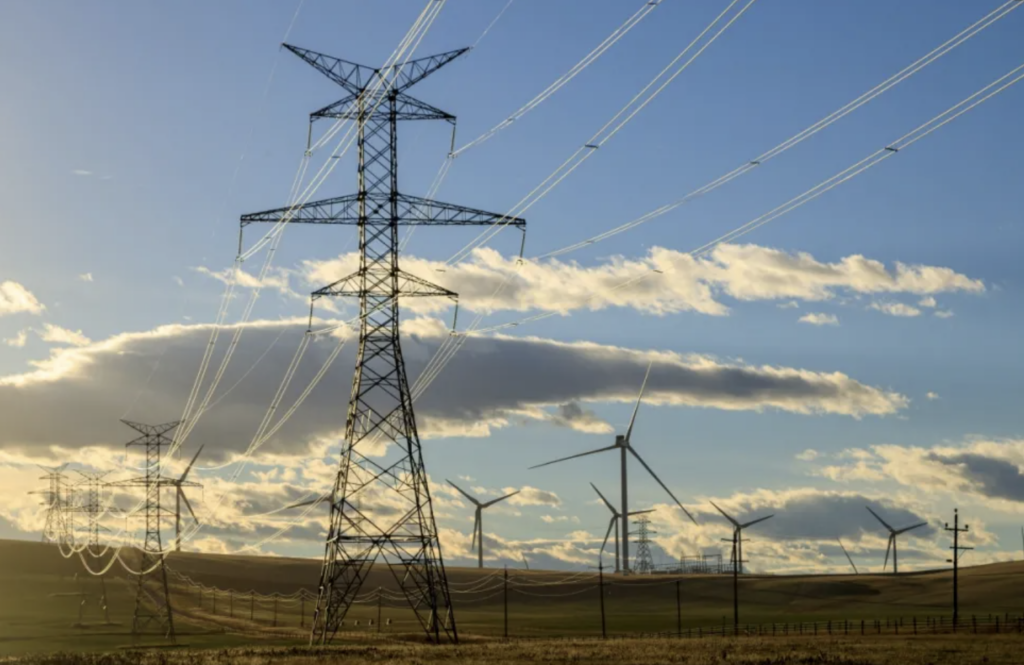
In Prime Minister Carney’s words, “The path to affordability is electrification. The path to competitiveness is electrification. The path to sustainability is electrification.”
He is absolutely right. But you really need to dig to find the electrification headlines.
The federal government has worked tirelessly to sell Canadians on the plan to build another taxpayer-funded oil pipeline, but there isn’t much on how electrification will fundamentally change our everyday relationship with energy by 2035. We aren’t seeing government readouts on how Canada stacks up against peer nations in the global race to electrify our lives and industries.
In 2026, abundant clean energy is no longer the stuff of climate optimists. Thanks to advancements and steep price drops from massively scaling up proven technological solutions – and one global geopolitical crisis after another making oil and gas more expensive and volatile – clean energy is now the affordable, reliable and secure, safer and healthier energy choice.
But while Canada is saying many of the right words, our actions – and investments – don’t yet follow.
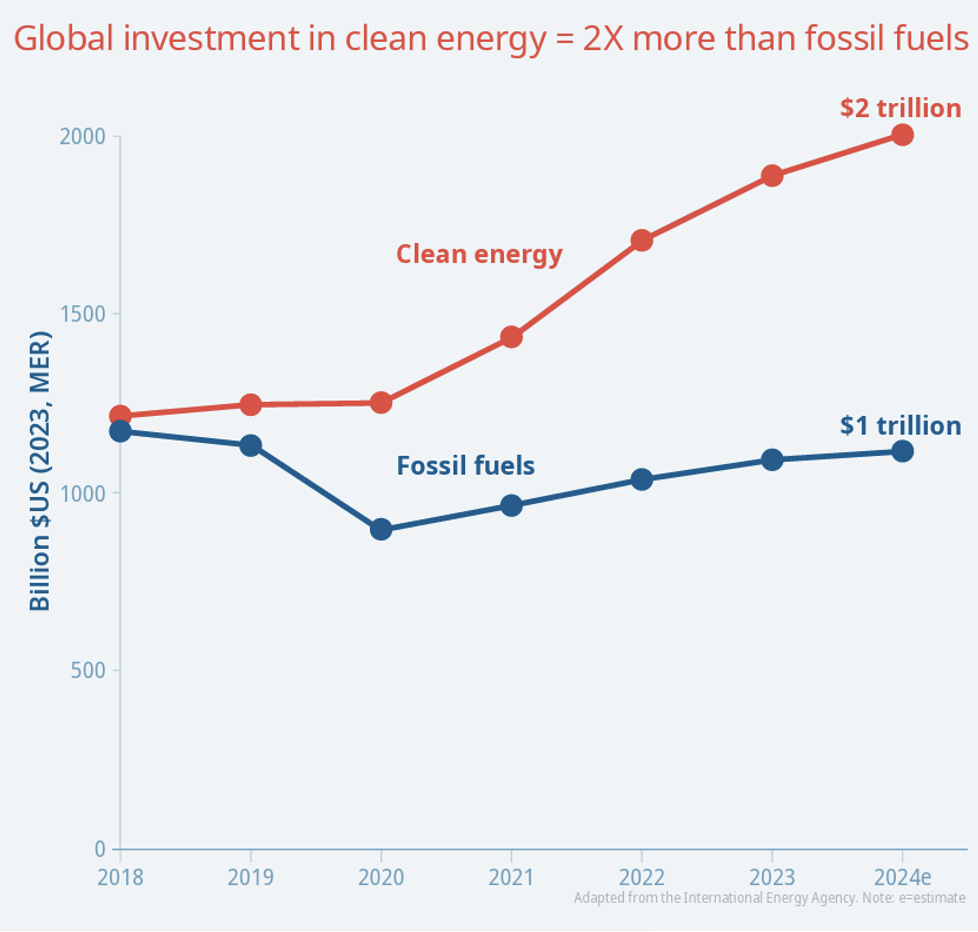
Globally, investment in clean energy now outpaces investment in fossil fuels 2:1 (in 2025, $2.2T to $1.1T). Yet, the federal government’s September Investment Summit prospectus, for example, presented 11 “Conventional Energy” projects totalling $103.87B USD in potential investment, compared to 29 “Clean Energy” projects totalling $88.88B USD. Not yet a 1:1 ratio, let alone 2:1.
Instead, as the global energy transition accelerates, the energy conversation in Canada remains disproportionately focused on subsidizing and expanding legacy fossil fuel interests – leaving our “clean energy superpower” ambitions on a far-off horizon.
It’s time Canada to recognize that embracing our potential as a clean energy superpower can be how we hit back at a bully without laying a finger.
And it can start to come to life in Budget 2026 on November 5.
The Pembina Institute developed a suite of federal recommendations – here are the top 3:
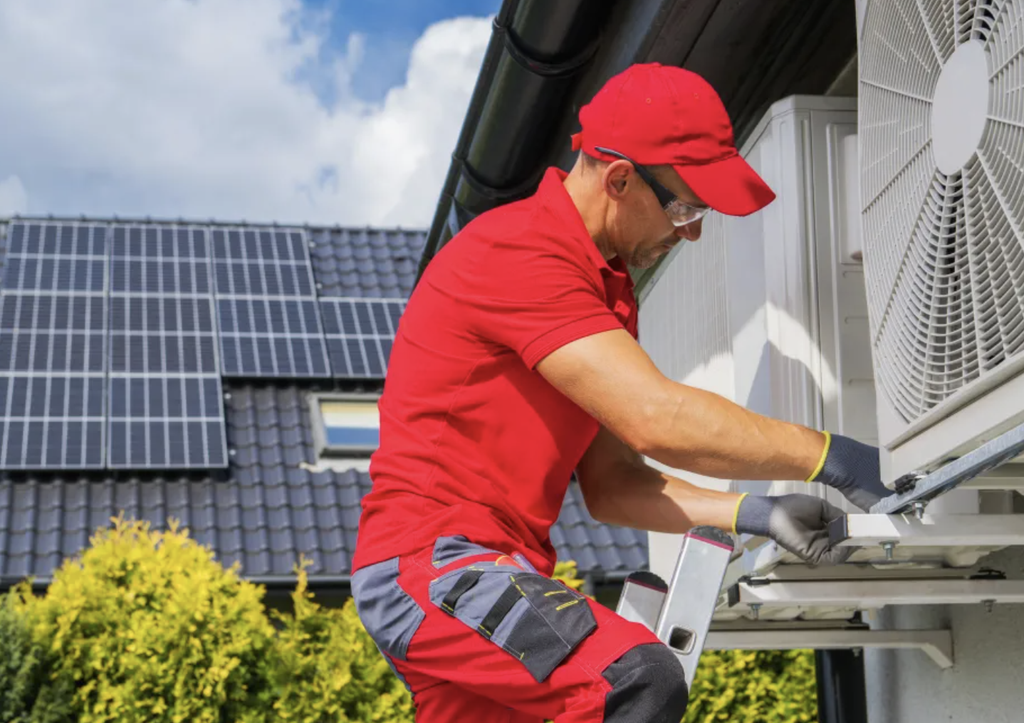
- Building on the $2B for heat pumps announced in October, seize the nation-building initiative of scaling up a strong domestic building retrofit sector, starting with multi-unit residential buildings (MURB). Electrifying Canada means our buildings become energy hubs, with the most efficient heating and cooling systems, and integrated EVs, small-scale renewable energy, and batteries for energy storage. Retrofits make our homes more efficient, affordable, resilient and safe, while creating opportunities for Canadian skilled trades, supply chains and manufacturers. Government should grow this industry through loans, an industrial strategy framework that sparks financial institution and private sector investment, and coordination with provinces, territories and utilities. This would generate tens of thousands of jobs for one-tenth the price of a new west coast oil pipeline.
- Federal coordination and underwriting to strategically connect our isolated provincial and territorial electricity grids. Today, Canadian grids are better connected to the U.S. than their Canadian neighbours. More province-to-province interties will create a Canadian electricity grid that is more affordable, clean, reliable, and secure. If done right, this nation-building initiative would enable Indigenous communities to meaningfully participate and hold financial equity in energy projects from coast to coast to coast.
- $6.5 billion to evolve from a basic analog power system built using 1950s technology to a fully modern one that actively encourages consumers to save money by telling their house, car, and major appliances to use and store power when it’s cheap and abundant. Investing in these “demand-side management” solutions means using energy more efficiently, avoiding energy losses, and matching supply to demand more effectively. Canadians benefit by participating in the system and saving (potentially even making) money.
These federal actions and investments would go a long way toward solving the massive challenges Canada faces – from national security and economic competitiveness, to affordability and jobs, to public health and climate resilience. They are the kinds of investments the Carney government will make if it’s serious about its electrification strategy as key to building a competitive, future-proofed economy while reducing emissions.
Since early 2025, Canada has been enraptured in a conversation on how to build a stronger, more secure and resilient country. Big megaprojects – including the $70-billion Gull Island and Churchill Falls power project, which would produce twice the power of the largest nuclear plant in North America – matter a great deal. But if we don’t also seize better, more affordable technologies to electrify our buildings, transportation systems, and most industries, economic growth will sputter – and most Canadians east of Manitoba will remain reliant on increasingly expensive mostly-U.S.-imported oil and gas.
If we are willing to invest tens of billions of taxpayer dollars in Canada’s fossil fuel sector – as has been committed in recent months – we must double, even triple those spends with investments in the clean economy. This is where the puck is going. Peer nations around the world are already chasing it.
The age of electricity is here. Canada has all it needs to prosper – the resources, people, technologies, relationships and reputation. Being an energy superpower in 2026 and beyond means being an electricity superpower. Budget 2026 is the next big opportunity for Canada to put its money where its mouth is and reset the balance on Canada’s energy system, for the benefit of all Canadians.
In Prime Minister Carney’s words, “When we master energy, we master our destiny.”