Nibi Is Life: Safeguarding Lake of the Woods in an Era of Climate Disruption and Austerity
As climate disruption intensifies across the Lake of the Woods watershed, Teika Newton argues that freshwater protection is a core public responsibility, not a discretionary environmental line item. She traces how legacy nutrient pollution, worsening algae blooms, and rapidly warming winters are converging with fiscal austerity in Canada and the United States to weaken the scientific monitoring and cross-border cooperation that underpin restoration effort. Highlighting the fragile, collaborative work of the International Multi-Agency Arrangement, Newton contends that durable government investment in long-term data collection and ecosystem science is now the essential condition for protecting water “on a forever scale.”
“Nibi is Life”
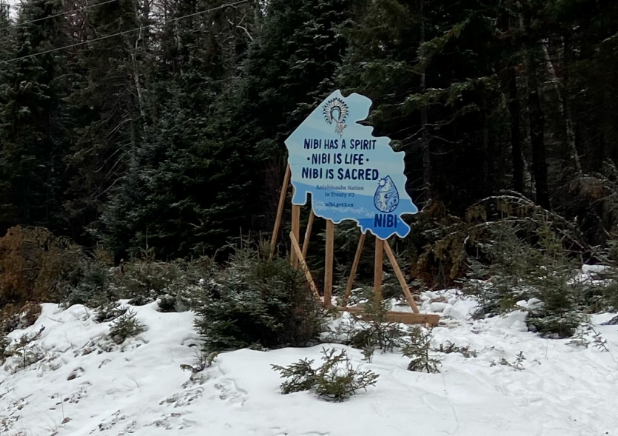
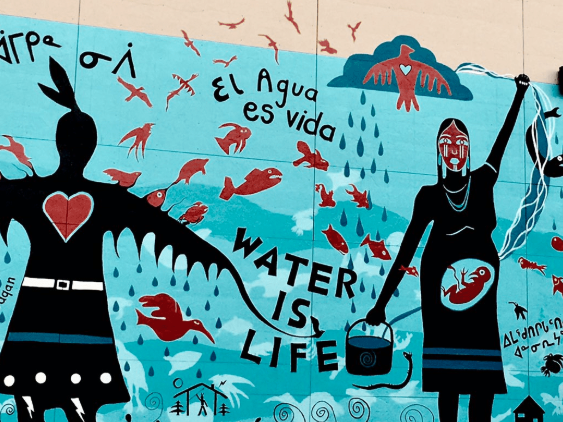
Along highways throughout the Lake of the Woods watershed in Treaty 3 territory, billboards speak to the Anishinaabe laws and understanding of Nibi – water and the life-giving spirit it engenders. All life systems are intertwined through water that flows through our communities, bodies, and between generations from mother to child. If our lakes and waters suffer, so too does all life, including our own. This understanding is woven into the foundations of our governance, with the Anishinaabe account of Treaty #3, known as the Paypom Treaty, describing a sacred covenant between peoples committed to reciprocity in this shared place, that will “… last as long as the sun will shine and water runs, that is to say forever.”
In this place, water truly is on a “forever” scale.
The landscape is speckled with thousands upon thousands of lakes and streams, more water than land, with Lake of the Woods the largest of all – a 70,000 sq km watershed draining 600 km of streams and lakes.
But even here, where water abounds, it is in grave peril from cumulative stresses after decades of pollution and the overwhelming disruption of climate change. At just the moment when government’s support is most needed to ensure the fundamental public interest of survival, capacity for basic science and data collection is eroding in the race to counter trade ruptures and turbulent geopolitics. Water resources managers in our watershed are pleading for renewed, redoubled, enduring public investment in the basic data collection and science that will best protect our ecosystems and us.
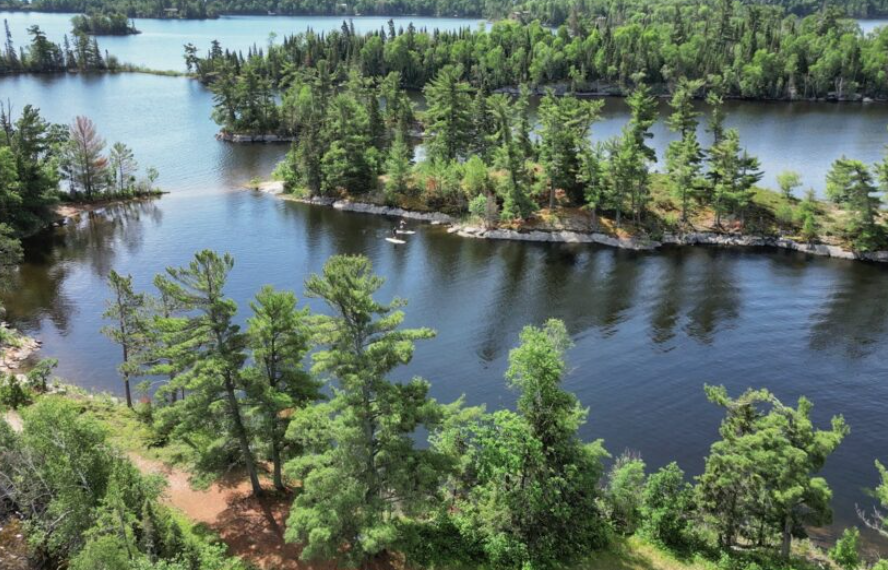
Lake of the Woods is a geographically, politically and ecological rich region, bounded by the Great Lakes and Lake Winnipeg. The International Joint Commission, the entity charged by the Governments of Canada and the United States with implementing the 1909 Boundary Waters Treaty that maintains peace between neighbours through the protection of their shared waters, has a strong presence here, as do the governments of Ontario, Minnesota and Manitoba, the Anishinaabe nation in Treaty 3, Chippewa and Ojibwe tribes in Minnesota, and Métis peoples. Dozens of water resources management agencies are active in the watershed.
For decades, the lake has been seasonally compromised by harmful and toxic algae blooms, a problem borne from a legacy of pollution caused by dumping untreated industrial and municipal effluent into its primary tributary, the Rainy River, from the 1880s until the 1960s. While the sources of that pollution are long gone or now well managed, the residual nutrient contamination remains downstream in the lake, fuelling a toxic and ugly environmental crisis that threatens the lives of residents and a lake-based economy worth more than $500M.[1]
The algae problem has been the focus of tens of millions of dollars of investment in research and policy among international governance and research partners since the late 1990s, and in recent years, their collaboration has informed evidence-based policy and water restoration plans based on robust science. However, a troubling confluence of governments’ turns toward austerity budgeting, plus complex ecosystem impacts from a rapidly warming climate, are exposing watershed vulnerabilities like never before.
The current U.S. federal administration initiated a series of deep cuts to its workforce in early 2025, terminating dozens of long-term scientists and managers from federal agencies active in our watershed. Those who remain have had budgets dramatically curtailed. Indigenous nations and the state of Minnesota have stepped up to fill some capacity gaps on the US side, but resources are stretched tightly and personnel few. Meanwhile, in Canada, both federal and provincial government priorities to counter trade challenges have bumped water, climate and environmental spending to the back of the line, potentially impacting Canadian capacity to maintain a meaningful level of involvement in Lake of the Woods watershed science. Federal ministries and departments have been instructed to find efficiencies and reduce budgets by 7.5% this year, 10% in 2026 and 15% in years to follow – a level of austerity that may compromise agencies’ abilities to regularly and routinely collect basic data.
In the foreground, daily life in the watershed is increasingly disrupted by accelerating climate impacts, where winters are already around 4C warmer than the pre-industrial average.[2] Two of the past five years have seen century-old flood and drought records broken, and we have experienced extreme water levels anomalies in four of the past five years. Heat domes and persistent, widespread wildfires on an unprecedented scale abound, disrupting wildlife and limiting wild food sources. In the current year, all wild berry crops failed from drought, leading to hungry wildlife. Meanwhile, I’ve been swimming in the lake outside my home in October, a month when, in years past, I’d have been more likely to be shovelling snow. Ecological disruption is the new norm.
The science is clear that climate change is already wreaking on the Lake of the Woods watershed – from more than a month less ice cover in winter, to darkening lakes (because when landscapes are hit with drought, then heavy rainfall, more erosion occurs and organic material that washes into lakes is dark), to rising temperatures and depleted oxygen, more light penetration, more alien invasive species surviving increasing temperate winters, more light in lakes allowing for more plant productivity, more wildfires producing more ash that provides yet another nutrient boost to nuisance algae, more methylation of mercury[3] and on and on… What is less well understood is what the cumulative impacts of all these stressors might be, and how or when we will know that the stress has become too much for our ecosystem to bear. There is a very real risk that, despite all the very good management interventions we are attempting to make, we may see catastrophic ecosystem collapse within decades if additive climate and contamination stresses prove more than nature can handle.
For now, local water resources experts from government agencies in Minnesota, Ontario, Manitoba, Indigenous nations, and federal governments, have created a makeshift solution to meet research capacity needs through an initiative called the International Multi-Agency Arrangement (IMA). At least 30 agencies are represented at this non-binding, unfunded, cooperative table that has been convened and coordinated through the Lake of the Woods Water Sustainability Foundation since 2009. Over the years, the IMA partners have built the interpersonal trust necessary to foster interagency, international collaboration in developing and implementing restoration plans. In the same cooperative spirit, the IMA furnishes the International Joint Commission with the data required to report on exceedances of key water quality parameters and progress toward internationally shared water quality goals. IMA partners share common goals and support one another in leveraging resources, training, and capacity building to do essential work that receives, at best, episodic and intermittent public resourcing. It is a remarkable example of bottom-up organizing… and ultimately, the model is unsustainable in its current form without sustained and durable buy-in from senior levels of government.
In policy circles, we speak about the imperative to fund and support climate adaptation, especially at the local level, imagining that investment in building infrastructure resilience to fires and floods may afford communities ongoing safety and comfort. But what happens when the basic ecosystems that sustain life and livelihood around us collapse?
Our best defense against our own demise is information and knowledge that give us capacity to act. Never has there been a more urgent moment for governments to enhance and sustain data collection and data-driven research, never has an environmental budget line been more in the nation’s interest.
End Notes:
[1] https://ero.ontario.ca/public/2024-05/LOTW-ERO-019-6067-RecreationalWalleyePlan.pdf
[2] https://climate.umn.edu/climate-change-north-central-minnesota
[3] Mercury is a naturally occurring element in boreal forest soils, and in the form of methylmercury, which forms when soils are flooded and then dried and flooded again within a single season. Methylmercury bioaccumulates in fish and the wildlife and humans that eat them, and mercury poisoning creates lasting neurological disease. Mercury is also produced through industrial processes, especially the burning of coal, and when released to the atmosphere, it can travel thousands of kilometers before falling to the earth once more. Both atmospheric deposition and local sources are big contributors to mercury pollution in the Lake of the Woods watershed, where fish consumption advisories exist for every lake due to mercury contamination.