One Pipeline? or 214 Million Solar Panels? You Pick…


The federal money offered to oil sands producers for a pipeline, if shifted to solar panels, would produce enough electricity to meet the electricity needs of 85% of all Canadian households.
Here’s the math from the back of my napkin (and a calculator).
Even at a small scale, with a crate of just 27 panels, the cost of solar panels has dropped to about $196 per panel. That buys a top-of-the-line, bifacial Canada Solar panel measuring 2.4 metres long by 1.13 metres wide, with a “nameplate” (aka “faceplate”) rating of 620 watts, a 10-year guarantee, a 30-year yield warranty, and the ability to withstand major weather events.
“Bifacial” means that energy is absorbed on both sides of the panel, although usually far less from the underside. The nameplate rating means that 620 W is replicable in the field, or on a rooftop, when the panel is positioned at the optimum angle, at solar noon, with good reflection and no shading. That is not the energy flow you are actually going to see for most of the day. But still: across Canada, solar panels typically generate 1,125 kWh of electricity annually for every 1 kW of installed nameplate capacity.
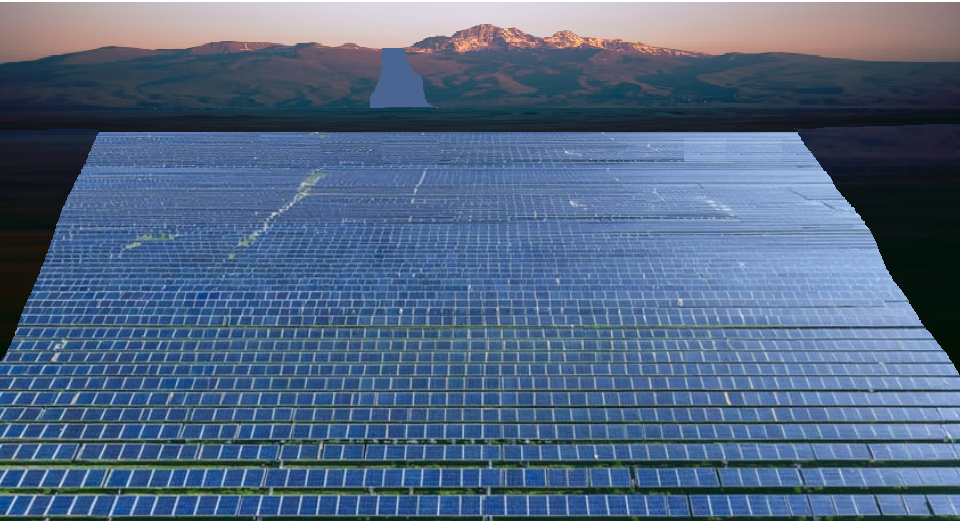
So…here are the calculations: Had Mark Carney instead invested $42 BILLION into buying solar panels instead of an empty pipeline, we could have bought a whopping 214 MILLION solar panels!
To put that in perspective, 214 million panels would form a path 76 panels wide, (86+ metres / 95+ yards wide – or to visualize, roughly the length of an American football field wide). And if lined up side by side beside the Trans-Canada Highway, they would run the entire football-field-wide ribbon of panels the entire 6,699-kilometre distance from St. John’s, Newfoundland, to Victoria, British Columbia.
To put otherwise, that is more than five panels for every single person in the country. Or enough panels to cross the country 76 times over.
Let that sink in…
Same money.
Together, those panels would have a nameplate rating of more than 132 GW, or approximately 132,680 megawatts. For comparison, all of Canada consumes, on average and at any given moment, just slightly more than half that amount of electricity: 72 GW.
Of course, the sun does not always shine, so a different equation comes into play. On average, across the entire length of the Trans-Canada Highway, one kilowatt of installed solar panels, based on nameplate capacity, produces between 1,000 and 1,250 kWh of electricity annually in real-world conditions.
Using the midpoint of 1,125 kWh, those 132,857,142 kW of installed panels would generate 149.464 terawatt-hours of electricity each year. The average Canadian household uses 11,135 kWh of electricity annually. That means these panels would generate enough electricity to power 13,422,926 Canadian households for a year.
That is more than 85% of all existing households. For the next 30 years. Without any pollution.
Now, the naysayers will point out that the panels need infrastructure to connect them: wires, inverters, controllers, racks, land, and installation.
Absolutely – and fair enough. But in this (admittedly crazy) hypothetical, once the system is built, its operating costs would be far lower than those associated with digging holes two kilometres into the ground, pumping steam down and heating and then extracting sludgy tar, diluting it, pushing it through a1,200 km long pipeline, up and down mountains, and then separating out the diluent, and refining the sludge into something useful. And then building gas stations, storage tanks, pumps… tanker trucks to ship the stuff around,
The pipeline also requires extensive infrastructure to support it. Although not many jobs.
The other difference, of course, is that our renewable-energy developers are Canadian. The profits stay here. Employment is far higher per dollar invested (Building renewable energy infrastructure creates roughly 3 to 3.5 times more jobs per million dollars invested than the fossil fuel and pipeline sector).
And the panels produce no costly aftertaste, such as a $260 BILLION petrochemical cleanup bill, literally 99% of which is currently completely unfunded. That means another enormous – and continually growing – taxpayer liability down the road.
Ask yourself: Is a pipeline really a good deal for Canada? And why are we prioritizing foreign-owned oil companies over Canadian-owned renewables developers?
Maybe call your MP and ask why we’re spending 42 Billion on oil infrastructure – and less than 1 billion on renewables.