Atlantic Carbon Mineral Hub
Projects Sponsor

Delta Management Group is the leading sustainability, ESG and clean tech focused search firm in Canada. Delta is proud to have founded the Canada's Clean50 Award program in 2011, and has been the primary sponsor for the past 13 years.
Giant legacy asbestos mine waste in Baie Verte, Newfoundland is a massive liability and environmental injustice with health & safety risks for the community; BAIE Minerals, operator of the Atlantic Carbon Mineral Hub, is solving this problem by transforming toxic waste into decarbonized minerals and critical metals while generating CO2 mineralization carbon credits. This high-value reclamation solution removes pollution, enables ecological restoration and delivers economic impact to the community, providing minerals and climate solutions for the future by cleaning up the past.
In Baie Verte, Newfoundland, roughly 300 million tonnes of asbestos-laden mine waste has sat as an orphaned liability since the last chrysotile mining operation closed, too costly and too hazardous for anyone to have found a way to clean it up. Baie Minerals Inc., founded by generational residents of the community, spent more than five years developing a process to detoxify that waste and extract value from it instead, work that has become the Atlantic Carbon Mineral Hub. The technology destroys asbestos fibre structures entirely, recovers more than 90% of the site’s minerals as saleable, decarbonized industrial and critical minerals, and activates a natural chemical process that turns the remaining mine waste into a source of carbon dioxide removal credits. The company estimates the site’s combined mineral and carbon-credit value in the billions, a figure that would turn what has long been considered an unfundable cleanup into a self-financing reclamation project.
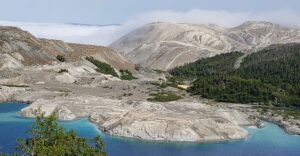
The mine waste itself is the legacy of more than 30 years of chrysotile asbestos mining, abandoned by the operator that created it and left behind as both a health risk and, for the community that has lived beside it ever since, a longstanding injustice. Baie Minerals’ founders grew up in Baie Verte, and that history shaped the project’s starting premise: any solution would need real community support to succeed, and it would need to treat the waste not as a problem to bury, but as a resource that had simply never been safely processed.
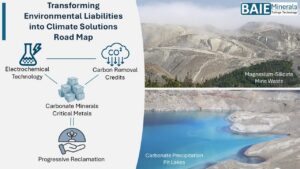
The objective from the outset was narrow and specific: develop a way to detoxify asbestos-laden waste, render it safe enough to process as feedstock, and extract the industrial and critical minerals still locked inside it. Baie Minerals built the Hub around that core technology, bringing in carbon-dioxide-removal partners to capture the additional value created when the same treatment process activates the waste’s capacity to mineralize CO2.
Getting to a working process took years of trial and error alongside Canadian research institutions, including Deepak Pirpalani at the National Research Council of Canada and Leo Cheung at the Research and Productivity Council, both of whom ran lab and bench-scale testing on the company’s behalf. Early results proved that detoxification and mineral liberation were both possible, but the first viable method relied on strong acid and high heat, an approach that worked but came at real cost. Baie Minerals and its research partners pivoted to a proprietary cavitation and electrosorptive process, since named BAIEmag, that uses only water and electricity. It costs less, uses less energy, and skips the acid and heat entirely. That technology has since advanced from bench-scale testing to pilot demonstration.
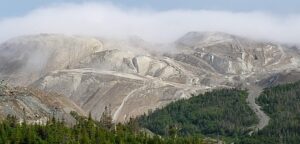
The carbon removal side of the Hub works because of a property the waste itself already had. Processing the mine waste promotes alkaline activation, which speeds up a natural process by which certain minerals absorb and lock away carbon dioxide. Baie Minerals didn’t invent that chemistry, but the treatment process accelerates it enough to turn a slow geological reaction into something that can generate verified carbon removal credits on a useful timeline, adding a second revenue stream on top of the recovered minerals themselves.
The obstacle Baie Minerals ran into most often wasn’t technical, it was reputational. Asbestos carries a well-earned stigma as a hazardous, carcinogenic material, and that stigma alone kept many research institutions from being willing to handle it on-site at all, while investors treated the entire category as too risky to touch. The company’s answer was procedural: every stage of handling and processing uses water and slurry to keep the material fully non-friable, meaning it’s never airborne and never poses the inhalation risk asbestos is known for. That safety discipline, more than any single piece of chemistry, is what made the rest of the project possible to pursue.
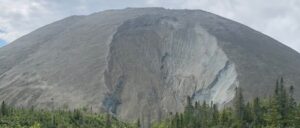
Put together, the technology destroys 100% of asbestos fibre structures during processing, recovers more than 90% of resident minerals as saleable, decarbonized industrial and critical minerals, and does it with near-zero waste, using only water and electric power instead of the acid and high heat the original method required. It has advanced from bench-scale testing to pilot demonstration, and by the company’s own accounting, the combined value of recovered minerals and carbon dioxide removal credits runs into the billions.
What Baie Minerals is proposing, in effect, is a new category of environmental cleanup: one where the reclamation pays for itself. Orphaned mine sites across the country carry the same unfundable-liability problem Baie Verte did, and a model that turns toxic waste into a revenue stream is one other communities sitting on similar legacies could eventually put to use.
Baie Verte spent three decades producing something nobody wanted. What Baie Minerals is proving is that the same site, treated differently, can produce something everybody does.













