Building Stronger Communities
Projects Sponsor

Delta Management Group is the leading sustainability, ESG and clean tech focused search firm in Canada. Delta is proud to have founded the Canada's Clean50 Award program in 2011, and has been the primary sponsor for the past 13 years.
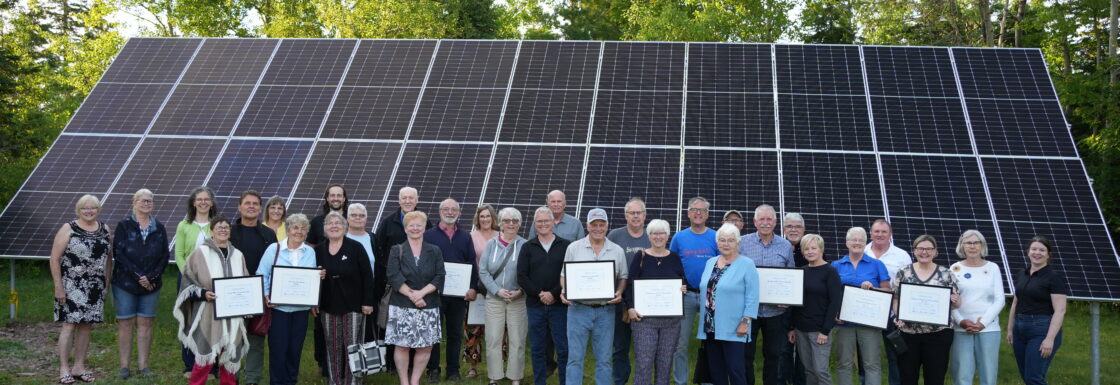
Bake sales are a rough way to cover a heating bill, and rural community halls across Pictou County were feeling the pinch as energy costs climbed and volunteer boards ran thin. This project pooled funding, technical expertise and project management for 21 organizations into one coordinated push, rather than sending each to chase grants and contractors alone. With $1.35 million in grants and rebates, 15 halls achieved net zero at no cost to the communities running them, and saved those halls a combined $135,000 a year – reinvested straight into programming. An emissions drop of 1,200 tonnes/year, and a waiting list of 65 more halls, says the model works.
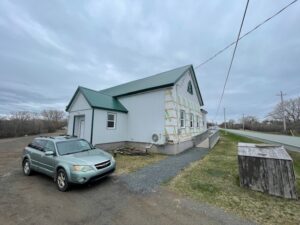 Andy Thompson was raking leaves one afternoon, thinking about the rural Nova Scotia community halls he’d watched close for winter or get sold outright because their volunteer boards couldn’t keep up with heating bills, when the question occurred to him: what if you could eliminate their biggest expense? Community Developer with Aging Well Nova Scotia, Thompson wasn’t chasing a climate target so much as an affordability crisis closing the buildings rural communities depend on. That question evolved into the Pictou County Net Zero Community Hall Retrofit Project, and it grew far past its own expectations.
The plan deliberately avoided asking volunteers to become grant writers, energy auditors and construction managers all at once. The project, instead, centralized those roles into one coordinated delivery model. What started as an idea involving five or six halls drew applications from 17 sites, expanded into 21 completed projects, and left a waiting list of more than 65 additional community organizations hoping to get in. Every one of the 21 participating halls received a third-party energy audit, and cross-referencing those results against historical utility bills, over 30,000 litres of heating oil and 1,700 gigajoules of annual energy use across the portfolio, pointed to a clear pathway: a 60 percent reduction in energy use was achievable through efficiency measures alone, with the remaining 40 percent offset by on-site solar. The deeper finding, though, was that the real barrier had never been technical. It was capacity.
Navigate Energy was brought on through Nova Scotia’s Low Carbon Communities program as project manager, the single point of contact for funders, contractors and utilities so volunteer boards could stay focused on running their halls rather than managing a construction site. Because rebates and tax credits arrive months after work is completed, the project needed early capital, solved through a Community Capital Fund seeded by the Nova Scotia Federation of Municipalities, which paid contractors as work finished and was replenished as rebates flowed back in rather than to individual halls. A small oversight committee of hall representatives reviewed progress and approved payments, keeping community ownership intact without burying volunteers in administration. Construction moved in coordinated groups of five to six buildings at a time rather than as 21 separate projects, letting contractors work efficiently. At the same time, local trades kept the investment in the region.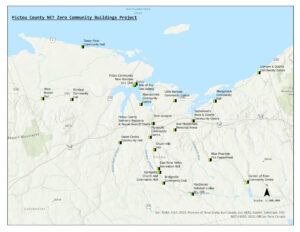
The obstacles were the kind no spreadsheet predicts. Site hazards turned up beyond the budgeted asbestos and vermiculite remediation, including a two-story beehive discovered inside one building’s wall, prompting the team to add a hazard walkthrough to every future project. A funding structure that only released 50 to 80 percent of grants upfront left a $150,000 holdback that had to be bridge-financed through a rural development bank. At one hall, solar panels went up before the utility had finished approving the net-metering tie-in, which turned out to require moving a power pole ten feet; the array sat generating nothing for eight months, a costly lesson in sequencing that now shapes how the team gates every phase of construction.
The results settled the argument about whether capacity, not ambition, was the real constraint. Fifteen halls reached net zero outright, the remaining six identified and pursued their own efficiency upgrades. The portfolio secured $1.35 million in capital improvements at no out-of-pocket cost to any participating organization, eliminated more than $135,000 in annual energy costs, now redirected into programming and maintenance, and avoids 1,200 tonnes of greenhouse gas emissions a year while displacing over 30,000 litres of heating oil. This means that individual halls are now averaging $6,500 in annual savings! Spaces that used to close for winter now run year-round, daycare and recreation programming continues through heat waves that once sent children home, and seniors have a resilient place to shelter during severe weather.
 For the communities themselves, what lingers longest isn’t the emissions number. It’s that halls once quietly disappearing from the map now spark neighbours’ questions about solar panels and cold-climate heat pumps, with a waiting list of 65 more communities betting the same model will work for them. Several of the funded halls have also reported a noticeable uptick in event turnout and volunteer sign-ups since the retrofits wrapped; a warmer, cheaper-to-run building draws people back.
The model’s real innovation was never the heat pumps or the solar arrays themselves; those technologies were already proven. It was recognizing that volunteer-run organizations were not short on ambition, only on the coordinated capacity to act on it, and building a delivery system, complete with a revolving capital fund and a single point of contact, flexible enough to carry 21 very different buildings through the same process at once. A building doesn’t need saving from the cold twice; it just needs someone to ask the right question, perhaps while raking leaves.













