Canada’s Circular Construction Collective
Projects Sponsor

Delta Management Group is the leading sustainability, ESG and clean tech focused search firm in Canada. Delta is proud to have founded the Canada's Clean50 Award program in 2011, and has been the primary sponsor for the past 13 years.
Construction sites across Canada routinely discard valuable materials while new, carbon-intensive products are ordered for the next project. The ReUse Collective is building the coordinated industry system needed to change that. Led by Green Salvaged Materials, it brings together owners, designers, contractors, manufacturers, government and industry associations to develop practical standards, protocols and procurement approaches that make material reuse scalable. Since 2024, more than 150 organizations have engaged through working groups spanning masonry, steel, interiors and federal collaboration. Together with Matlas, the materials intelligence platform built to operationalize circular construction, the Collective is turning disconnected reuse efforts into shared infrastructure that can scale across projects, portfolios and regions.
Somewhere between construction, renovation or demolition and the dumpster sits a mountain of perfectly good brick, steel, drywall and other materials with nowhere sanctioned to go. Canada’s construction sector generates enormous volumes of waste while simultaneously buying new, carbon-intensive materials to replace what it just threw out, and the problem was never really a lack of interest in reuse; it was the absence of a system that made reuse practical. Owners had no consistent procurement language requiring it. Contractors had no standard process for identifying and managing excess material. Designers had no guidance for specifying something reclaimed instead of new. The ReUse Collective set out to build the mortar connecting all of it.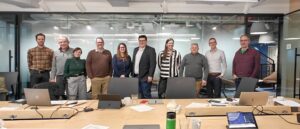
The insight driving the project came from more than a decade in structural engineering and building assessment work, watching usable material get discarded simply because nobody along the chain had the time, information or contractual authority to save it. Salvage decisions were typically made after demolition contracts were already signed, once the window for reuse had quietly closed. Structured conversations with owners, architects, engineers, contractors, manufacturers, demolition firms and government departments uncovered a consistent pattern: Canada lacked a broad marketplace for construction materials, while international examples showed that marketplaces alone could not solve the problem. Materials still needed to be identified, assessed and documented early enough to create reliable supply. Different materials- brick, structural steel, interior fit-outs- carried entirely different testing, warranty and liability hurdles, meaning no single fix would work across the board.
The build of the Collective proceeded in stages rather than one grand launch. Its preconstruction relied on early workshops that mapped practical barriers at every point in a material’s life, timing, ownership, insurance, storage, and market demand, before the Collective publicly launched at Toronto Climate Week’s Built Environment Day in October 2025. From there, material-specific working groups took shape: one on masonry and brick reuse, working alongside the Canada Masonry Design Centre and CSA Group on assessment and testing and pathways toward standardized reuse; one on structural steel, tackling fabrication, connection and liability questions with engineering firms including RJC Engineers, Blackwell Structural Engineers and Arup; and one on interiors, bringing architecture firms like Perkins&Will and Diamond Schmitt together with landlords and decommissioning specialists to build standardized decommissioning processes and catch materials lost during routine tenant turnover.
Its framing stage followed. The Materials Management Plan became the project’s most practical mechanism, requiring contractors at the outset of a project, not the end, to plan how materials will be managed, track excess and recoverable materials, and identify pathways for their next use. A Federal ReUse Working Group pulled in five departments and agencies, including Treasury Board Secretariat and Natural Resources Canada, connecting industry practice to federal procurement and real-property policy. But frameworks alone could not make materials visible or connect supply with demand at scale. That led to Matlas emerging as a digital implementation layer, a platform designed with venture-building partner R-Labs to capture material information, connect available materials with demand, and generate the data needed to track cost, carbon and diversion outcomes.
The obstacle that shaped everything else was structural: no single organization owned this problem. Procurement, design, demolition, insurance and government policy each held one piece, and early discussions risked becoming an endless conversation where everyone agreed change was needed, with nobody responsible for making it happen.
The fix? Deliberately narrow mandates, splitting the work into material-specific streams with defined outputs rather than one sprawling committee.
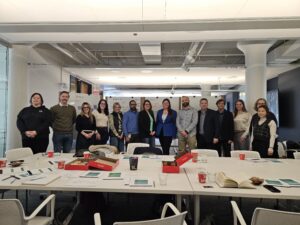 The numbers now show an ecosystem taking shape rather than a single finished product: more than 150 organizations engaged since 2024, roughly 15 industry associations at the table, three formal material working groups running, and a five-department federal working group in place, all building toward a Materials Management Plan model and a Matlas platform not yet at full scale.
What the ReUse Collective proves is less about any one recovered brick and more about sequencing. The Collective’s governance layer is revolutionary to Canadian construction with material-specific technical groups, a federal working group, procurement language owners can put directly into their contracts and the early architecture of a platform to track it all. All of that is the infrastructure emissions and waste reductions will eventually run through.













