Chill Smarter, Brew Greener
Projects Sponsor

Delta Management Group is the leading sustainability, ESG and clean tech focused search firm in Canada. Delta is proud to have founded the Canada's Clean50 Award program in 2011, and has been the primary sponsor for the past 13 years.
To crack open energy efficiency and reduce carbon emissions, Tin Whistle Brewing partnered with the City of Penticton to analyze energy use and identify savings opportunities. A key part of the project involved decommissioning a 25-year-old rooftop cooling unit that chilled the brewery’s beer tank storage walk-in cooler and tying the load into a newer, more efficient glycol chilling system. With data-backed decisions and industry expertise, the retrofit significantly cut energy consumption and supported Tin Whistle’s commitment to being B.C.’s first carbon neutral brewery. It’s a case of smarter operations, reduced environmental impact, and annual energy savings of over 12,700 kWh, served cold.
As much as we might all try to deny or delay the inevitable, there comes a time where each of us has to accept the inescapable fact that we too must clean out the fridge.
Tin Whistle Brewing Co. B.C’s first carbon neutral brewery chose to face this fact head on. They recognized they needed to address excessive energy use from an aging, inefficient rooftop chiller cooling their 4,536 ft3 beer tank storage cooler. This outdated system ran almost constantly and was a major contributor to operational emissions, conflicting with their goal to remain a carbon neutral brewery. They needed to hop to it.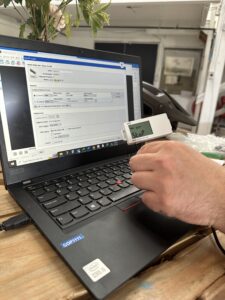
Tin Whistle set out to reduce electricity consumption, eliminate unnecessary emissions, and integrate operations into the newer, more efficient glycol chilling system already in use. They wanted to leverage existing capacity to improve efficiency and align with climate action goals.
Before implementation, Tin Whistle collaborated with the City of Penticton to monitor the existing rooftop unit using a motor logger and HOBOware software and translate this data into actionable insights. This logging process revealed rapid cycling, long runtimes, and high electricity usage, indicating inefficiencies compared to modern systems. Benchmarking against potential savings from a newer glycol system confirmed that tying into this unit would dramatically cut consumption and extend the life of cooling equipment. All while maintaining vital safe beer storage conditions.
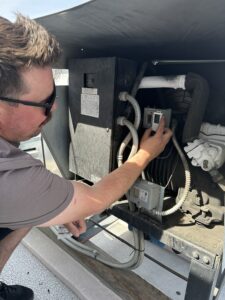
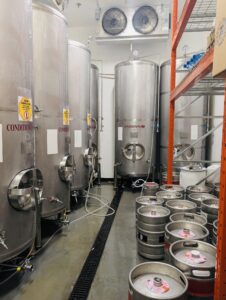 After identifying the energy inefficiencies through motor logging and confirming excess capacity in the glycol cooling system, Tin Whistle engaged Cellar-Tek to design and execute the refrigeration retrofit. The team decommissioned the quarter century old rooftop unit (including six evaporator motors and two condenser fan motors and one compressor motor), installed a new Hussman glycol cooling fan coil in the walk-in cooler, and connected it to their existing high efficiency glycol loop. A Belimo drive and temperature controller were added to manage operations. All lines were insulated, and the system was commissioned and tested. Staff were trained on the new equipment.
The biggest challenge in all this was ensuring consistent beer cooling during the transition. After all, any temperature variation could risk product loss. The team worked around this by carefully staging the changeover and relying on expert design from Cellar-Tek.
Ultimately, work began on January 24, 2025 and was completed efficiently without disruption to beer storage.
 The retrofit resulted in daily energy savings of 34.92 kWh—totaling 12,746 kWh annually. These savings reduce greenhouse gas emissions, lower operational costs, and strengthen Tin Whistle’s position as B.C.’s only carbon neutral brewery. The project also helped demonstrate a practical, scalable method of deep energy retrofitting, supporting both Tin Whistle’s goals and those of the City of Penticton’s Community Climate Action Plan.
The project is a replicable model for other breweries and small businesses looking to retrofit outdated equipment and meet climate targets affordably. Tin Whistle is brewing up smarter operations, reduced environmental impact and generous annual energy savings, served cold of course.