Climate Change & Resilience Course for BC Non-Profit Housing Association
Projects Sponsor

Delta Management Group is the leading sustainability, ESG and clean tech focused search firm in Canada. Delta is proud to have founded the Canada's Clean50 Award program in 2011, and has been the primary sponsor for the past 13 years.
Climate risk doesn’t pause for a housing sector already stretched thin, which is why the Academy for Sustainable Innovation built training that meets nonprofit housing staff where they are. Working with BC Non-Profit Housing Association, BC Housing, and the Aboriginal Housing Management Association, the team designed a course connecting climate change to equity, tenant health and housing stability, equipping housing professionals with practical tools rather than more talking points. Ninety percent of participants said the content applied directly to their work, could name an action they’d take because of it, and would recommend the course to a peer. It’s resilience training that helps everyone else stay safe!
Nonprofit housing providers spend their days keeping roofs over the heads of some of the most vulnerable people in the province. Until recently, there was a disconnect between the climate change impacts that are making that harder every year, and the tools and resources available to support them to take action. The Academy for Sustainable Innovation (ASI), working with the BC Non-Profit Housing Association (BCNPHA), BC Housing, and the Aboriginal Housing Management Association (AHMA), built an online course to close that gap, weaving climate change together with equity, tenant health and safety, and housing stability. Since its November 2025 launch to more than 600 member organizations, 94% of participants say the content applies directly to their work and would recommend it to a colleague. Ninety percent walked away with an action they could actually take.

The need was clear before the course existed. Nonprofit housing communities, already managing aging buildings and tight affordability mandates, are among the first to feel the impacts of extreme heat, flooding, and wildfire smoke, and among the least resourced to prepare for them. Buildings account for 13 to 18 percent of Canada’s greenhouse gas emissions, and BC Housing alone is targeting 14,500 new affordable homes by 2029, so the pressure to build and retrofit responsibly was only going to grow. What was missing wasn’t awareness. It was a resource written specifically for people doing this work, rather than a generic climate primer that assumed away their constraints.
ASI set four objectives from the outset: build climate literacy across the sector’s workforce; embed climate thinking into everyday planning and asset management; create something scalable enough to eventually work outside BC; and connect providers directly to the retrofit programs, energy coaches and funding they’d need to act on what they learned. Getting there started with research, not content. The team studied real-world cases of climate resilience in housing design and sat down with each partner organization to understand the pressures specific to their sector, from capital constraints to the disproportionate risk carried by residents already facing inequity.
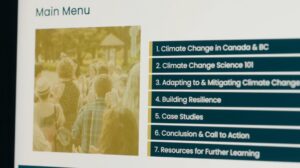
That groundwork shaped everything that followed. The Academy for Sustainable Innovation built the course framework alongside BCNPHA, BC Housing, and AHMA, folding in Indigenous perspectives on land and resilience not as a separate chapter but throughout the material. Subject-matter experts from each partner organization enriched it with case studies and practical resources, and Kilo Communications turned the finished content into an interactive online experience, complete with a launch video produced by Brandon Deepwell Videography featuring recognizable leaders from BC’s housing sector. The course launched in November 2025 alongside the Housing Central conference in Vancouver, showcasing it to 1,500 attendees, and the content was explored more deeply at a dedicated panel discussion the same week.
None of it came together on the first draft. Early material risked reading as either too abstract or too technical for a busy housing manager to use, so the team spent dedicated time revisiting the tone and details until it felt grounded rather than academic. That mattered more than usual here: the course touches on real losses, including lives lost to extreme heat, flooding, and wildfires, and the team was deliberate about handling that material with care rather than turning it into a checklist exercise. Measuring long-term impact has also proven harder than measuring the course itself. Behaviour change and emissions reductions play out over years, not immediately after a module ends, and data privacy rules limit how much the team can track once participants return to their own workplaces. They’re still building better feedback loops for that.
Though that tracking can be difficult, early numbers back up impact. The course is now available to more than 600 member organizations of BCNPHA and their staff across BC, and in post-course surveys, 94% of participants said the content applied directly to their work, 90% identified at least one concrete action they could take, and 94% said they’d recommend it to a peer. Word has already travelled beyond BC: the Co-operative Housing Federation of Canada, the Alberta Seniors & Community Housing Association, and the Ontario Non-Profit Housing Association have all confirmed plans to adapt the course for their own members, and the BC collaboration itself spun off a new cross-organizational working group on climate adaptation that didn’t exist before this project.

Angi Ross, Education Manager at BCNPHA, put it simply: “They took the time to deeply understand the impacts of climate change and the needs around resilience, mitigation, and adaptation within the unique context of non-profit housing providers… they coordinated multiple project partners and brought together many informed viewpoints into a course that feels unified, accessible, and purposeful.”
The course was designed as a template rather than a one-off, with a core built to be re-used and sections built to be swapped out for regional context. That’s already happening: other provincial associations are lining up to bring it to their own members, which means the real measure of this project may not be the 600 organizations it started with, but the number it eventually reaches once every region has its own version.
A course built for 600 organizations in one province is already being asked for in three more — usually a sign it was the right solution.













