Connecting for Climate Change Action (C4CCA)
Projects Sponsor

Delta Management Group is the leading sustainability, ESG and clean tech focused search firm in Canada. Delta is proud to have founded the Canada's Clean50 Award program in 2011, and has been the primary sponsor for the past 13 years.
Teaching people the facts about climate change turned out to have a side effect nobody planned for: despair. When a student told one professor the course was leaving her in a dark place, the team rebuilt it around a two-eyed seeing approach that weaves together Indigenous Knowledges with Western science, plus reflection exercises that make room for hard feelings instead of ignoring them. The resulting free online course has enrolled more than 3,000 people since 2024. Course alumni have gone on to run for office and start community action groups. Hope is teachable and powerful.
A student once told Dr. Katrina Eyvindson that she loved her climate change course at Western University and that it was ruining her life. Not in those exact words, but close. She was so overwhelmed by what she was learning that she’d sunk into despair about her own future and the planet’s. Eyvindson had spent nearly a decade teaching the course on the assumption that knowledge alone would move students to act. Instead, it seemed that students had found themselves on the edge of eco-anxiety. That moment became the reason Connecting for Climate Change Action (C4CCA) exists.

Eyvindson turned to Dr. Beth Hundey at Western’s Center for Teaching and Learning, and together they started experimenting with experiential learning rather than lecture content alone, building a Climate Change Challenge where students committed to one carbon-cutting habit for three weeks and reported back on what they learned about the problem and about themselves. Around the same time, Sara Mai Chitty, who is Anishinaabe and was the Curriculum and Pedagogy Advisor at Western’s Office of Indigenous Initiatives, and Serena Mendizabal, who is Haudenosaunee and was a graduate student in Geography and Environment at Western, joined the growing team and made a case to reshape the entire project. Indigenous knowledge and a genuine relationship to the land carry a kind of hope that Euro-Western science alone doesn’t offer.
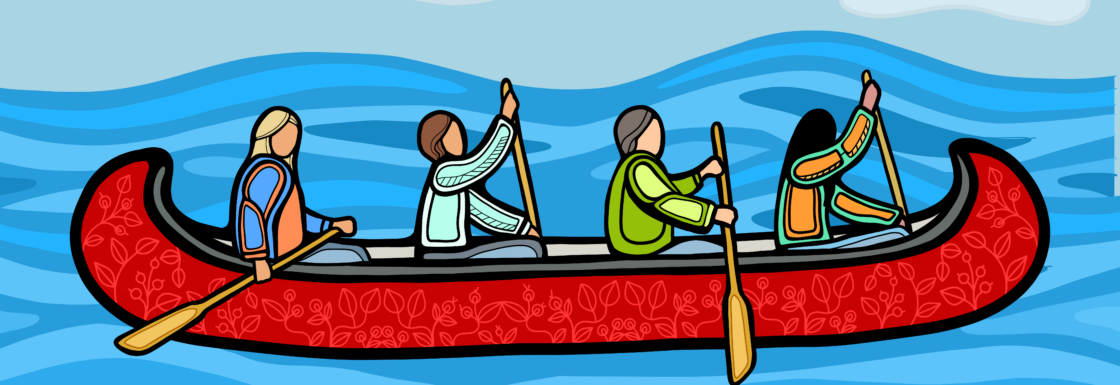
With funding from eCampus Ontario and Western University, the team grew to sixteen, including Mushkego Cree artist Hawlii Pichette, an instructional designer, e-learning specialists and a roster of student multimedia designers who turned Pichette’s artwork into videos to illustrate important concepts in climate change.
The team built the course around Etuaptmumk, Two-Eyed Seeing, a framework described by Mi’kmaw elder Albert Marshall, that treats Indigenous and Euro-Western knowledge as distinct and equally valid ways of understanding the world, and seeing the world through both lenses, we find ways to benefit everyone.
The principles the course is based on demanded something slower and more deliberate than a typical curriculum build. The core team held more than fifty weekly meetings over roughly a year and a half of development, prioritizing trust and relationship before locking down content, because a course meant to teach connection couldn’t credibly be built any other way. Twenty-seven experts and community members were interviewed to widen the perspectives students would encounter beyond the sixteen people building it.
The finished MOOC runs eight modules over thirteen weeks, launched in September 2023 on Coursera and open to anyone in the world at no cost. Each module opens with original art from Pichette. One recurring image depicts the three sisters, corn, squash and beans, illustrating the reciprocity the course keeps returning to, paired with an interactive glossary and low-stakes comprehension checks designed by instructional designer Aamir Amin. Story Map activities let students investigate real climate data such as ice core records, and one Story Map built specifically around the course’s philosophy, Gifts for Climate Justice and Action, features twenty individuals describing how they’ve applied their own particular skills to the crisis before asking students to identify and record their own.
 Between January 2024 and March 2026, more than 3,000 people enrolled from Canada and beyond, including learners in the US, Europe, Asia, Africa and Australia, and the course holds an average rating of 4.7 out of 5. A post-course survey found 89 percent of students rating themselves very or extremely knowledgeable about climate change, up from 32 percent before starting, while the share who considered themselves only slightly or not at all knowledgeable dropped to zero from 24 percent. Eighty-seven percent said the course had specifically improved their understanding of the connection between Indigenous ways of being and climate action. The ripple effects reached beyond the platform itself: one graduate, Adrienne Crowder, started an independent Community of Practice that now includes roughly 80 C4CCA alumni meeting monthly, some of whom have gone on to run for local office, join Seniors for Climate Action Now, or lobby municipalities to protect pollinator habitat, changes the group credits directly to what the course motivated them to do.
Building a course this collaborative inside Euro-Western institutions where courses are typically developed and taught by solo instructors created friction of its own. The core team, one full-time faculty member, two staff and a graduate student, was an unusual teaching arrangement by any university’s normal accounting, requiring active advocacy and dedicated funding to support this unique arrangement.
Braiding two knowledge systems together meant the team had to slow down and listen to each other before writing a single module, then run focus groups with Indigenous and non-Indigenous students to catch places where the balance still tilted too far toward one perspective. Since every team member was already stretched across other academic responsibilities, sustaining the relational, unhurried pace the course itself demanded took deliberate effort: prioritizing people over deadlines and trusting colleagues to step in without being asked.
What C4CCA ultimately proves is that climate literacy and emotional resilience were never separate problems requiring separate courses. The team’s own working method, built on relationship, reciprocity and genuinely equal footing between knowledge systems, became the same lesson it hands to students. Facing a crisis this large is bearable, and even motivating, once you understand your own gifts and join with others to take action towards a better climate future.













