CPKC Hydrogen Locomotive Program: Evaluating Hydrogen-Powered Freight Rail Technology
Projects Sponsor

Delta Management Group is the leading sustainability, ESG and clean tech focused search firm in Canada. Delta is proud to have founded the Canada's Clean50 Award program in 2011, and has been the primary sponsor for the past 13 years.
Diesel has powered North American freight rail for a century, but through their Hydrogen Locomotive Program, Canadian Pacific Kansas City (CPKC) are testing a replacement. In partnership with CSX, since 2020, the program has grown from North America’s first hydrogen-powered line-haul freight locomotive to a fleet of 13. Backed by dedicated hydrogen production and fueling infrastructure, by the end of 2025, the fleet had logged more than 75,000 miles of revenue-service runs and over 1000 hydrogen refueling events, generating the operational data CPKC needs to evaluate hydrogen as a lower-carbon alternative to diesel at scale, validating CPKC’s World leadership in this space, and proving hydrogen can pull a lot of weight.
Diesel has powered North American freight rail for more than a century, and with over 37,000 diesel-electric locomotives still in service, locomotive fuel remains the sector’s single largest source of greenhouse gas emissions. CPKC’s Hydrogen Locomotive Program set out to test whether hydrogen could take some of that weight off diesel’s shoulders. What started in 2020 as a single prototype, North America’s first line-haul hydrogen-powered freight locomotive, has grown into a fleet of eight hydrogen locomotives backed by dedicated production and fueling infrastructure. By the end of 2025, the program had logged more than 17,000 miles of testing, 33 revenue-service runs and over 100 hydrogen refueling events.
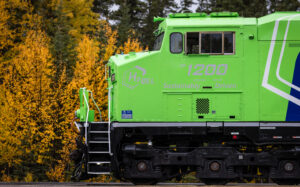
The pressure behind the program is structural, not sentimental. Freight railways have already improved fuel efficiency by more than 40% since 1990, but further cuts to a sector built entirely around diesel power are genuinely hard to come by, and the highly integrated nature of the freight rail network means no single railway can solve it alone. CPKC’s response was to evaluate hydrogen specifically because it offered something other alternatives didn’t: a plausible path to retrofitting existing diesel-electric locomotives rather than replacing the entire fleet, while letting the company build real operational knowledge of fueling, infrastructure and maintenance requirements under actual freight conditions.
Before committing to hydrogen, CPKC assessed the wider field, weighing fuel efficiency improvements, fleet renewal, renewable fuels and other alternative technologies against the performance freight rail actually demands. Hydrogen stood out because it could work with existing locomotives instead of requiring entirely new ones, and because pursuing it would force the company to learn, firsthand, everything a hydrogen fueling and maintenance ecosystem in a rail setting would require.

The program’s timeline reads like a slow build toward credibility rather than a single launch. CPKC announced its plan to build a hydrogen line-haul locomotive in December 2020, incorporated Ballard fuel cell modules the following year, and saw its prototype move under its own power for the first time in late 2021, supported by funding from Emissions Reduction Alberta that expanded the program to include additional conversions and fueling facilities in Calgary and Edmonton. In 2022, locomotive CP 1001 completed its first revenue move. CPKC and CSX announced a joint venture around hydrogen conversion technology in June 2023, the same year CP 1002 finished yard and mainline testing before entering switching service in Calgary. By 2024, CPKC and ATCO EnPower had commissioned hydrogen production and refueling facilities in both cities, each running a 1 MW
electrolyzer, and the program extended testing into the Canadian Rockies hauling steelmaking coal between Sparwood and Golden, B.C. In 2025, CPKC joined the Calgary Region Hydrogen Hub and, with CSX, launched Hyion Technologies, a joint venture aimed at developing modern, low-horsepower hydrogen locomotives, closing out the year with an eight-locomotive fleet in testing or revenue service.
Building one working hydrogen locomotive would have been hard enough. CPKC had to build an entire supporting ecosystem instead, since a locomotive is useless without matching hydrogen production, storage, fueling and safety systems, and each piece needed to be designed, tested and refined in step with the others rather than handed off as an afterthought. Meeting the power, range and reliability bar of genuine freight rail operations, not a demonstration track, was its own challenge, and moving from proof-of-concept into actual revenue service added a layer of scheduling and logistics complexity most pilot projects never have to face. CPKC managed this through a deliberately staged approach, prototype first, then yard switching, then dedicated infrastructure, then line-haul service, with each phase generating the operating data that made the next one possible. None of it happened without partners: Emissions Reduction Alberta and the Alberta and federal governments funded infrastructure and technology development, ATCO EnPower built and commissioned the hydrogen facilities, Ballard Power Systems supplied the fuel cells, On-Track Controls handled locomotive conversion and power electronics, Bilton Manufacturing supported the heavy retrofitting work, and CSX became a co-developer through Hyion Technologies.
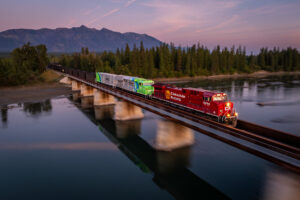
The results speak to a program that moved well past proof-of-concept. CPKC built North America’s first line-haul hydrogen-powered freight locomotive at a Class I railway, stood up hydrogen production and refueling infrastructure in two cities, and grew its fleet to eight locomotives logging real freight miles, including 84 days of revenue switching service from locomotive CP 1100 alone. Air Products has since signed on to supply future hydrogen from its Net Zero Canadian Hydrogen Complex, and Elk Valley Resources has used the program’s locomotives to move actual steelmaking coal through the Rockies, evidence that this isn’t staying a research exercise confined to a test track.
Diesel has had more than a hundred years to prove itself on Canadian rails. CPKC just spent five proving hydrogen can run on the same ones.













