Decarbonization in Action: Implementing Climate Solutions in Canadian Hospitals
Projects Sponsor

Delta Management Group is the leading sustainability, ESG and clean tech focused search firm in Canada. Delta is proud to have founded the Canada's Clean50 Award program in 2011, and has been the primary sponsor for the past 13 years.
Health care generates 4 to 5 percent of the world’s greenhouse gas emissions, which makes hospitals both part of the climate problem and one of its more promising fixes. Launched in April 2025 Decarbonization in Action gives Canadian hospitals dedicated technical expertise to scale low-carbon clinical practices and close the capacity and data gaps that usually stall this kind of work. The project also built a cross-hospital network, connecting 110 sustainability professionals, andi In its first year alone, backed 26 initiatives across 13 hospital systems, facilitating a reduction of more than 1,550 tonnes of greenhouse gas emissions, a fairly healthy prognosis for a high-stakes and complex industry.
Health care generates 4 to 5% of the world’s greenhouse gas emissions, which puts hospitals in the odd position of being both part of the climate problem and, potentially, one of the more powerful places to fix it. The Canadian Coalition for Green Health Care spent its pilot year testing that second half of the equation. Launched in April 2025 and funded by the Peter Gilgan Foundation, Decarbonization in Action gave hospital sustainability champions across the Greater Toronto and Hamilton Area the dedicated technical support they’d never had time to build themselves. In its first year, the project touched 26 decarbonization initiatives across 13 hospital systems and influenced more than 1,550 tonnes of avoided and reduced greenhouse gas emissions, more than triple its original 500-tonne target.
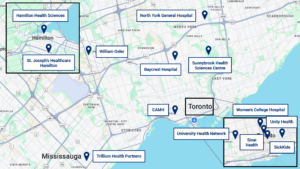
The gap this project was built to close wasn’t ambition, it was capacity. Hospital staff across the country were already trying to drive sustainability work, just from the side of their desks, squeezed in around clinical duties with no dedicated time to build the data or business cases that would move an idea from a good instinct to an approved project. That gap widened further around Scope 3 emissions, the sprawling category covering procurement, clinical activity and waste, where the accounting complexity alone was often enough to stall a project before it started.
Before launching anything, the team reviewed sustainability literature from Canada, the UK, the US and Singapore and ran more than a dozen one-on-one interviews with hospital sustainability champions to understand what was actually standing in their way. The interviews confirmed the capacity problem and surfaced two more: champions struggled to prioritize among competing sustainability opportunities given how complex Scope 3 accounting gets, and even hospitals with a solid emissions baseline often lacked the initiative-level data needed to build a credible project pipeline. Just as telling, nearly everyone interviewed wanted more contact with other hospitals doing similar work, less because the ideas didn’t exist yet and more because nobody felt like they had company.
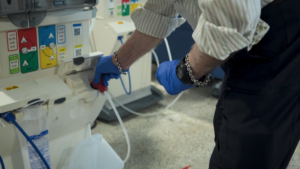
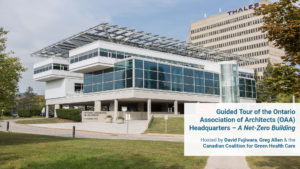
That research shaped four pillars of support. The team built 14 custom carbon and cost-benefit calculators so hospital staff could make the case for specific interventions, from switching to reusable clinical supplies to phasing out leaky nitrous oxide anesthetic gas infrastructure. They produced high-visibility communications, including a “brightspot” video on a novel centralized acid distribution system for dialysis at St. Michael’s Hospital (a site of Unity Health) that sharply cut plastic waste and emissions, an idea that later drew national attention and a peer-reviewed publication in Kidney International co-authored with the project team. They ran peer-learning programming, including facility tours and webinars, to get sustainability champions talking to each other directly. And they built the Solutions Atlas, an online platform cataloguing proven low-carbon health care solutions, refined with feedback from more than 15 sustainability experts before launch. The centrepiece of the pilot year was a conference: Sustainable by Design, held October 3, 2025 at Women’s College Hospital as part of Toronto’s inaugural Climate Week. It drew more than 110 health system sustainability champions and 35 speakers, including sixteen six-minute lightning talks on climate solutions already working inside Canadian hospitals. The Decarbonization in Action project team led the planning and programming, with enthusiastic support from the Canadian Coalition for Green Health Care’s network, spanning across other project team staff, advisers, partner organizations, and student volunteers. Its success was enough to set a second annual conference already in motion.
None of this came together without some recalibration. The team started out offering expertise across building systems, clinical practices and procurement simultaneously, and quickly ran into the limits of what a small project team could actually support well. They narrowed their focus to clinical sustainability and supply chain initiatives specifically, the areas where frontline staff had the least outside help already available to them, which let a small team deliver higher-impact resources instead of spreading thin across everything. A second challenge was more logistical: launching the pilot without a formal commitment process kept things flexible for busy hospital staff, but made it hard to track real institutional buy-in. The team addressed that with an official cohort kick-off meeting and, for future cohorts, a tiered participation model backed by a formal Terms of Reference document. Breaking down the isolation between hospitals working on similar problems proved the hardest obstacle of all, ultimately solved less through formal infrastructure and more through the conference and the brightspot video themselves, which generated enough organic buzz to spark cross-hospital introductions the team then followed up on directly.
Beyond the Pilot Year
The Peter Gilgan Foundation renewed funding for three more years, through 2029, with plans to expand the model across Ontario and, eventually, the rest of Canada. MaRS Discovery District supported the project throughout, from project management to editorial coverage of the work, helping extend its reach beyond the hospitals directly involved.
Hospitals are built to save lives, one patient at a time. What this project showed is that the same institutions can cut emissions the same way, one anesthetic gas line and one supply cart at a time, and that the math adds up faster than anyone expected.













