Electrifying Last Mile Delivery
Projects Sponsor

Delta Management Group is the leading sustainability, ESG and clean tech focused search firm in Canada. Delta is proud to have founded the Canada's Clean50 Award program in 2011, and has been the primary sponsor for the past 13 years.
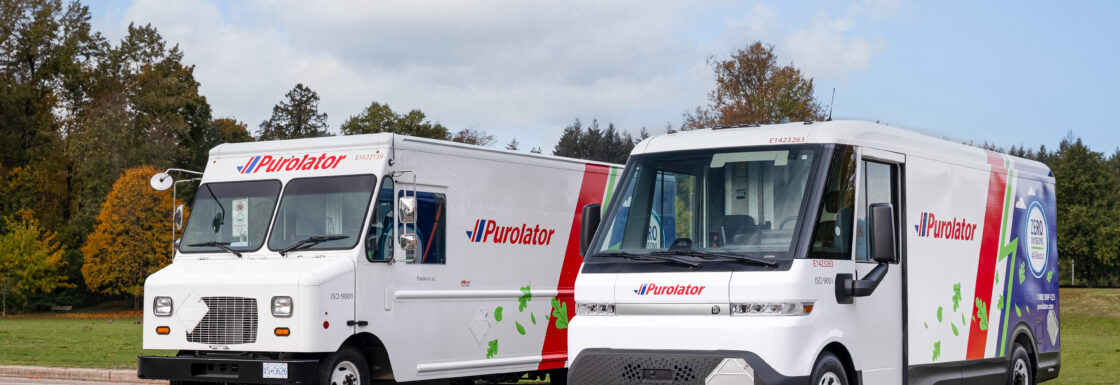
Electric vans are the easy part; keeping a national parcel network moving on batteries, without stranding drivers mid-route, is the hard part. A hundred vans on three test routes piloted the solution. Scaling EV delivery meant treating chargers, utility hookups, driver training and route matching as one project instead of four. The result: more than 550 electric vehicles, 825-plus chargers and 17 electrified terminals nationwide, adoption rates topping 90 percent, and roughly 3,300 tonnes of CO2e avoided in a single year. Cold weather, transformer capacity and permitting threw up obstacles, but the lessons are now baked into a repeatable rollout model for the terminals to come.
Buying electric delivery vans is the easy part. Running a national parcel network on batteries is most certainly not, and Purolator became intimately familiar with that fact during its first pilot, roughly 100 electric delivery vehicles tested across Richmond, B.C., London, Ontario and Quebec City. The pilot proved EVs could handle real routes, but it also showed that scaling would take far more than a bigger vehicle order. Phase 1 was built to answer the harder question: what does it take to electrify a complex logistics network terminal by terminal, not van by van. 
As one of Canada’s largest integrated freight and logistics providers, Purolator has committed to net-zero emissions by 2050, and transportation is the most material lever it has to pull. The pilot’s research phase, which included route analysis, facility electrical assessments, utility engagement and benchmarking across multiple vehicle manufacturers and charging technologies, confirmed that large-scale electrification was technically viable for a significant share of the last-mile network. It also surfaced the risks that would define Phase 1’s design, like utility interconnection timelines, uncertain vehicle supply from manufacturers, unpredictable cold-weather range, and the basic organizational challenge of getting drivers, dispatchers and maintenance crews to treat EVs as normal rather than experimental.
Rather than launch everywhere at once, Purolator assessed candidate terminals on operational value, emissions potential, electrical capacity and site complexity, then advanced priority sites through electrical assessment, detailed design, permitting, construction and charger commissioning before vehicles arrived. The defining feature of Phase 1 was refusing to manage fleet procurement, charging infrastructure, utility coordination, incentive applications, driver training and change management as separate workstreams as many electrification efforts do. All of it moved together, deliberately, so when a terminal went live, the vehicles, chargers, routes and drivers were ready simultaneously rather than arriving in some order that left the project idle.
 The results moved the program well past pilot status. By the end of 2025, Purolator’s EV fleet had grown to more than 550 vehicles supported by 825-plus chargers across 17 electrified terminals nationwide, with adoption rates above 90 percent and vehicles that are running real routes daily rather than sitting in reserve. In 2025 alone, the fleet added 274 all-electric delivery trucks, 50 e-bikes and nine electric tugs, contributing to roughly 3,300 tonnes of CO2e avoided that year. Beyond the emissions ledger, the electrified fleet is quieter and cleaner in the neighbourhoods it serves, cutting local air pollution and noise on top of tailpipe carbon.
Infrastructure readiness became the critical path, often more so than the vehicles themselves. Transformer capacity, trenching, switchgear and permitting all had to clear before a single van could plug in, so Purolator moved utility engagement earlier in the timeline and used charge management software to squeeze more out of existing electrical capacity while longer-term upgrades caught up.
Vehicle supply brought its own uncertainty, since manufacturer delivery schedules, payload specs and model availability kept shifting, which Purolator managed by staying flexible across more than one OEM and matching whichever vehicles were available to the routes suited to their range and payload. Cold weather posed a genuine operational risk to range and driver confidence, addressed through route selection tuned to seasonal conditions and performance monitoring across climate zones.
The subtlest challenge was cultural. Electrification changes how a vehicle gets assigned, charged, inspected and maintained, and Purolator found that structured training, EV open houses and standardized operating procedures mattered as much as any charger on the wall in moving electrification from a special project into ordinary business.
 None of this happened independently. CIMA+ handled facility assessments, electrical engineering and utility coordination across terminals, while Flipturn’s charge management software provided the dynamic power balancing needed to avoid peak demand penalties. Workhorse, Motiv and other manufacturers supplied the vehicles themselves, Natural Resources Canada’s ZEVIP program supported infrastructure funding, and demand response programs through BC Hydro and Hydro-Québec turned the fleet’s charging patterns into an asset for the grid rather than just a load on it.
Phase 1 delivers a repeatable operating model, not a one-time achievement. Every lesson about sequencing infrastructure ahead of vehicles, engaging utilities before construction, and treating change management as core project work rather than an afterthought now travels directly into the next terminal on the list. Purolator didn’t just prove electric trucks can deliver parcels in Canadian winters. It proved a national fleet can be electrified terminal by terminal without ever pausing delivery to figure out how.













