EV Everywhere – Using Artificial Intelligence to Manage Residential Electric Vehicle Charging as a Non-Wires Alternative
Projects Sponsor

Delta Management Group is the leading sustainability, ESG and clean tech focused search firm in Canada. Delta is proud to have founded the Canada's Clean50 Award program in 2011, and has been the primary sponsor for the past 13 years.
Every new EV on a residential street is one more appliance the local grid didn’t plan for, and BluWave-ai’s answer is to let the cars help manage themselves. EV Everywhere uses AI to coordinate residential charging schedules, turning a neighbourhood of private EVs into a virtual power plant. An Ottawa pilot delivered 112 to 1,005 kilowatts of flexible capacity per 1,000 EVs, hit its coordination targets 100 percent of the time, and cut peak-hour charging by 21.7 percent, all with a 4 percent opt-out rate. It’s roughly 55 times more capital-efficient than building new utility-scale batteries, deferring $2.3 to $7.9 million in infrastructure per 1,000 EVs, no new poles required.
Every electric vehicle plugged in overnight is a small battery sitting idle in a driveway, and BluWave-ai set out to prove that thousands of them, coordinated by software, could do the job a new substation would otherwise be built to do. The company’s EV Everywhere pilot used AI to manage residential EV charging across Hydro Ottawa’s territory, turning private vehicles into what amounts to a virtual power plant. Across 42 formal test scenarios, the system hit its dispatch targets 100% of the time, cut the neighbourhood’s synchronized evening charging peak by as much as 21.7%, and did it all at roughly 55 times the capital efficiency of a utility-scale battery, deferring an estimated $2.3 to $7.9 million in infrastructure spending for every 1,000 EVs enrolled.
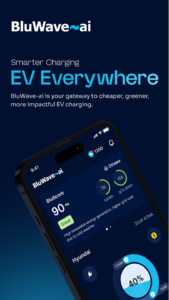
The problem BluWave-ai was chasing is a quietly growing one. EV owners tend to plug in the moment they get home, often with charging timers set for 6 p.m., which stacks thousands of individual decisions into one sharp, synchronized load on local transformers and feeders. Utilities have historically answered that kind of pressure with new poles and wires. BluWave-ai wanted to test whether AI-coordinated, behind-the-meter charging could work instead, as what the industry calls a Non-Wires Alternative, doing the grid-capacity job without the capital project.
The objectives were specific: validate a demand-response platform that could aggregate privately owned EVs, pair it with a front-of-the-meter battery system as a faster-responding backstop, measure how customers actually behaved when asked to participate (including how many would opt out), prove dispatchable capacity to the Independent Electricity System Operator’s standards, and package the whole thing into a playbook other utilities could pick up. Getting there started with research most drivers never see: reviewing Hydro Ottawa’s own distribution data and simulating 25 local loops to understand real transformer loading, evaluating EV telematics APIs and charging protocols, and working through the regulatory fine print, including Measurement Canada’s revenue-metering rules and how Ontario’s regulator treats software-heavy, opex-driven programs on a utility’s books. That last piece mattered more than it might sound: the team identified a “prudency risk” baked into existing rate frameworks that discourages utilities from adopting exactly this kind of solution, a finding that shaped how they’d eventually pitch the program to regulators.
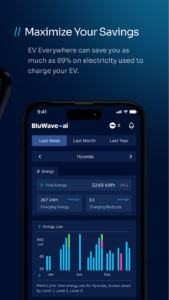
Building the system meant modelling distribution circuits, choosing two sites for front-of-the-meter battery storage, and building a direct-to-vehicle telematics architecture that could read charging status without requiring a special home charger or an inspection. BluWave-ai’s team, led by CEO and founder Devashish Paul alongside Alex Linchieh, Minming Ni, Hubert Sugeng and Rob Refvik, released the EV Everywhere app and a utility-facing dashboard running on their AI optimizer, BluScore, secured with Zero Trust and software-defined networking. Recruitment brought in more than 220 EV owners across Hydro Ottawa’s territory, using a $50 welcome bonus and a $15 monthly credit for participating in Grid Smart events. From there, the team ran 42 formal IESO DER Integration Demonstration scenarios and 151 total tests across both summer and winter, dispatching 40 to 80 kW loads and testing peak shaving alongside the battery backstop.
Not everything cooperated on schedule. Vehicle-API and charging-status feeds proved intermittent enough to temporarily shrink qualified event participation, which the team solved with direct-to-EV integrations and better retry logic. Only about 40% of enrolled EVs met the strict criteria for monthly payouts, so recruitment, onboarding and incentives all needed refinement to keep enough capacity available. EVs also proved slower to respond than a battery, taking 90 seconds to two minutes to curtail charging, which is why the front-of-the-meter battery system exists at all: as the fast-response layer, with EVs doing the scalable, low-cost work behind it. On the regulatory side, IESO’s one-megawatt minimum aggregation threshold and Measurement Canada’s metering rules initially blocked EV telemetry from counting toward market settlement at all, a barrier the team addressed by documenting the gap and recommending lower thresholds and modernized measurement standards. Battery siting and interconnection also took longer than planned, lessons the team folded directly into how they’re now planning dual-resource rollouts elsewhere.
Scaling Beyond Ottawa
The pilot didn’t stay a pilot. With funding from Natural Resources Canada, BluWave-ai has already launched a Phase 1 expansion into Oakville, Oshawa, Essex and Summerside, carrying the program across Ontario, Alberta and Prince Edward Island. Hydro Ottawa itself became an active aggregator in IESO’s wholesale market during the pilot, and BluWave-ai’s own modelling puts Ontario’s near-term potential at roughly 231 MW today, climbing toward 11.6 GW by 2050 if managed EV charging scales the way the Ottawa data suggests it can.
None of this required a single new pole. Every EV enrolled in the program was already going to be plugged into someone’s driveway every evening; the only thing missing was software patient enough to ask it to wait a few minutes.













