Flexible Plastics Collection Expansion
Projects Sponsor

Delta Management Group is the leading sustainability, ESG and clean tech focused search firm in Canada. Delta is proud to have founded the Canada's Clean50 Award program in 2011, and has been the primary sponsor for the past 13 years.
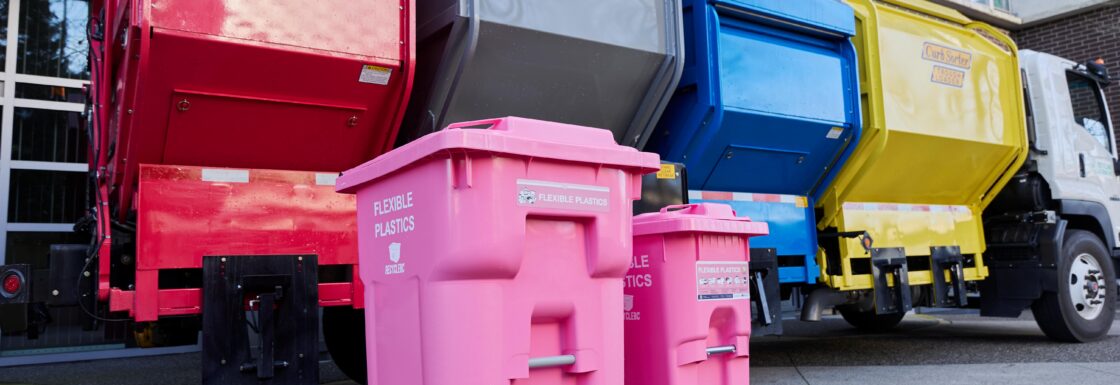
Chip bags, bread bags and candy wrappers have long been recycling’s problem children, challenging to recycle and rarely done. After years of developing a domestic recycling pathway with a local processing partner, this initiative moved flexible plastics beyond the depot-only bin and onto the curb, rolling out dedicated pink collection containers and new four-stream trucks that keep materials sorted en route. More than 300,000 households across British Columbia can now recycle these materials from home, all in a concentrated effort to significantly increase collection rate, one crinkly wrapper at a time.
Flexible plastics- the plastic bags, zipper pouches and crinkly overwrap that pile up in every kitchen drawer- have long been recycling’s problem child. They’re light, they jam sorting equipment, and for years the only responsible way to recycle them in British Columbia was loading them into the car and driving to a depot. Recycle BC had already solved the harder half of that problem by 2022, building a verified local recycling pathway with end-market partner Merlin Plastics. What remained was the stubborn half of getting people to do it.
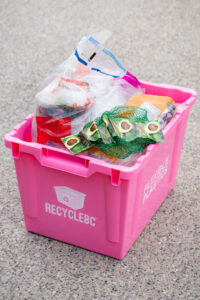
Depot collection worked, diverting thousands of tonnes from landfill, but recovery rates stayed well below other packaging categories because convenience was the wall nobody could get past.
Consumer research consistently showed residents skipped recycling that required a special trip, no matter how strong their intentions were. That finding collided with an ambitious commitment in Recycle BC’s 2025 Program Plan: recover 50 percent of all flexible plastics supplied into the BC market by 2027, more than double the 23 percent recovery rate the program was sitting at. Education alone would never close that gap. The system itself needed to change.
The plan moved in careful, sequenced stages rather than a single provincial rollout. First came a curbside pilot in West Vancouver, running from November 2021 to May 2022, which confirmed that segregated collection could work from people’s homes without degrading material quality or spiking contamination. With that proof in hand, Recycle BC scaled the model to West Vancouver, Maple Ridge, the City of Vancouver and the Regional District of Central Okanagan between mid-2024 and mid-2026, rolling out dedicated pink collection boxes and carts that made flexible plastics as simple to recycle as paper or containers. For communities that directly manage recycling service for residents under contract with Recycle BC, the program updated every curbside and multi-family collection contract in January 2025 to include incentive rates for segregated flexible plastics pickup, giving the City of Chilliwack a standardized pathway to become the first contracted community to adopt it in June 2026.
The new process needed new equipment. Conventional collection trucks are built for three material streams, at most, so Recycle BC partnered with Rollins Machinery and Labrie to design four-stream vehicles capable of collecting paper, containers, glass and flexible plastics on the same route without cross-contaminating any of them, a necessary piece of collection-system engineering.
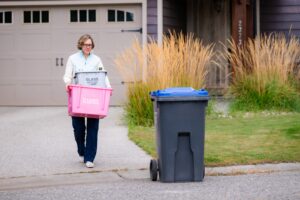 By May 2026, the expansion reached more than 300,000 households: 65,000 in the Regional District of Central Okanagan, 34,000 in Maple Ridge, 20,500 in West Vancouver and 181,000 multi-family households in the City of Vancouver. The headline recovery number tells a more honest story than it first appears. The 2025 recovery rate dipped slightly to 23 percent from 24 percent in 2024, not because collection slowed but because the volume of flexible plastics collected rose 5.5 percent, from 5,432 to 5,733 tonnes, while the amount of packaging supplied into the market grew even faster. Crucially, the biggest expansions in Central Okanagan, Vancouver and Chilliwack were launched after the reporting period closed, so their impact on recovery has yet to show up in the numbers at all. Digital education campaigns supporting the rollout generated more than 30 million impressions and 1.96 million video views in 2025, and consumer research found 95 percent awareness of Recycle BC generally, though only 52 percent awareness that flexible plastics could be recycled at all, a gap the ongoing campaigns are built to close.
The obstacles ran deeper than logistics. No recycling pathway existed at all when Recycle BC first committed to this material, which is why the program kept collecting through depots for years while Merlin Plastics spent more than five years perfecting a commercial process, including diverting material to an engineered fuel that displaced coal at a cement kiln in the interim rather than landfilling it. The vehicle problem and the behaviour problem both needed solving simultaneously, but early monitoring showed uptake lagging in some communities even after the pink boxes arrived, a reminder that infrastructure alone doesn’t change habits without sustained education behind it.
Recycle BC’s real achievement here isn’t a single recovery percentage; that number is still catching up to the infrastructure built to support it. The biggest achievement is proving that one of the hardest materials in the entire residential recycling stream can move from not being collected at all to depot-only acceptance to curbside routine, provided the recycling pathway, the collection hardware and the resident education all get built at the same time rather than in sequence.













