From Water Shortage to Water Security: Turning Crisis-Driven Conservation into Lasting Resilience
Projects Sponsor

Delta Management Group is the leading sustainability, ESG and clean tech focused search firm in Canada. Delta is proud to have founded the Canada's Clean50 Award program in 2011, and has been the primary sponsor for the past 13 years.
When the pressure was on, Calgarians proved that every drop counts! When Calgary’s Bearspaw South Feedermain failed in 2024, residents and businesses reduced water use by an estimated 9.5 billion litres, demonstrating what conservation can achieve under pressure. Calgary has since accelerated its Water Efficiency Plan, made outdoor watering schedules permanent, and expanded conservation, water reuse and public education initiatives to strengthen long-term water security. Despite welcoming nearly 49,000 new residents in 2025, summer water demand has flattened, turning a high-pressure moment into lasting water resilience.
When the Bearspaw South Feedermain failed in 2024, Calgary lost a critical piece of the infrastructure that keeps its taps running and found itself managing an emergency water shortage in real time. What happened next became the more interesting story: residents and businesses, given clear information and practical guidance, saved an estimated 9.5 billion litres of water during the crisis, enough to supply a city of 75,000 people for a year. Rather than treat that as a one-time emergency response, the City of Calgary built lessons into a permanent Water Efficiency Plan, and despite welcoming nearly 49,000 new residents in 2025, has kept summer water demand stable while working toward a 20% cut in per-capita water use by 2040.
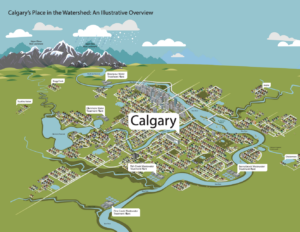
The pressure behind this project predates the feedermain failure. Calgary’s water system was already facing a familiar combination: rapid population growth, a changing climate, drought risk, aging infrastructure, and a finite, river-based water supply that doesn’t expand just because the city does. The 2024 failure exposed how vulnerable that system could be,: that coordinated demand management, not just new infrastructure, could meaningfully move the needle on water security.
Nicole Newton, the City’s Director of Environmental Risk and Resilience, and her team set concrete objectives: cut per-capita water demand by 20% by 2040, manage the summer peak that strains the system hardest, get more out of existing infrastructure rather than defaulting to new capital projects, and build resilience against both drought and future infrastructure disruptions, all while accommodating continued growth without a matching rise in consumption. Getting there started with research, not policy: demand forecasting, infrastructure capacity assessments, climate and drought analysis, customer research, and benchmarking against leading North American utilities. That research confirmed what the crisis had hinted at, that demand management is among the most cost-effective tools a city has for improving resilience, and that Calgary’s own emergency response had already proven it could work at scale.
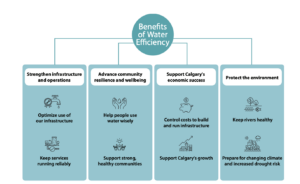
Implementation moved from analysis into action. The team studied what had actually happened during the shortage response, including customer behaviour, system performance, and where the 9.5 billion litres of savings had come from, then accelerated demand-management work already underway: expanded forecasting, conservation programs, efficiency incentives, water loss reduction, governance improvements, and public education. Residents, businesses, industry stakeholders and regional partners were brought into shaping the long-term approach directly, which fed into a renewed Water Efficiency Plan and a permanent Outdoor Watering Schedule. Council approved the plan in 2026, and the City moved straight into launching the schedule and accelerating its priority actions.
The hardest part wasn’t technical, it was persuasion. In the aftermath of the feedermain failure, public attention understandably focused on infrastructure reliability and on Calgary’s roughly 23% water loss rate, and many stakeholders felt the City should fix its own system before asking residents to change their habits. Newton’s team needed to make the case that water security isn’t an either-or between infrastructure investment and demand management, it’s both, and that demand management could deliver savings and capacity benefits faster and more cheaply than waiting on major capital projects alone. That case was built on ROI analysis, benchmarking against utilities already using these tools, and the hard evidence Calgary had just generated itself during the 2024 response. The city’s own crisis, in other words, became the strongest argument for the policy that followed it.

Industry partners did real work here too. advancing water-saving measures across commercial and institutional operations. Irrigation landscape associations promoted efficient outdoor watering and landscaping practices among their members. All were involved from early workshops and surveys through to implementation, helping shape a plan that reflected how their sectors actually operate rather than a policy written without them, and then carrying its message out to their own members and customers.
The results validate the foresight. Calgary approved a Water Efficiency Plan targeting a 20% reduction in per-capita water use by 2040, backed by a permanent Outdoor Watering Schedule, accelerated water loss reduction, and expanded conservation and reuse programs. And the early numbers hold up under real pressure: with close to 49,000 new residents added in a single year, summer water demand has stayed flat rather than climbing with the population, which is exactly the outcome the whole strategy was built to prove was possible.
A burst pipe forced Calgary’s hand in 2024. What the city did with that emergency, rather than just patching it and moving on, is the part worth remembering













