Indigenous-Led Living Lab for Low-Carbon Year-Round Northern Food Sovereignty & Workforce Development
Projects Sponsor

Delta Management Group is the leading sustainability, ESG and clean tech focused search firm in Canada. Delta is proud to have founded the Canada's Clean50 Award program in 2011, and has been the primary sponsor for the past 13 years.
Growing fresh food in winter has never been cheap or easy, but AgriTech North built a greenhouse that argues otherwise. Its 2,500-square-foot Living Lab in northern Ontario pairs a patented multi-layer thin-film envelope (cutting heat loss by ~75% vs. glass) with a water-based climate control system that saves 41 to 71 percent on energy,skipping synthetic refrigerants altogether. A demonstration avoided an estimated 6.26 T of CO2e; scaled across Canada’s existing greenhouse footprint, that’s a potential 966,000 T avoided annually. The project already backs more than 100 local food businesses and has put over $300,000 into school curriculum and growing units, proving Northern food sovereignty can take root even in permafrost country.
In Dryden, Ontario, a 2,500-square-foot greenhouse is quietly rewriting what year-round food production looks like above the snow line. AgriTech North built it inside a 10,000-square-foot Living Lab, wrapped it in a patented multi-layer thin-film envelope that cuts heat loss to roughly a quarter of what single-pane glass allows, and ran the whole thing on a water-based climate-control system instead of the synthetic refrigerants most indoor farms depend on. In its first full year, the demonstration avoided an estimated 6.26 tonnes of CO2e. Scaled across Canada’s existing greenhouse footprint, that same efficiency gain could theoretically avoid nearly a million tonnes annually. The project now supports more than 100 local food businesses and has planted the seeds, literally and otherwise, of a workforce pipeline through school curriculum and in-class growing units.
The problem AgriTech North set out to solve was never really about greenhouses. It was about geography. Canada’s greenhouse industry was built for milder climates, bigger markets and easy access to trades and parts, none of which describe rural, remote, Northern or Indigenous communities. Outside Southern Ontario and Western B.C., operators face brutal winter heating loads, high freight costs and thin local markets, which is why fresh produce in the North so often travels a long way before it reaches a plate, at a price and a carbon cost that reflects the distance.
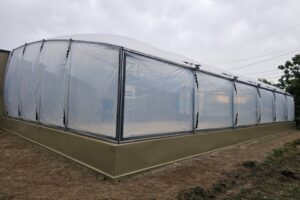
Benjamin Feagin Jr., AgriTech North’s CEO and co-founder, and his team set out with a stack of objectives that all pointed the same direction: build a greenhouse envelope tough enough for rugged cold without sacrificing light, pair it with a climate-control platform that recovers and reuses heat instead of burning through it, and prove the whole system could turn a profit at urban food prices in a Northern market. Just as important, they wanted to test it inside a real operating food business rather than a lab, and build the local workforce needed to keep it running long after the ribbon-cutting.
Getting there took the scenic route. AgriTech North spent more than a year researching vertical farming before actually trying it, and the results were the kind of instructive that only comes from real operating losses: the technology worked, but the economics didn’t, once energy, labour and equipment costs were tallied against a small Northern market. That failure redirected two more years of research toward greenhouse and hybrid systems, benchmarking everything from double-pane glass to geodesic domes before landing on multi-layer inflated thin-film as the most promising envelope, and a shared hydronic platform as the way to stop treating heating, cooling and dehumidification as separate problems.
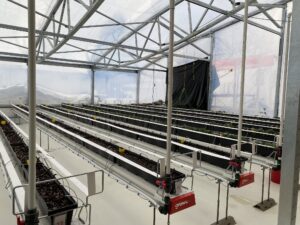
The build itself was a team effort. Fabian Velez, the company’s COO and co-inventor, translated crop and operational needs into engineering; Samantha Allan kept operations coordinated; Jose Isaac Ramos Franco, working the hydroponic floor day to day, fed back what actually held up under real handling and maintenance. Sheridan College ran the thermal and ventilation modelling that replaced manufacturer estimates with real Northern performance data, while Collège Boréal and a long list of provincial and federal partners, including FedNor, the Northern Ontario Heritage Fund Corporation and Agriculture and Agri-Food Canada, backed the research and construction along the way.
None of it came easily. Some early energy-storage concepts looked technically elegant but made no financial sense once modelled against the site, and had to be scrapped in favour of something buildable. The greenhouse envelope itself needed more than manufacturer spec sheets to prove out. Standard performance tables couldn’t capture how a multi-layer film actually behaves in a Northern wind, so the team leaned on field measurement and third-party validation instead. The most disruptive stretch was a near two-year intellectual-property and construction dispute, including a contested lien, that AgriTech North had to defend against while self-represented, at real cost to both liquidity and staffing. The company came through it with its patent position intact, though not without trimming its team from around 11 people to six to protect the core group that could carry the project forward. Feagin also raised a broader, structural obstacle before the Standing Senate Committee on Agriculture and Forestry: current Canadian accounting treatment of government assistance can make a publicly funded, asset-rich company look under-capitalized to lenders right when it needs financing most, a gap he estimates at roughly $4 million for AgriTech North alone.
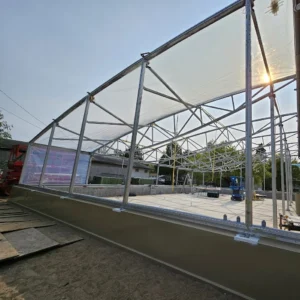
Despite all that, the numbers hold up. Heat loss runs at roughly a quarter of single-pane glass performance, climate-control energy use is down 41 to 71% versus conventional refrigerant-based systems, and the site avoided 6.26 tonnes of CO2e in 2025 alone, a figure that scales to a theoretical 966,000 tonnes annually if the same approach were applied across Canada’s greenhouse sector. The system has eliminated synthetic high-GWP refrigerants from its climate-control pathway entirely, and beyond the environmental numbers, it’s now supporting more than 100 local food businesses, drawn more than 50 commercialization inquiries from across North America, and anchored more than $300,000 in school curriculum and in-class growing units.
AgriTech North is now converting a one-off demonstration into something repeatable: standardized components, a kit-of-parts build, and certification work aimed at getting the system into other communities facing the same climate and market constraints, rather than keeping it as a single showcase greenhouse. The company sees the model less as a product and more as infrastructure, something a Northern town, a First Nation or a school district could eventually own and run themselves.
A greenhouse built to survive a Dryden winter turns out to be a decent metaphor for the company behind it: engineered for a hard climate, tested under real pressure, and still standing at the end of the season.













