Industry-Leading Sustainable Manufacturing Operations
Projects Sponsor

Delta Management Group is the leading sustainability, ESG and clean tech focused search firm in Canada. Delta is proud to have founded the Canada's Clean50 Award program in 2011, and has been the primary sponsor for the past 13 years.
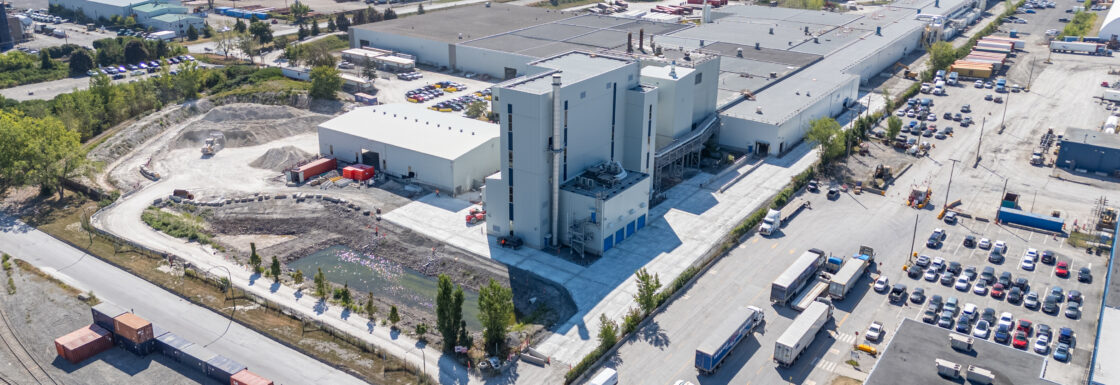
Gypsum wallboard has always needed a natural-gas-hungry kiln and dryer to turn rock into drywall, a process that alone accounts for over 40 percent of the product’s carbon footprint. This facility gutted that logic, swapping gas burners for electric heating elements and running entirely on Quebec’s hydroelectric grid. The three-year retrofit kept the plant fully operational throughout construction and emerged as North America’s first and the world’s largest zero-carbon (scopes 1 & 2) gypsum wallboard plant. Emissions dropped by 44,000 tonnes a year, and energy use fell by up to 30 percent. Looks like building materials can hold up a wall and a climate target.
 Gypsum wallboard manufacturing has long faced a significant challenge: its most energy-intensive step runs on natural gas, making manufacturing responsible for more than 40 percent of a wallboard’s total lifecycle CO2 emissions. Saint-Gobain looked at its Sainte-Catherine, Quebec plant and decided to solve its emissions problem at the source rather than offset it downstream, betting that Quebec’s abundant hydroelectricity made full electrification not just possible but competitive.
The building sector accounts for nearly 40 percent of global carbon emissions and roughly half of natural resource consumption, and Saint-Gobain’s own 2050 net-zero roadmap, validated by the Science-Based Targets initiative, commits the company to a 33 percent reduction in Scope 1 and 2 emissions by 2030 against a 2017 baseline. In 2020, an opportunity to expand capacity at the Montreal-area facility, driven by rising Canadian housing demand, collided with that decarbonization mandate. Rather than simply add gas-fired capacity to meet demand, Saint-Gobain rebuilt the plant’s core processes around electricity from the ground up.
The first two years went into groundwork rather than construction. A full Life Cycle Assessment established a clear baseline for the plant’s carbon footprint, building on the Environmental Product Declarations CertainTeed had already published, the first third-party verified, location-specific EPDs in the gypsum wallboard market. That research identified where the emissions were hiding- the calciner and the multi-deck dryers- and confirmed the scale of the opportunity in replacing both. Strategic partnerships with the Government of Quebec and Hydro-Québec were signed in 2022, setting the stage for a three-year construction and upgrade program that would need to replace roughly 80 percent of the plant’s equipment.
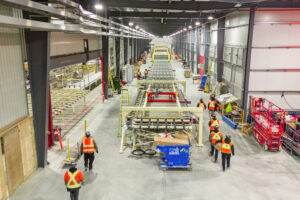
What makes the project unusual is that it didn’t require shutting the plant down. The facility ran 24 hours a day throughout the entire upgrade, forcing the team to build an entirely new gypsum rock mill and drying line in parallel with live production rather than in sequence. Natural gas burners gave way to high-efficiency electrical heating elements, real-time smart energy meters and management systems went in to track performance continuously, multiple heat recovery systems and upgraded insulation cut waste heat, and new process sensors and improved compressed air design tightened quality control across the line. Construction ran from 2023 through 2025, when the upgraded plant was completed, inaugurated and brought into production.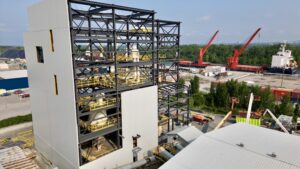
The completed facility became North America’s first, and the world’s largest, zero-carbon (Scope 1 and 2) gypsum wallboard plant, cutting CO2 emissions by 44,000 tonnes annually, roughly the equivalent of taking 14,000 cars off the road for a year, while cutting energy consumption by up to 30 percent. It also increased production capacity by up to 40 percent, evidence that decarbonizing the plant made it more productive rather than less. That combination let CertainTeed launch Infinaé CarbonLow, a new wallboard line carrying up to 60 percent less embodied carbon cradle-to-gate, which generated more than $1 million in sales within months of its October 2025 launch, a rare case of a sustainability retrofit becoming a genuine new revenue line rather than a cost centre.
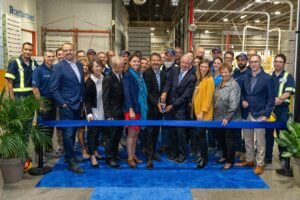 Running a $160 million rebuild inside a live 24/7 plant demanded relentless coordination across teams that don’t normally share a construction schedule. The solution was less a single fix than sustained discipline; it required sequencing the new mill and dryer construction so the existing line never had to slow down and leaned on collaboration across Saint-Gobain’s operations and sustainability groups to keep both the retrofit and daily production moving without either one compromising the other. Government support helped absorb some of that risk, with Quebec’s EcoPerformance program contributing $40 million toward the total investment. A long roster of specialized contractors, including OSLO Construction, SOREL Construction, Mecanitec S3i, GCM Consultant and Saint-Gobain’s own central engineering team, handled everything from foundations and electrical distribution to mechanical installation and site safety across the length of the project.
The Sainte-Catherine plant now stands as proof that a legacy industrial process doesn’t have to choose between decarbonizing and staying productive. Saint-Gobain rebuilt one of its oldest manufacturing steps, calcination itself, around clean electricity, kept the line running the whole time, and came out the other side with more capacity, a new low-carbon product line, and a plant. Other manufacturers now have an actual working blueprint to copy rather than a theoretical target to chase.













