Kvina River Alkalinity Enhancement: The World’s First Verified RAE Carbon Credits
Projects Sponsor

Delta Management Group is the leading sustainability, ESG and clean tech focused search firm in Canada. Delta is proud to have founded the Canada's Clean50 Award program in 2011, and has been the primary sponsor for the past 13 years.
Norway’s Kvina River had been losing an argument with acid rain for decades. The government’s liming program, which added crushed alkaline rock to counteract the acidity, had held the river’s pH at a modest 6, limited by budget rather than ambition. CarbonRun saw the unfinished math: add more limestone, push the pH up to 7, and the same chemical reaction that restores a river’s health also converts atmospheric CO2 into stable bicarbonate that stays locked in the ocean for tens of thousands of years. In January 2026, that bet paid off in the form of 76 tonnes of verified carbon removal, the first credits of their kind ever issued anywhere in the world.
Rivers are the main channel through which carbon actually moves from land to ocean, but acid rain has quietly degraded that function across watersheds in Canada and Europe alike. River liming itself wasn’t new; Scandinavia has used it for more than 30 years to fight acidification and protect fish populations. What was new was the idea that the same intervention could be measured and sold as carbon removal. Dr. Shannon Sterling at Dalhousie University made that connection first, working with freshwater ecologist Dr. Eddie Halfyard to build the scientific case that liming for alkalinity should also sequester carbon. Luke Connell recognized the commercial opening, angel-funded the company, and built the buyer relationships that would eventually turn a research hypothesis into a market.
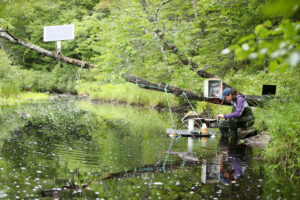
The Kvina project existed to prove three things at once: that River Alkalinity Enhancement could remove measurable, quantifiable tonnes of CO2 under live field conditions, that a rigorous measurement protocol could meet the highest bar of any carbon registry, and that the whole pathway was commercially viable enough to repeat elsewhere. The site itself was chosen deliberately, for its decades of liming history, existing monitoring infrastructure, and clear ecological upside for the fish and aquatic life that depend on a healthier river.
None of it started with Kvina. CarbonRun’s scientific foundation came out of four years of field research in Nova Scotia with Dalhousie University and the Nova Scotia Salmon Association, which established the core measurement methodology the company would later scale internationally. Before touching the Kvina site, the team built baseline models from 14 years of historical river chemistry data and worked with Isometric’s independent network of more than 300 scientists through a 30-day public consultation to co-develop the RAE Protocol, published in May 2025 as the world’s first certified protocol for carbon dioxide removal via rivers. Kvina became the live field test for that protocol before any credit was ever issued.
Execution moved in careful stages, built on top of the river’s existing 25-plus years of liming infrastructure rather than starting from scratch. The team set up four distinct monitoring sites, including an untreated control tributary to serve as the counterfactual baseline, then raised the river’s pH in three controlled phases between April and September 2025, from 6.6 to 6.8 to a sustained 7.0, with continuous in-situ sensors and weekly lab samples running the entire time. From there, CarbonRun compared the treated site against the modelled counterfactual to calculate gross carbon removal, subtracted the project’s own lifecycle emissions and a conservative uncertainty discount, and arrived at a verified net figure. A third-party audit and public consultation followed that fall, closing with zero public comments.
Three real obstacles shaped the project. Operating in a country where CarbonRun had no prior footprint meant a steep learning curve, made worse when its first Norwegian contractors communicated poorly and strained relationships with local regulators. The company leaned into its own habit of transparent, early community engagement instead, a discipline built from years of earning trust with First Nations communities in Nova Scotia who’d seen that trust broken before by others working in their rivers, and it paid off in local advocates who vouched for the project without being asked. Measuring carbon removal accurately in a constantly shifting, live river system was a second problem nothing on the market was built to solve, so CarbonRun built its own proprietary monitoring stack, work the company now licenses to others. The third obstacle was commercial: Frontier, CarbonRun’s largest buyer, was openly worried that a first project outside Canada could distract from everything else on the roadmap. The team took the bet anyway, and Kvina became the first-ever on-registry credits CarbonRun delivered to Frontier.
The results reached further than the carbon math alone. The 76 verified tonnes went to buyers including Google, Shopify and Stripe under a Frontier offtake agreement covering 55,442 tonnes of removal through 2029, and the underlying protocol is now the credibility standard the entire RAE pathway runs on, presented at forums from EGU in Vienna to Yale’s Planetary Solutions conference. The river itself came out ahead too: pH held at a stable 7.0 throughout the four-month trial, comfortably clearing the 6.5 to 6.8 threshold salmon and other sensitive species need, with weekly testing across more than 35 water-quality parameters confirming no harm to the broader ecosystem.
Beyond Kvina
CarbonRun has already built three more RAE projects in Nova Scotia and is expanding across Canada, the EU and beyond, all under the protocol Kvina helped establish as the global standard. Every future river carbon removal project anywhere, by CarbonRun or any competitor, will register under rules this one river helped write.
A river spent decades slowly losing its ability to buffer carbon. CarbonRun just proved it can get that ability back, one verified tonne at a time.













