Living Cities Canada
Projects Sponsor

Delta Management Group is the leading sustainability, ESG and clean tech focused search firm in Canada. Delta is proud to have founded the Canada's Clean50 Award program in 2011, and has been the primary sponsor for the past 13 years.
75% of Canada’s mid-to-large-sized cities have lost tree cover and natural space over the past 20 years, leaving neighbourhoods more exposed to flooding and heat waves, with low-income and racialized communities the hardest hit. This national funding and coaching program set out to change this inequity from the roots up. Since 2024, the $1.3 million it has channelled to 150 community-led projects across the country has restored nearly 50,000 square metres of urban land with 43,500 trees, shrubs and perennials. More than 12,500 volunteers, including 7,200 youth, did the digging, and over 700 people completed free training to keep the momentum growing. Cities are getting their canopy back, one planted patch at a time.
Three-quarters of the country’s large and mid-sized cities have grown less green since the early 2000s, with canopy and soil giving way to impermeable surfaces that turn a heavy rainstorm into a flood and a heat wave into a health emergency. Low-income residents, Black, Indigenous and other communities of colour absorb the worst of the risk.
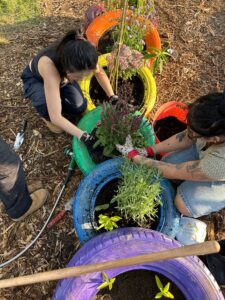
The fix isn’t a mystery: trees, rain gardens, bioswales and de-paved lots let a city breathe again, and the research on how to build them has existed for years. What’s missing is everything between the plan and the shovel, and Living Cities Canada, a program of Green Communities Canada, set out to close that gap.
The first Living Cities Canada move was a framework: the Pathways to Living Cities Framework, built in 2022. The Framework pulled proven strategies from cities across North America and Europe into a single playbook for practitioners who had the will but not always the roadmap. That research became the spine of everything that followed: a free, self-paced course called Mobilize Your Living City walks community groups, municipalities and non-profits through building a local green infrastructure policy from scratch, alongside companion courses on de-paving and mini forests aimed at specific, implementable interventions rather than abstract goals.
 Training alone doesn’t plant trees, so the program layered on direct funding and peer coaching, aimed squarely at the grassroots organizations and smaller BIPOC-led groups that usually get priced out of infrastructure work before it starts. A Community of Practice ties funded partners together so lessons from a bioswale in one city make it to a de-paving project in another instead of evaporating.
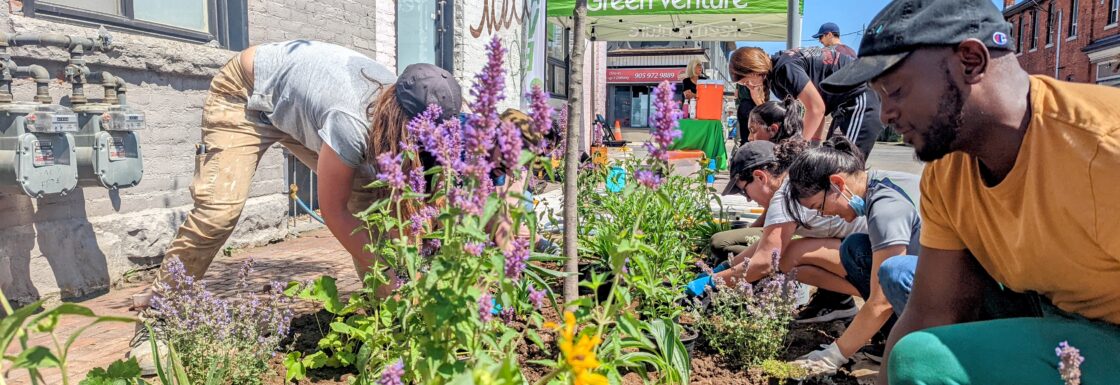
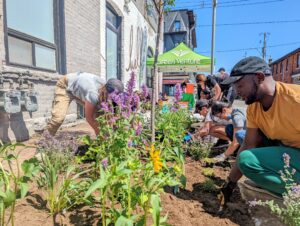
Since 2024, the project has moved quickly. Living Cities Canada has distributed $1.3 million to local partners, backing 150 green infrastructure projects nationwide, restoring close to 50,000 square metres of urban land and putting 43,500 trees, shrubs and perennials into ground that used to just repel water. None of it happened without hands: 12,500 volunteers, including 7,200 youth, turned up for planting days, site planning and the less glamorous work of stewardship that keeps a young tree alive past its first summer. More than 700 people have now completed the program’s free training courses, seeding a slew of practitioners well beyond the funded projects themselves.
But the trees didn’t become a forest overnight, and the program faced some challenges that no one could prepare for. Site conditions shift, permitting drags, a design gets revised mid-project, and inclement weather has a way of arriving on exactly the day volunteers show up to plant. Rather than treat these hurdles as project failures, the program built flexibility into its funding model from the outset, adjusting timelines, adding resources or brokering introductions across its partner network when a group hit a wall it couldn’t climb alone. 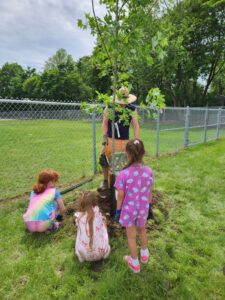 In 2025, Trees for Life joined as a full project delivery partner and co-funder, extending direct support to local organizations and widening the bench of expertise available to groups working through their first de-paving or planting season.
What distinguishes Living Cities Canada from a typical grant program is the wraparound design: funding, training and peer coaching arrive together rather than as separate applications a small non-profit must juggle. That combination lowers the barrier for exactly the organizations that research shows are shut out of green infrastructure funding elsewhere, and it treats a completed project as the start of a stewardship relationship rather than the end of a grant cycle.
The tally so far- 150 projects, 43,500 plantings, 12,500 volunteers and $1.3 million redirected to community hands- tells only part of the story. The deeper shift is in communities getting to decide what their own blocks look like and having access to a network of grassroots groups who know how to write a green infrastructure policy, run a planting day and keep the resulting trees alive. Living Cities Canada is rooted in capacity that tends to outlast any single grant cycle.













