Low Energy Data-Centre Cooling
Projects Sponsor

Delta Management Group is the leading sustainability, ESG and clean tech focused search firm in Canada. Delta is proud to have founded the Canada's Clean50 Award program in 2011, and has been the primary sponsor for the past 13 years.
Bell Canada’s network sites need cooling around the clock, typically requiring air conditioners to run continuously regardless of outdoor conditions. A pilot phase change cooling system combines thermal storage, free cooling and low-energy air movement to absorb heat from the network space before mechanical cooling is required. The result: 67 percent lower HVAC energy use, approximately 20 percent lower annual electricity consumption, roughly 500 fewer hours of mechanical cooling annually, 25,000 kilowatt-hours saved, and improved power usage effectiveness from 1.35 to 1.14. The successful pilot could scale to thousands of similar sites across Canada. Sometimes the coolest fix in the room is the one that barely turns on.
Every telecom network site runs on a simple, expensive rule: keep it cool, twenty-four hours a day, or risk the equipment inside it. Bell Canada and its facilities partner BGIS decided to test whether that rule had to mean constant mechanical air conditioning, and piloted a phase change material cooling system that delays the AC instead of leaning on it around the clock. The results were hard to argue with: a 67% cut in HVAC use, about 25,000 kWh saved annually, mechanical cooling pushed back roughly 500 hours a year, and a site power usage effectiveness score that improved from 1.35 to 1.14, a better-than-15% efficiency gain at a facility that can’t afford to compromise on reliability.
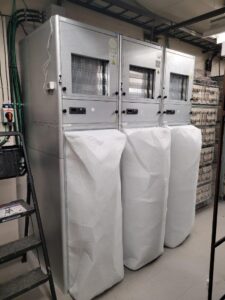
Network sites are unusual buildings. Unlike an office, they can’t dial back demand during off-peak hours, since the equipment inside needs steady temperatures whether it’s 3pm or 3am. That around-the-clock requirement has historically meant an AC-first approach: run the mechanical cooling constantly and treat energy use as the price of uptime. Bell and BGIS set out to challenge that assumption, not by replacing the AC, but by building a staged system that handles as much of the cooling load as possible before mechanical cooling ever has to switch on.
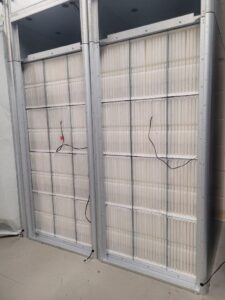
The approach layers three things together: phase change material for thermal storage, air displacement for low-energy air movement, and free cooling that draws on ambient conditions whenever they cooperate. The goal was to shift the site’s default from “AC first” to “AC last,” while holding to the same strict temperature reliability a critical network site demands. Before touching any hardware, the team consulted European vendors with direct experience in PCM and air displacement systems, ran detailed climate analysis to find a pilot site with the right conditions, and worked through a technical review covering integration risk, 24/7 reliability, and temperature thresholds. That groundwork carried the project through Bell’s internal approval process and into funding.
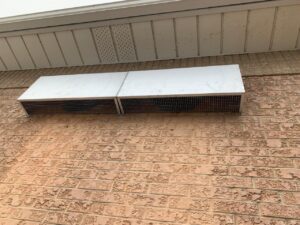
Implementation moved in stages: selecting the site, designing how PCM units, air displacement and the existing cooling infrastructure would work together, then installing unit placement, airflow configuration and controls in sequence rather than all at once. Once commissioned, the system needed real tuning, not just a switch-on. Iterative adjustments to temperature thresholds helped the team squeeze more use out of free cooling, and performance was tracked continuously to validate that the staged approach was actually doing what the modelling predicted.
BGIS, working as what both sides describe as a close, integrated extension of Bell’s own team rather than an outside vendor, led the project management and day-to-day implementation, from design review through installation and performance validation. Bell’s Iliana Margan and BGIS’s Alireza Moeini anchored the partnership from their respective sides, with Bell holding governance and strategic direction while BGIS’s energy and operations specialists handled system integration and ongoing optimization.
The rollout wasn’t friction-free. Early operation surfaced a condensation risk created by the interaction between cold mechanical cooling and warmer ambient air, which sent the team back into the control logic to adjust setpoints. Folding a genuinely new cooling approach into existing HVAC infrastructure took careful coordination to avoid compromising reliability, and extreme weather conditions tested how far the system could lean on free cooling before mechanical backup had to step in. None of these were solved with a single fix; they were worked out through iterative tuning, closer monitoring, and tight collaboration between Bell’s operations team and BGIS’s technical staff, the kind of unglamorous, ongoing adjustment that pilot projects rarely get credit for but almost always require.
The numbers, once the tuning settled, told a clear story: a 67% reduction in mechanical cooling use at the pilot site, roughly 25,000 kWh in annual energy savings (about 17% of total site energy use), mechanical cooling delayed by approximately 500 hours a year, and a power usage effectiveness score that improved from 1.35 to 1.14, a gain of more than 15%. All of it built on a staged cooling model designed from the outset to scale across similar network sites, not stay a one-off pilot.
The real test for a pilot like this isn’t whether it works once, it’s whether it’s worth repeating. Bell operates thousands of sites with the same round-the-clock cooling requirement, and a system that delays mechanical cooling by 500 hours a year at one location adds up fast across a network that size. The partnership between Bell and BGIS was built specifically to produce something repeatable rather than a one-off showcase, which is the difference between an efficiency story and an efficiency strategy.
Bell’s network needs to stay cool no matter what. This project just found a way to get there with a lot less huffing and puffing from the air conditioner.













