Maximizing Climate Solutions Through the Integration of Beneficial Management Practices
Projects Sponsor

Delta Management Group is the leading sustainability, ESG and clean tech focused search firm in Canada. Delta is proud to have founded the Canada's Clean50 Award program in 2011, and has been the primary sponsor for the past 13 years.
Soil health and climate action often get treated as separate projects; the Regenerative Alberta Living Lab treats them as the same one. The initiative pairs roughly 110 core producers across some 400,000 acres with soil scientists to co-develop and measure practices that sequester carbon and cut emissions together rather than in isolation. Using 10-metre resolution soil mapping, the project has tracked adoption of 8 carbon-sequestration and 7 emissions-reducing best practices, often stacked on the same field for compounding results. More than 600 producers have joined peer-to-peer workshops and field demonstrations as the project runs through 2027, proving good soil can hold more than just crops.
Farmers across Alberta had been adopting regenerative practices like cover cropping, intercropping and adaptive grazing for years, often observing real changes in their soil. What didn’t exist was any coordinated way to measure those changes, validate them, or figure out which combinations actually worked best together. The Regenerative Alberta Living Lab set out to close that gap, pairing 111 core producers directly with soil scientists to co-develop and measure beneficial management practices as integrated systems rather than one-off fixes. Those partnerships now span 400,939 acres, with an estimated 73,941 tonnes of CO2e per year in site-level climate impact.
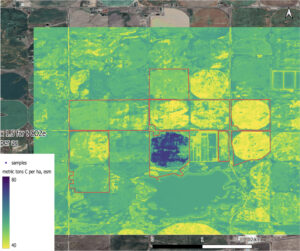
The problem wasn’t a shortage of farmer-led innovation, it was a shortage of shared language and replicable metrics. Natural soil building takes 1000 years for an inch of topsoil, yet we know that can be sped up through good practices, with farmers focused on soil building able to increase their soil organic matter by 3 to 5 percentage points. The Living Lab was built to capture and articulate what regenerative farmers were seeing and make it scalable. Individual beneficial management practices, tested and measured in isolation, can miss what happens when a producer stacks several of them on the same field at once. The project’s objective became maximizing agricultural climate solutions specifically through the integration of stacked practices, while building a working partnership between producers, regional Applied Research and Forage Associations (ARAs), and scientists to co-develop systems that fit real farm and ranch conditions well enough to actually scale.
The Living Lab didn’t start from a blank field. It built directly on three prior years of province-wide soil carbon mapping, the Alberta Soil Carbon Quantification effort, which had already brought in producer participants from every region of the province and produced a 30-metre resolution carbon map identifying where over a century of degraded farming and forage practices had left real sequestration potential on the table. That earlier work did more than generate data, it built trust, and it’s that existing relationship with producers that made a genuinely farmer-led Living Lab model possible instead of a purely academic research design imposed from outside.
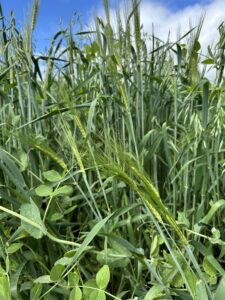
From there, the team recruited 111 core producers across cropland, rangeland and grazing operations, working through seven ARAs as regional partners to run co-development sessions on which practices made sense for each operation. On the science side, soil sampling and predictive mapping at 10-metre resolution tracked carbon changes over time, while kitchen-table socioeconomic interviews dug into what actually drives or blocks adoption on a working farm. As practices matured, the team began documenting where producers were combining several BMPs in a single paddock on their own initiative, feeding that emerging knowledge straight back into peer-to-peer workshops and field demonstrations delivered by the regional ARA partners across the province.
Coordinating a project spread across a province this size brought its share of obstacles. Leadership turnover across several partner Applied Research and Forage Associations shook up the project’s working group and threatened its momentum, which Food Water Wellness Foundation addressed by taking on a larger share of coordination directly and rebuilding the group with aligned new members. Delays in soil sample analysis pushed back the predictive soil maps producers and scientists rely on as a shared reference point, slowing some co-development conversations. And with core producer sites spread up to 1,600 kilometres apart, weather windows and sampling logistics were a constant constraint on the field team, resolved by building tighter regional sampling routes scheduled around each ARA partner’s own network, so crews could work efficiently without cutting the number of sites covered in a season.
The project drew on a wide bench of partners to get this far. The Alberta Conservation Association serves as technical lead and Contribution Agreement signatory, with Food Water Wellness Foundation as co-lead handling day-to-day delivery. Seven Applied Research and Forage Associations, ARECA, BRRG, FFGA, GWFA, LARA, MARA and NPARA, along with Farming Forward and CAFLA, delivered regional producer engagement, workshops and field demonstrations. Research partners at Agriculture and Agri-Food Canada (AAFC) include Dr. Monika Gorzelak and Patrick Neuberger on genomics and soil science, Dr. Tim McAllister on cover crop nutrition and GHG emissions, and Dr. Emma Stephens on econometric analysis, alongside Dr. Preston Sorenson of the University of Saskatchewan on predictive soil mapping, with funding from AAFC under the Agricultural Climate Solutions Living Labs program.
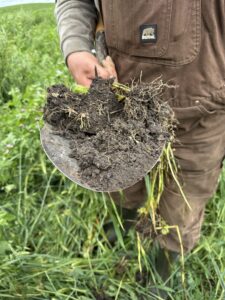
The results reach well past the 111 core farms directly enrolled. Beyond the 400,939 acres and an estimated 73,941 tonnes of CO2e in annual site-level climate impact, the project has run 73 co-development activities with 365 producer attendees, turning BMPs from theory into practices refined for each operation’s actual conditions, and 35 knowledge transfer events reaching 1,222 producer attendees, extending the project’s influence well beyond the participant group itself. Funded at $9.2 million by AAFC, the Living Lab has moved regenerative agriculture in Alberta from scattered early-adopter success stories toward a measured, farm-specific evidence base, with BMPs increasingly stacked together on individual paddocks rather than adopted as single, isolated changes. The model itself, pairing producers directly with scientists and regional associations, is built to be replicable well beyond Alberta’s borders.
A field doesn’t stop changing once someone measures it, and that’s the quiet premise this project was built on. Alberta’s producers had been reading their own soil for years; the Regenerative Alberta Living Lab just finally gave that reading a shared set of numbers.













