Okanagan Eco Park: BC’s Largest Rooftop Solar Energy Project
Projects Sponsor

Delta Management Group is the leading sustainability, ESG and clean tech focused search firm in Canada. Delta is proud to have founded the Canada's Clean50 Award program in 2011, and has been the primary sponsor for the past 13 years.
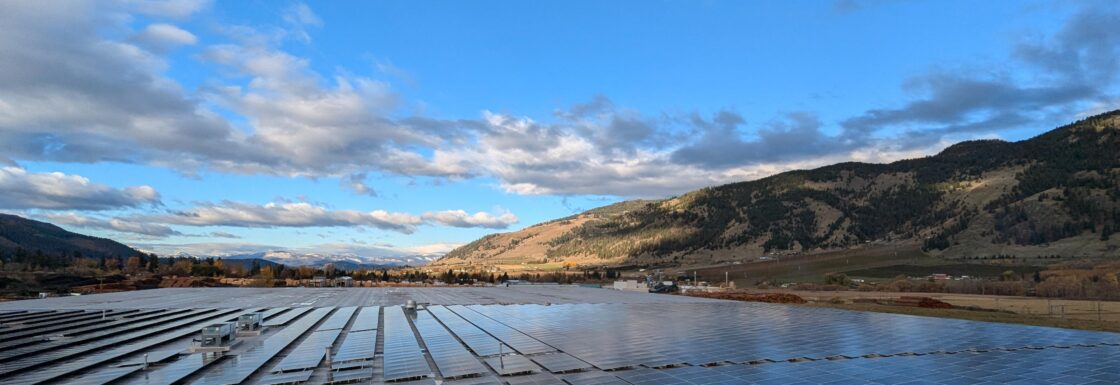
When Restoration Land’s eco-business park had a large flat roof running well below its solar potential, Kuby’s engineering team designed a large-scale array that wouldn’t require an overhaul of the building’s existing electrical infrastructure. In eight weeks, they designed and installed 2,460 panels and six commercial inverters — now British Columbia’s largest rooftop solar installation. Each panel sits at an optimal five-degree tilt and are expected to generate approximately 1.69 million kilowatt-hours of clean energy per year — enough to power around 150 homes — with no additional land required. It’s a practical example of how existing infrastructure, engineered correctly, can become a meaningful source of clean energy.
Rooftops are the most overlooked real estate in industrial Canada. Restoration Lands Eco Park was built to break from the norm, around a vision of environmental leadership and responsible land use from the outset, and it was only obvious to put its own roof to work rather than let it sit idle above an increasingly power-hungry business park. 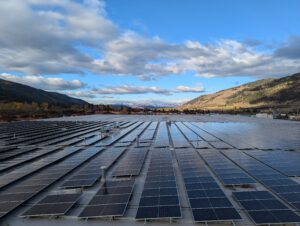 The brief to Kuby Energy was to deliver a high-performing solar system without triggering a costly overhaul of the building’s existing electrical infrastructure. The result? British Columbia’s largest rooftop solar installation, a 1.71 MW array of 2,460 panels feeding six commercial inverters, built to prove that existing commercial buildings can become part of the climate solution without consuming an acre of new land.
The project required real engineering restraint before a single panel went up. Solar resource modelling based on regional weather patterns, structural review to confirm the roof could bear the load, and electrical analysis to see what the existing service could handle all fed into the overarching goal to fit the system to the building rather than fitting the building to the system. That discipline produced a five-degree rooftop tilt, balancing production against wind loading and future expansion room, and a configuration of six 185 kW inverters tuned to integrate with the site’s existing electrical service without major modification.
Design and engineering included months of coordination with BC Hydro to approve a system of this scale for interconnection. Procurement and logistics followed, staging 2,460 modules and building an installation strategy for a rooftop project with no real precedent in the province. 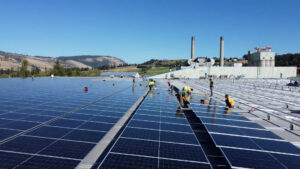 Construction crews then moved through racking, wiring and electrical integration, wrapping the entire physical build in eight weeks with minimal disruption to a facility that never stopped operating underneath them. Commissioning verified performance before final activation, and an ongoing operations phase, run as a pilot for Kuby’s own IQ commercial monitoring platform, now keeps the array compliant with BC Hydro’s guidelines in real time.
Coordinating 2,460 modules demanded commercial-specific installation sequencing that Kuby has perfected across hundreds of commercial installations. BC’s weather forced constant rescheduling around rooftop access windows, requiring the field and project management teams to tighten communication, prioritizing safety without letting quality slip. The thorniest challenge was ensuring a system producing this much power wouldn’t destabilize the distribution grid it fed into; early, sustained collaboration with BC Hydro on a zero-export strategy, keeping all that clean power on site rather than pushing it back onto the wires, took months to finalize but let the project proceed without a costly utility-side upgrade, while still preserving the distribution system’s integrity once such a large generator came online.
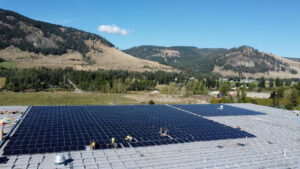 The finished system now generates roughly 1.69 million kWh annually, enough for about a quarter of the industrial park’s current electricity needs, or the equivalent of 150 homes. Getting there required partners well beyond the roofline, as ComAp supplied the energy management and control systems needed to balance solar output against real-time facility demand, monitoring both sides of the meter so output could be intelligently curtailed rather than wasted; BC Hydro’s utility integration work ensured the array could operate at this scale without compromising grid stability. Structural engineers, electrical specialists and equipment manufacturers rounded out the team, handling design validation, equipment selection and the safety compliance work that a project of unprecedented rooftop scale in the province demanded at every stage.
Though the solar panels are impressive, the real headline is the precedent set by the project. British Columbia has historically trailed other provinces on solar adoption, and this project’s central bet, that the existing electrical service could absorb a record-setting array without a rebuild, is now proven rather than theoretical. That matters because the alternative, an expensive service upgrade, is precisely the cost that scares most commercial building owners away from solar at this scale in the first place.
Thousands of warehouses, municipalities and commercial buildings across the country share the same unused rooftop and the same underlying question of whether their existing electrical service could handle a serious solar retrofit. Restoration Lands Eco Park answered it, and did so while converting energy generation into a visible symbol of what responsible land use can look like when a business treats its roofline as an asset instead of an afterthought.













