Preventive Environmental Management of Industrial Port Zones
Projects Sponsor

Delta Management Group is the leading sustainability, ESG and clean tech focused search firm in Canada. Delta is proud to have founded the Canada's Clean50 Award program in 2011, and has been the primary sponsor for the past 13 years.
Ships, docks and heavy industry keep Canada’s ports humming, but a spill or contaminant runoff can quietly wreck the ecosystems those ports depend on, often before anyone notices. This monitoring network gives the coastline a round-the-clock lifeguard: more than ten sensor stations track 30 water and air quality indicators in near real time across two Quebec port zones. The system has logged nearly six million data points, feeding an open-access portal that flags anomalies and guides decisions on the spot, protecting more than 250,000 people and 20 municipalities nearby. Recognized by UNESCO under its Ocean Science Decade, the model is now a plug-and-play template for ports worldwide.
Most port operators have no way of knowing something has gone wrong until it already has, since few possess the monitoring programs needed to catch contaminant runoff or a spill before it does damage. INREST built Enviro-Actions to close that gap, giving port managers an up-to-date ecological picture in near real time instead of relying after the fact on hindsight.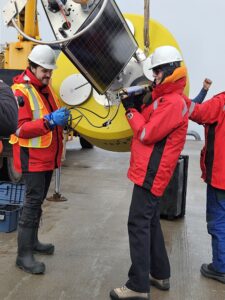
The idea grew out of the Sept-Îles Environmental Observatory, a five-year research effort in North America’s largest mineral ore port. Led by INREST alongside Canadian universities and local stakeholders, it produced the first holistic ecological study of the Bay of Sept-Îles, one of the most substantial environmental observatories in Québec. That project revealed, as much as any single data point, the value of having a neutral scientific body between industry and community, translating research into something port administrators could act on. A companion effort, the Saguenay Fjord Ecosystem Research Team, extended that same model to a second port region with two more Quebec universities on board.
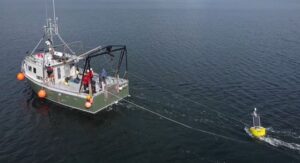 Turning research into an operating system took real engineering. The team designed three types of monitoring stations, container-mounted on docks, trailer-based, and scientific buoys at sea, all weather-resistant, energy-autonomous and built to move without requiring engineering studies or interrupting port operations. Multiparametric sensors on these stations track water and air quality every five minutes, streaming data over cellular networks into an online platform built to handle very large, continuous datasets under strict quality control. AI processes the incoming stream automatically, generating reports for partners instead of leaving analysts to comb through raw numbers. Layered on top is the Enviro-Alert system, born from direct meetings with port authorities to set preventive thresholds ahead of any formal regulation, monitoring around the clock for anomalies to trigger a response from the right person the moment one appears.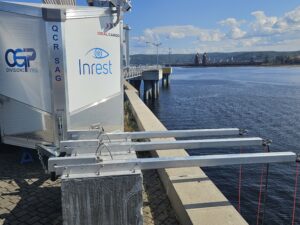
Since 2022, five stations have run from March through November each year across the demonstration zone in Sept-Îles and the validation zone in Saguenay, generating nearly 6 million data points across 30 water and air quality parameters. That volume of continuous, high-resolution evidence has already changed how ports operate day to day: administrations have modified ship-loading procedures, closed ore conveyors to cut particulate emissions, and sharpened restorative action after spills, decisions made possible only because the data existed to justify them in the moment rather than in a report filed months later.
More than 20 municipalities and roughly 250,000 people across the Saguenay and Sept-Îles regions now sit within the reach of that monitoring network, and UNESCO has recognized Enviro-Actions as a major contribution to the UN Decade of Ocean Science, a nod that has carried the project’s model to an international audience.
Building hardware for a harbour is not the same as building it for a lab. The team had to select and modify instruments never designed for saline, weather-battered marine conditions, while testing and adjusting equipment in situ before landing on a platform that could survive a season on the water. Working inside an active industrial port added its own friction, as every employee needed safety training, deployments had to be coordinated around ship traffic, and exceptional events like large shipments or passenger arrivals occasionally forced schedules to bend.
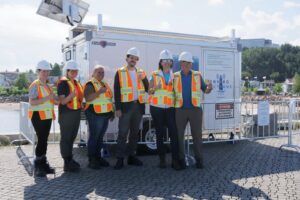 None of it happened alone. Roughly $8.8 million came through the Gouvernement du Québec’s Avantage St-Laurent maritime strategy, joined by direct support from the Port of Sept-Îles, Port of Saguenay, Rio Tinto and Promotion Saguenay, a coalition with environmental monitoring as core port infrastructure rather than an optional add-on.
What Enviro-Actions ultimately offers is a plug-and-play blueprint rather than a one-off installation. The stations, sensors and alert thresholds were built to be portable from the start, meaning any industrial port anywhere, not just the two currently wired into the system, can adopt the same real-time approach to protecting the water it depends on. An ecosystem under an active port will never stop taking pressure, but Enviro-Actions made sure someone is finally tracking it instead of playing catch-up.













