Retrofit Accelerator Mentorship Program
Projects Sponsor

Delta Management Group is the leading sustainability, ESG and clean tech focused search firm in Canada. Delta is proud to have founded the Canada's Clean50 Award program in 2011, and has been the primary sponsor for the past 13 years.
The high-performance construction industry has plenty of open jobs and not enough people trained to fill them, so EnviroCentre built a bridge between classroom and jobsite. RAMP pairs early-career tradespeople with established professionals for mentorship and real-world experience on deep energy retrofits, giving participants a chance to put building science training into practice on an actual job. By developing partnerships between trades organizations, learning institutes and students, the program creates tangible pathways into the retrofit sector for mentees from communities construction hasn’t always reached. RAMP is building the workforce one mentor at a time.
Roughly 30% of Canada’s greenhouse gas emissions come from its buildings, and hitting net-zero by 2050 means deep energy retrofits at a scale the current workforce simply isn’t built for. EnviroCentre’s Retrofit Accelerator Mentorship Program, known as RAMP, set out to close that gap by pairing early-career tradespeople directly with established professionals in high-performance construction, putting classroom learning into practice on real jobsites doing real retrofit work. Across its first sessions, RAMP trained 28 mentees, several of whom walked straight into jobs with the contractors who’d trained them, and more than half now plan to build their careers in the energy retrofit industry.
The workforce problem RAMP addresses is bigger than any one program can fully solve, but it’s well documented. The Future Skills Centre estimates Canada needs to train and certify over 264,000 new apprentices by 2034, a 49% jump from current levels, just to meet demand under a green-transition scenario, while the Canada Green Building Council has flagged more than 85,000 forecasted retirements in Ontario’s construction sector alone over the coming decade. Onsite experience and mentorship, according to the Delphi Group’s 2022 Green Retrofit Economy Study, are especially effective training mediums for trades specifically, which is exactly the gap between classroom and jobsite RAMP was designed to bridge.
Building the program meant being selective on every side of the mentorship relationship. Training institutes needed relevant retrofit-related programs and genuine flexibility to accommodate hands-on learning; contractors needed to be willing to take on more than a typical project scope and flex their own scheduling; mentees needed real interest in the field and the availability to show up. In 2025, RAMP partnered with two contractors already working on EnviroCentre’s mass-scale social housing deep energy retrofit in Ottawa, and in 2026 added a modular passive house panel builder from Baysville, Ontario, as a second industry partner.
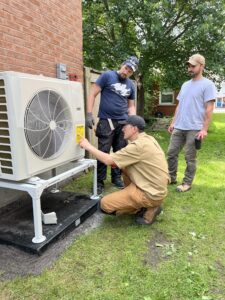
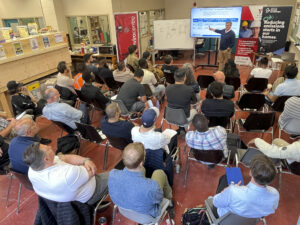
From there, RAMP ran through three deliberate phases. Recruitment brought organizers and contractor partners into Ottawa-area educational institutions to run information sessions and enroll cohorts, with applications reviewed alongside educators and accepted mentees signing on with required certifications in hand. Because deep energy retrofits fundamentally change how a building behaves, thermally and structurally, building science training came next: after researching several delivery formats, the team settled on the Canadian Home Builders Association’s online Advanced Building Science course, required of every mentee and contractor technician before fieldwork began, with as many attempts as needed to pass. Icebreaker events followed, giving mentors, mentees, contractors and trainers a chance to meet and review building science fundamentals together before the real work started. The field work itself, the phase every mentee actually showed up for, ran two to four days per cohort, with small teams tackling building envelope insulation and air sealing, converting fossil-fuel mechanical systems to heat pumps, or fabricating and installing passive house exterior panels, alongside career-focused sessions on the real barriers to entering the trades.
The Baysville sessions added something the Ottawa cohort didn’t have: mentees were bussed from Ottawa to Huntsville and housed for a full week, with meals and lodging covered, group activities built in for cohesion, and time spent learning about the Algonquin-Muskoka region they were working in, including an arranged Indigenous storytelling and smudging ceremony as part of the program’s reconciliation efforts.

Not everything went as planned, and RAMP’s team treated that as part of the design rather than a failure to correct out of the program. An early partnership with a large provincial college stalled under the weight of its own administrative structure, leading to months of stuttered communication before RAMP pivoted to smaller, more nimble private and non-profit training partners instead, where communication proved faster and more direct. A second lesson came from mismatched expectations: some mentees, particularly in the insulation and air sealing cohort, many of them newcomers to Canada, came in hoping for a direct path to employment rather than the experiential program RAMP was actually built to be, which the team addressed by being clearer about what RAMP is and isn’t in later recruitment rounds. Then, in the middle of RAMP’s second Baysville session in March 2026, an overnight ice storm knocked out power to the entire factory, and the restaurant catering lunch for the day, with no clear timeline for when it would come back. The team scrambled a backup plan on the spot: an unused hotel conference room thirty minutes away, mentors driving in with hastily assembled slideshows, a frantic run for HDMI adapters that would actually work with the hotel’s ancient screens, and a new lunch order for twenty people. It wasn’t the hands-on, sawdust-filled day anyone had planned, but by all accounts it turned into a genuinely engaging one anyway.

The results back up the improvisation. Mentees at the Ottawa site reported 90% satisfaction overall, with 90% also saying their understanding of building science and retrofit principles improved significantly. Baysville mentees rated the program at 86% very satisfied, with strong marks across everything from transportation and lodging to mentor support. The most telling outcome wasn’t a survey number at all: two envelope-cohort mentees were hired directly by the insulation contractor they’d trained under, mechanical cohort mentees reported similar outcomes, and three Baysville mentees went on to work for EnviroCentre’s own retrofit programs and its EnviroCentre Build social enterprise.
A blackout at the factory didn’t end the lesson, it just moved it into a hotel conference room with borrowed cables and a scrambled lunch order. If that’s the kind of problem-solving 28 mentees walked away having watched up close, RAMP may have taught them more than the curriculum ever planned to.













