Urban Prescribed Grazing for Ecological Restoration Across Ontario Municipal Sites
Projects Sponsor

Delta Management Group is the leading sustainability, ESG and clean tech focused search firm in Canada. Delta is proud to have founded the Canada's Clean50 Award program in 2011, and has been the primary sponsor for the past 13 years.
Invasive plants and overgrown urban landscapes usually mean herbicides or heavy mowing equipment; Goats in the City brought in a different crew. The company’s prescribed grazing model uses managed goat herds, human Eco-Shepherds, portable fencing and GPS monitoring to restore difficult sites without chemicals or machinery. Since 2024, the model has cleared invasive plants and protected habitat for Toronto, Mississauga, the Ministry of Transportation, Waterloo Region, private landowners and even a cemetery. The most scalable land-care solution some sites need turns out to have four legs and a healthy appetite.
Steep slopes, wetland edges, sound barrier corridors and thickets of buckthorn and poison ivy are exactly the kind of terrain where a mower struggles and herbicide is unwelcome. Goats in the City set out to prove that a managed herd of goats, paired with trained handlers and real monitoring, could do that work instead, professionally and repeatably, not as a one-off public stunt. Since 2024, the model has supported sites for the City of Toronto, the City of Mississauga, the Ministry of Transportation, Waterloo Region, private landowners and cemetery operators, building a documented case that prescribed grazing belongs in a municipality’s actual land-management toolkit.
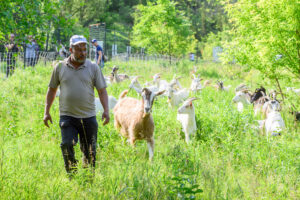
The problem was never really vegetation, it was credibility. Municipalities and land managers already knew mowing, brush cutting and herbicide treatment ran into trouble on steep slopes, in wetlands, along sound barrier corridors and in public parks where chemical use is unpopular or restricted. What they didn’t have was a professional-grade alternative. Goats in the City’s objective was never simply to bring goats to public spaces for the novelty of it; it was to build a managed ecological restoration model that could reduce invasive-plant pressure, support meadow and habitat management, protect pollinators and sensitive species, and earn public trust along the way. Central to that model is the relationship between the goats and their Eco-Shepherds, handlers who work the herd daily so the animals stay calm, familiar with people, and safe to guide in public-facing environments, which matters as much for safety as it does for the photo ops.
Before expanding, the team benchmarked prescribed grazing directly against conventional vegetation management, mapping where mowing, brush cutting and manual removal were difficult, expensive or environmentally sensitive, then studied how goats actually behave across different plants and seasons. Goats will apply strong browsing pressure to woody invasives like buckthorn and honeysuckle, but a herd is a living tool, not a machine, and the work only succeeds when it’s carefully timed to plant preference and site conditions. That research also surfaced something conventional land care doesn’t get: people stop to watch. Goats create a public-engagement opportunity that mowing crews never will, which turned out to matter just as much as the vegetation results themselves.
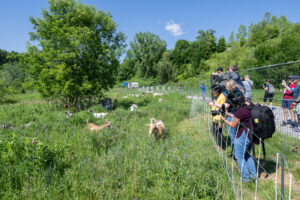
Getting from that research to a repeatable operation took building real infrastructure: temporary electric fencing, public safety fencing, water systems, signage, GPS-supported overnight monitoring and a site-specific grazing plan for every location. Each project starts with a site assessment, identifying target vegetation alongside anything that needs protecting, trees, pollinator plantings, young shrubs, which get fenced out or wrapped before a single goat arrives. The model proved itself first at Don Valley Brick Works Park, where the City of Toronto’s 2024 pilot grew into a full multi-year program running through 2029, using a rotational approach that grazes different meadow sections in sequence for genuine year-over-year comparison. In Mississauga, early 2024 work expanded into a formal multi-year prescribed grazing contract with two treatments per project area per year, part of the city’s broader invasive-species management strategy.
Once a site’s model was proven in the two flagship municipalities, Goats in the City expanded it well beyond the park gates. The herd now works MTO and Emcon sound barrier corridor lands wedged between concrete barriers and residential neighbourhoods, private large-acreage properties, a golf course, conservation land near Hamilton, the Waterloo Region Museum’s Doon Heritage Village, and Mount Pleasant Group cemetery sites, proof that a model built in two city parks could travel to terrain that has almost nothing in common with them.
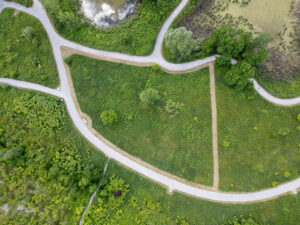
None of it happened without real friction. Goats draw crowds, which meant public safety needed layered solutions: double fencing where required, trained Eco-Shepherds on site, and GPS-supported monitoring for overnight stays. No two sites were dominated by the same weeds, so herd size, timing and fencing layout had to be matched individually every time rather than applied as a template. Protecting the plants clients wanted kept, milkweed, ornamentals, young trees, required constant attention, since a browsing herd doesn’t read a planting plan on its own. And proving the results to funders and award committees meant the project had to keep strengthening its own record-keeping around acres treated, grazing days, and before-and-after documentation, work that is still ongoing.
The documented results now back up the pitch. The Toronto and Mississauga municipal core alone represents roughly 8 acres of unique managed land and about 15 treated-equivalent acres of grazing activity between 2024 and 2026, with another 44 acres documented across MTO corridors, private properties, conservation land and cemetery sites. At a conservative 4 to 8 crew hours per acre for difficult invasive control, that Toronto and Mississauga work alone represents somewhere between 61 and 122 machine or crew hours of vegetation control replaced by goats instead. The City of Mississauga’s program went on to win the Lieutenant Governor’s Ontario Heritage Award for Excellence in Conservation, and Don Valley Brick Works Park drew more than 2,000 visitors a year while its 2024 pilot generated close to 143 media mentions and an estimated 139.5 million impressions, all of it reported as positive.
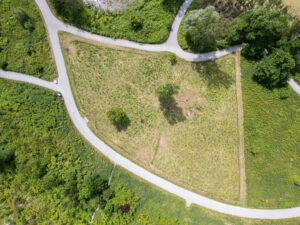
A goat, unlike a mower, stops to let people ask questions. That turned out to be the quiet advantage behind this whole project: restoration that used to happen invisibly behind a fence now happens in front of a crowd, and the crowd walks away having learned something about the weeds in their own backyard.













