Renewables own the future
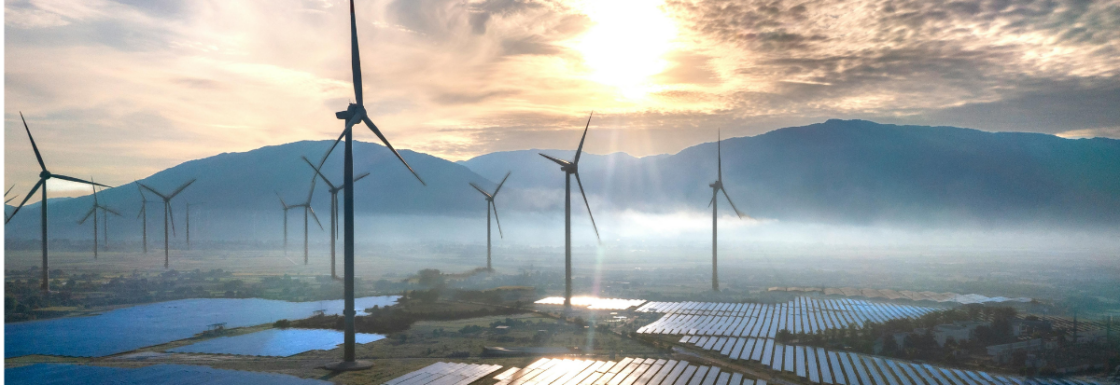

Will Canada become an energy superpower in this future?
Despite recent federal backtracks and the breaking of climate commitments in the name of oil and gas, Canada’s adoption of renewables hasn’t stopped, but its growth has not been steady, as wind and solar currently generate a modest 9% of our country’s electricity supply. Although Canada’s grid is already a relatively low-emission grid, thanks mostly to hydro, growing energy demand will require immediate planning and development of more sources; ideally, wind and solar.
In the past 10 years, Canadian renewable proliferation has ebbed and flowed from province to province, the ebbs inhibiting us from becoming a leader in the space and allowing more enthusiastic global powers across Asia, Europe and Latin America to reach the top in global solar, wind and battery development.
This article introduces a series that aims to contextualize renewable energy development in Canada. This first article offers some global and domestic context and foundational details of the industry’s Canadian proliferation, or lack thereof.
The series focuses on solar photovoltaic, wind and lithium-ion battery storage and will refer to only these three as “renewables” unless otherwise specified. The primary goal here is to gather synthesized knowledge of how renewables are developed in Canada from first-hand accounts, as well as barriers and opportunities. Hopefully, these articles can help provide a better understanding of where Canada is in the global race to switch to renewables and the process of these projects’ development.
The status of renewable energy deployment across Canada’s vast landscape depends on three main factors:
- Geography – One is less likely to stumble upon solar and wind farms where the sky is dark and the air is stagnant. Utility-scale wind, solar and storage projects depend on investors who expect an ROI that is worth their while. Insufficient fuel (wind and sun) will result in insufficient dividends.
- The Province and Territory – Constitutionally, these governments hold jurisdiction over electricity planning and operations, excluding nuclear. It is they who will ultimately decide if Canada is pushing forward or holding back.
- On whose land? – Renewables, like any other physical infrastructure, depend on land, and developers need access. This often requires complex deals and partnerships with rights holders and landowners.
Some of the provinces at a glance
Below is a brief look at the key provinces in Canadian renewable energy development and the politics that decide it.
In 2018, Ontario, because of Premier Doug Ford’s early austerity politics, spent hundreds of millions of dollars to cancel several utility wind and solar projects. After trying and failing to reduce hydro bills, working to develop more nuclear capacity and ramping up reliance on natural gas in the interim, the province has now re-opened its doors to utility-scale solar (12 projects), wind (2 projects) and storage development through the IESO (Independent Electricity System Operator). These projects require a minimum 50% Indigenous equity ownership structure. This round of IESO project procurement was not free of controversy, as the competitive process seemingly awarded gas power plants a substantial cost advantage. So, is the worst really behind us in Ontario?
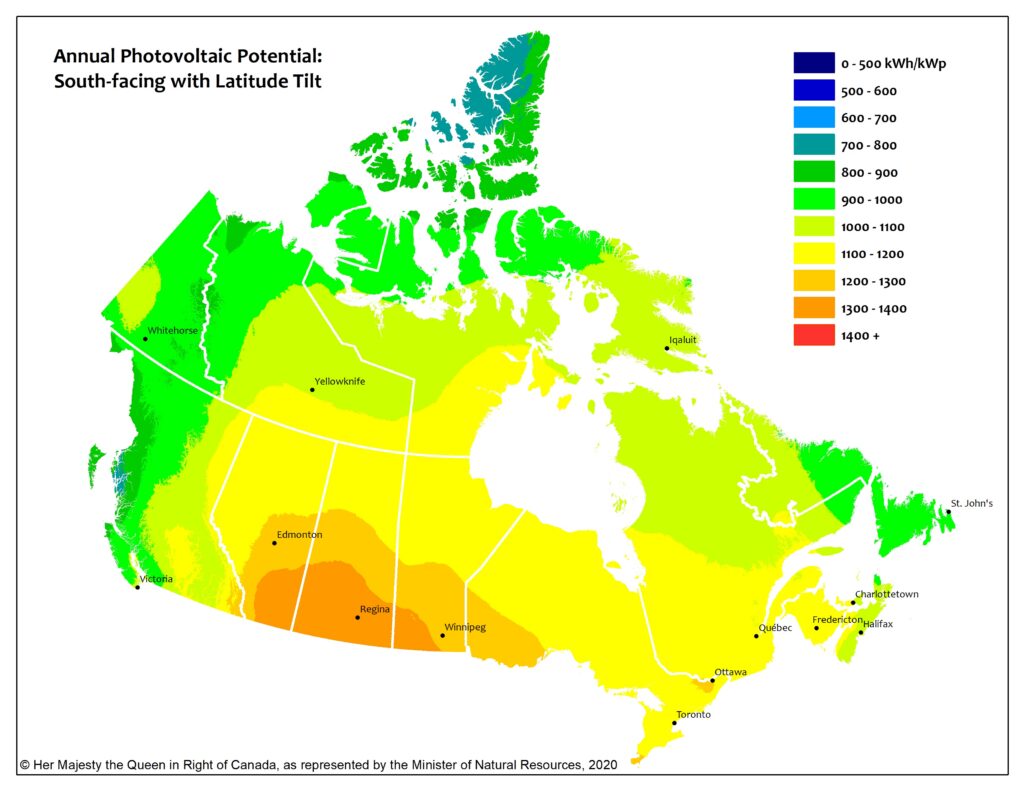
In 2023, Alberta’s newly elected United Conservative Party government introduced a 7-month utility-scale renewables moratorium and subsequent policies to, all but entirely, dismantle the industry. This moratorium resulted in the cancellation of $33 billion worth of projects at various stages of development. The loss hit investors, consumers, and workers, with an estimated loss of 24,000 job-years of employment (according to a Pembina Institute study). Alberta, once a leader in utility-scale renewable energy development, now faces plummeting investments. With existing solar buildout and its status as the second-sunniest province in the country, Alberta could be positioned as Canada’s renewable superpower, but that title is now on hold as Premier Danielle Smith is doing everything in her power to preserve the province’s sunsetting oil and gas industry.
Ironically, the two provinces with the greatest geographical potential to benefit from solar and wind energy combined are the two most invested in maintaining the status quo.
Saskatchewan’s premier Scott Moe is committed to two things: derailing the province’s coal phase-out timeline and eventually replacing it with nuclear. Moe’s insistence on depriving his constituents of the cheapest sources of energy and maintaining its status as the dirtiest grid in the country has gone so far as to get in on Smith and Ford’s proposed plans to develop an inter-provincial oil pipeline. At this point, it seems safe to assume that the renewables industry will continue to retreat from investment in Alberta and Saskatchewan, absent a different ideological bent at the top.
Annual Photovoltaic Potential Across Canada
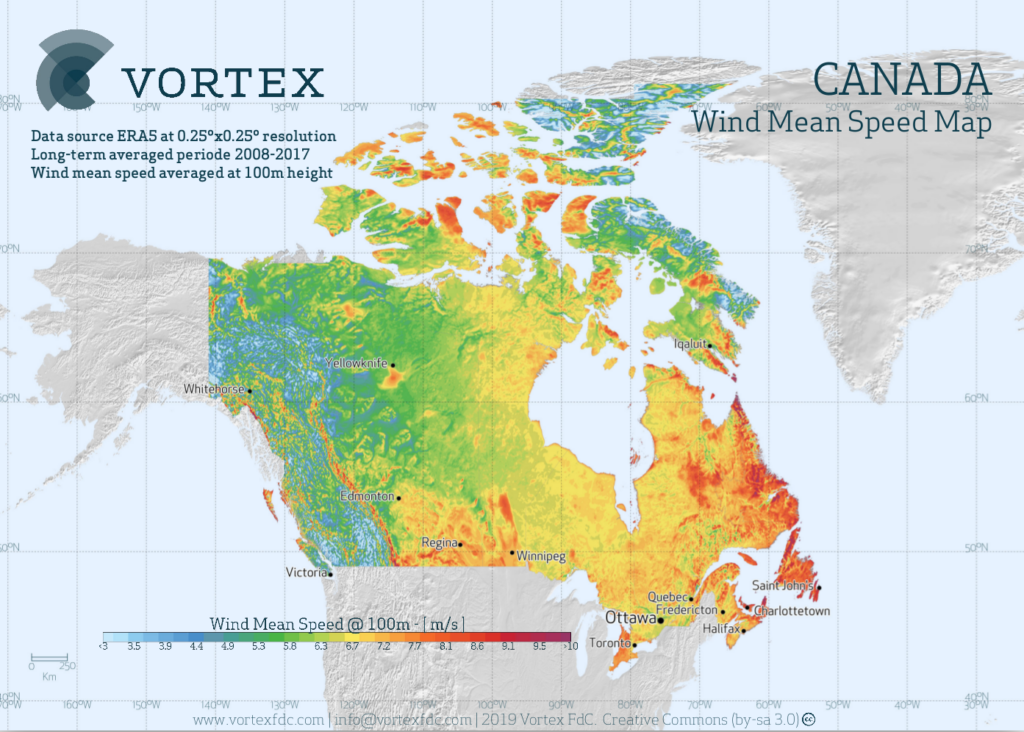
As Alberta has fallen back, Nova Scotia has stepped up. Nova Scotia, one of Canada’s 3 provinces still relying on coal to generate electricity, is aggressively decarbonizing its grid and attracting investors to build the future of renewables. Premier Houston is pushing the province’s coal phase-out and inviting investors to harness the province’s offshore wind and tidal energy potential. The Nova Scotian grid decarbonization strategy is diverse and will require significant investments in transmission infrastructure alongside the estimated 1.8GW+ of power from wind and solar by 2030.
Quebec, like most others, is facing a growing electricity demand. To meet this demand, the province is prioritizing wind and solar for cost-effective and rapid development of over 30GW by 2050 alongside more hydro for long-term projects. Premiers Christine Fréchette and Tony Wakehame (Quebec and Newfoundland and Labrador, respectively) have recently come to an agreement to come to an agreement. At stake, a 10 GW deal for further hydro and wind development across both jurisdictions. The federal government seems to have accelerated (some say prematurely) the news of the hopefully pending agreement. This came shortly after the cancellation of the EV mandate and as Liberal candidates face numerous questions about pipelines in by-elections. Many questions, including Indigenous involvement and consultation, remain unanswered.
British Columbia and Premier David Eby are burning the candle at both ends. Eby has enthusiastically endorsed and defended the federal government’s plans to ramp up natural gas (LNG) exports, arguing it’s an economic no-brainer. And he has enthusiastically advocated for renewable developments for British Columbians. Like Quebec, the hydro-rich province plans on expanding hydroelectricity alongside battery storage. The province will also rely on immediate solar and wind development, with its 2024 and 2025 Calls for Power securing 14 wind and solar projects (with 51% First Nations equity ownership).
Why Wind, Solar and Batteries?
Other than the obvious climate and economic poly-crises fuelled by the oil and gas industry, here are a few reasons why the people are pushing for more renewable development, and if they’re not, why they should be.
There’s no time like the present
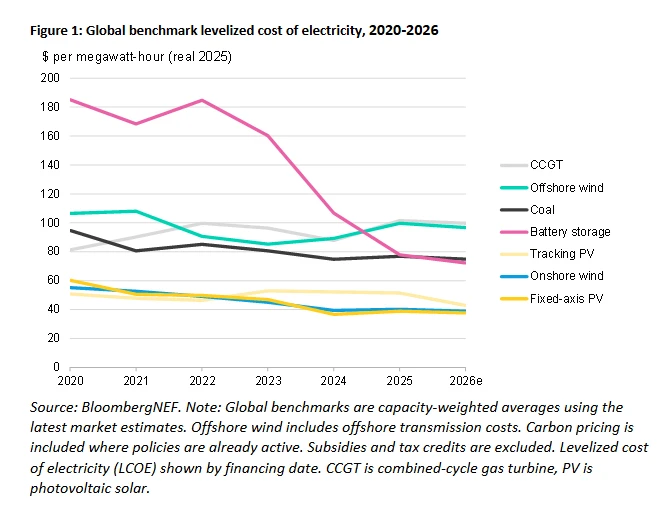
Solar panel and battery storage prices have plummeted, a drop like what wind turbines had in the mid-2000s. The cost of solar panels has fallen over 90% since 2000, from ~$7.5/watt to $0.25/watt today (USD). Despite an increase in the price of labour and other materials, it is now significantly less expensive to develop new solar projects globally. This has made solar more lucrative and has become the obvious choice for most in increasing supply for global electrification. Similarly, the cost of batteries has declined by 99% since 1990, from just over $9,000/kWh to $78/kWh (USD). Asia has reaped the most from this trend as solar has now become the continent’s third-largest energy source, surpassing gas this spring. In fact, renewables, including hydro and bioenergy, have surpassed gas in global electricity generation.
The graph below shows a comparison of renewable and non-renewable price trends per MWh. CCGT represents natural gas (gray line). Levelized cost of electricity (LCOE) accounts for the entire lifetime of the asset (capital to build, operating, maintenance, and financing costs).
Cost of Electricity by Generation Type: Bloomberg NEF
The Cost of Nuclear
Many governments and institutions that would like to keep our energy centralized and its owners wealthy have proclaimed that nuclear is the answer to a low-carbon grid. But what leaders like Ford and Moe often choose to de-prioritize when it comes to nuclear development is the economic cost. According to a June 2026 report from Environmental Defence, Ontario’s nuclear development is resulting in an electricity supply cost of $168/MWh; a renewable path would carry a $114/MWh price tag. The cost of nuclear spans far beyond its monetary price: “When you factor in uranium mining, radioactive waste, accident risks, water use, [harms to aquatic life,] thermal pollution, proliferation risks, and the centuries-long burden passed to future generations, nuclear energy becomes far from the “clean” solution it’s marketed to be” (Friends of the Earth, 2024).
Renewables = Freedom?
Utility-scale solar, wind and storage development sits at an opportune time for consumers and governments. Provinces that pursue significant growth in renewables now will experience benefits that far exceed the electricity generation itself. Renewables offer independence from the increasingly volatile relationship with the U.S. and its international actions. For many in Australia and California, significant solar adoption has resulted in free electricity, a scheme that would be impossible if the fuel itself were not free.
What’s next?
Building from this global and domestic context, the next article in this series will narrow down its focus on utility-scale renewable development in Canada. It will include first-hand accounts from Canadian renewables developers and their insights on the future of the industry. Future articles over the next few weeks will explore smaller and rooftop projects, and the barriers and opportunities for both.
About the Author
Carolina is a graduate student at York University in the Master of Environmental Studies program, studying renewable energy transitions and institutional decarbonization. She is particularly interested in the socioeconomic drivers, benefits, consequences, and retreats from renewable energy adoption, where she intends to build her career.