Shout from the Rooftop with Me – Uniting on Climate Change

As climate impacts intensify and global temperature thresholds draw closer, Laura S. Lynes contends that Canada’s greatest barrier to effective climate action is not a lack of technology or resources but fragmented governance. She argues that siloed policies and competitive funding structures divide mitigation, adaptation, and disaster risk reduction efforts, preventing the coordinated response required for a complex and interconnected crisis. Proposing a cross-ministerial climate resilience committee within the Prime Minister’s Office, Laura makes the case that embedding climate considerations across federal decision-making would signal the scale of the challenge and foster greater cooperation. Framing climate resilience as foundational infrastructure for economic stability and public safety, she calls for an integrated, “all hands-on the same deck” approach to confronting the climate crisis.
Climate Change Is the Crisis Beneath the Crisis
It is time for Canadians to unite on the monster challenges our country is facing, but not just the ones making headlines. Simmering beneath the surface of our acute geopolitical shocks is the overarching problem of climate change that will only get worse if we don’t take adequate action soon.
Accelerating climate change is blanketing the globe causing life threatening impacts that exacerbate every other challenge we face. Everything is made more difficult in excessive heat, drought, back-to-back wildfires and floods, and super-charged storms that some communities may never recover from. The science is clear this acceleration is because greenhouse gas (GHG) emissions[1] are increasing at a rate that exceeds Earth’s ability to mitigate through natural systems. Biodiversity is in rapid decline, the rate at which species are becoming extinct is staggering,[2] and year after year heat records are being broken while acute and slow-onset disasters are causing mayhem in communities–from explosive wildfires to back-to-back droughts. The term ‘unprecedented’ is losing its meaning.
It is commonly known that to avoid catastrophic impacts we need to reduce the amount of GHGs being released into the atmosphere. It is also widely understood that humans have developed adequate technology to address climate change, and that the Earth has enough raw materials to completely shift the globe’s energy system to fuel a cleaner, more sustainable way of life.[3]
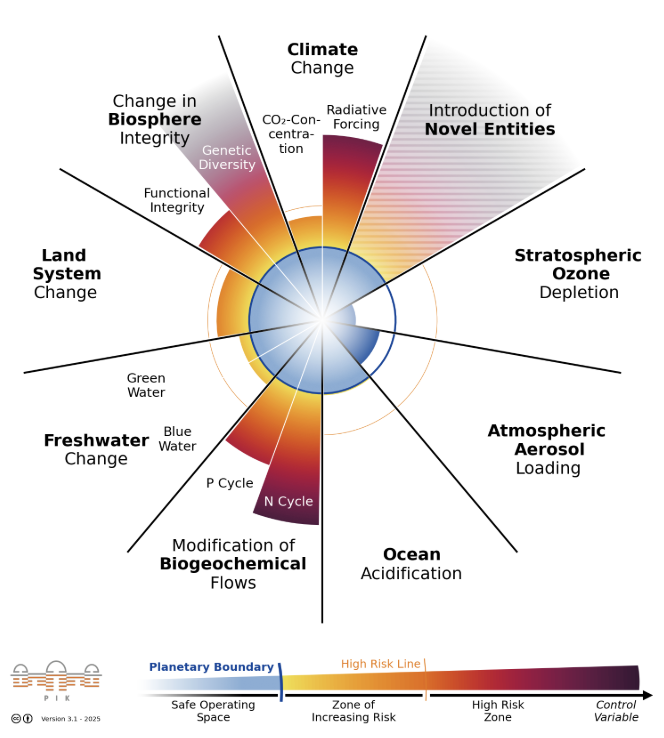
Yet here we are. Seven of the nine planetary boundaries have been breached,[4] the 1.5 °C threshold is unavoidable[5], and we’re tracking for a 2-3 °C global warming by the end of the Century.
Failing to adequately address the impacts of climate change will not only destroy our ways of life on the homefront– it will be a global moral travesty.
The Fragmented Climate Response
For the most part, daily routines continue – most people carry on, oblivious to the hazards they face from accelerating climate change, while others in complete awareness of the risks, benefit from business as usual. Then there’s the relatively few of us who are shouting from the roof tops – to either stop making the climate problem worse (mitigation), or to help minimize the pain from climate impacts (adaptation). The problem is we’re shouting from different roof tops.
We need to come together.
One of the greatest obstacles to adequately addressing climate change is the siloed approach. This isn’t just a Canada complex; climate strategies are often found embedded in different ministries and funding mechanisms across the globe. The siloed approach ensures that neither the root causes nor the symptoms of climate change can be adequately addressed, and paves the way for competition and polarization, neither of which are conducive to dealing with a multi-sector, socially and economically destabilising global challenge like climate change. For example, communities, academia, not-for-profits, and even related industries are competing against each other for inadequate amounts of funding in the form of grants, contributions, and awards that prioritize one approach over the other – all within the context of an arsenal of misinformation, deceit and manipulation by those who benefit from inaction on climate change.
A Climate Resilience Strategy for Canada
Canada needs an interconnected approach to climate resilience that enables better cooperation.
Imagine an overarching, explicitly named committee in the Prime Minister’s office that helped to ensure climate matters were embedded in all ministries. Something like “Climate Resilient Canada” along the lines of the Priorities, Planning and Strategy committee, and the National Security Council. Like incident response and natural security, climate resilience is not a “nice to have,” it is a necessary condition for life: for healthy economies and people, secure and prospering natural and built infrastructure, breathable air, drinkable water, and safety on all fronts. A cross-cutting climate committee combined with fit-for-purpose financial investment in the trillions (yes, trillions) would also send a strong signal to Canadians of just how critical the climate crisis is.
My work falls mostly in the adaptation camp, but I was recently reminded of just how interwoven climate change solutions are. For nearly two years I had the privilege of volunteering alongside 76 other experts from around the world on developing a set of adaptation indicators to advance the Global Goals on Adaptation (GGA)[6] Our work together highlighted the importance of adaptation that is inclusive, locally relevant, transparent and that helps to deliver meaningful impact for communities and ecosystems facing climate risks (which is the whole world!). But it also was impossible to agree on indicators without talking about climate financing, mitigation, disaster risk reduction strategies, and means of implementation.
As we enter what will likely be another “hottest year on Earth,” perhaps resolving the wicked problems of climate change will come easier if we think of ourselves as a dynamic network of adaptation, mitigation, and disaster risk reduction experts and organizations working together towards a climate safe world.
We can be sure that the consequences of climate change will be expressed across the country in interconnected, complex, and terrifying ways for the foreseeable future. Addressing this multifaceted problem requires an “all hands-on (the same) deck” approach.
Laura is the President / CEO of The Resilience Institute, a Canadian charity dedicated to minimizing the suffering from climate impacts.
End Notes:
[1] IPCC, 2023, A.1
[2] United Nations, 2024
[3] Crownhart, 2023
[4] Potsdam Institute for Climate Impact Research, Planetary Health Check, 2025, https://www.planetaryhealthcheck.org/#reports-section
[5] Berkeley Earth, Global Temperature Report 2024
[6] Under the UAE–Belém work programme of the United Nations Framework Convention on Climate Change (UNFCCC)