The Carbon Removal Problem Is Bigger Than Any One Solution. Canada’s Answer Is the Ocean.
As the gap between contracted carbon removal and delivered carbon removal widens, Mike Kelland, Co-Founder and CEO of Planetary Technologies and a 2027 Clean50 and Clean16 honouree, argues that the lesson is not that any single pathway has failed, but that permanent carbon removal is one of the hardest industrial problems humanity has taken on. Drawing on the latest UN Emissions Gap Report, Mike makes the case that meeting climate targets requires every durable removal pathway scaling at once, and that the ocean, where Canada now leads the world in verified deliveries, is the pathway with the most room to run.
Net zero has a second half
Every credible pathway to limiting warming has two components. The first is the one we talk about: cutting emissions as fast and as deep as possible. No amount of carbon removal replaces that work. The second component is the one we talk about less: removing carbon dioxide that is already in the atmosphere, and storing it permanently.
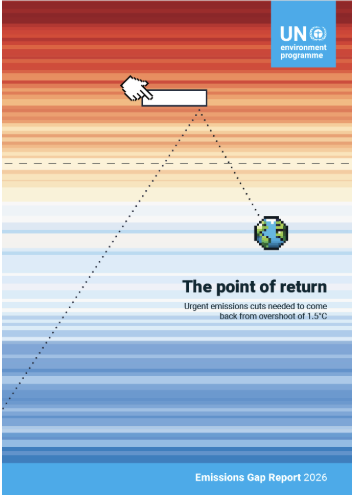
The second half is not optional. Some emissions cannot be eliminated at any realistic cost on any realistic timeline. Long-haul aviation, shipping, cement, steel, and agriculture will still be emitting in 2050. As the UN Environment Programme puts it in its new Emissions Gap Report, any remaining emissions at net zero must be balanced through CO2 removal. Every residual tonne needs a removed tonne to match it.
This year’s report, subtitled “The point of return,” goes further. UNEP concludes that overshooting 1.5°C is now unavoidable, and that the best remaining pathway peaks at 1.7 to 1.8°C and returns to 1.5°C by 2100 only through the removal and permanent sequestration of roughly 320 billion tonnes of CO2 over the course of this century. Each 0.1°C of overshoot we reverse costs about 220 billion tonnes of removals, and every five years of emissions at current levels adds another 200 billion tonnes to the ledger. The IPCC’s own 1.5°C pathways put cumulative removals as high as 1,000 billion tonnes this century. The numbers differ by scenario. The conclusion does not: removal at the scale of hundreds of gigatonnes is now written into every path back to a safe climate.
For context, total verified deliveries of durable carbon removal to date, across every engineered pathway on every registry, amount to a rounding error on a rounding error of that requirement. This is not a demand problem. Buyers like Frontier, Microsoft, and major airlines have contracted millions of tonnes. It is a delivery problem.
This is one of the hardest problems we have ever taken on
UNEP is candid about the difficulty. The report describes our ability to remove CO2 at these scales as uncertain, citing the socioeconomic and technological challenges of scaling removal measures and technologies. In its scorecard of global progress indicators, technological CO2 removal is one of the few lines marked with a question mark: the sector is too young for progress to be rated at all.
The early experience of direct air capture shows why. DAC is elegant in concept and backed by capable teams and serious capital, and it has a role to play in the portfolio. It is also attacking the problem on its hardest setting. CO2 makes up 0.04 per cent of air, and separating a gas that dilute takes enormous amounts of energy, sorbents, and machinery, followed by wells to store the result. The flagship facility in Iceland delivered a net removal of roughly 105 tonnes in its first year, and the most advanced large-scale project in the United States now implies costs around US$600 per tonne. None of that is a failure of effort or integrity. It is a measure of how hard this problem is, and a warning against betting the planet on any single approach.
That is the real lesson of the past five years of carbon removal: we need the whole portfolio. Forests and soils, biochar, enhanced rock weathering, bioenergy with carbon capture, direct air capture, and the ocean all have different costs, different durabilities, and different ceilings. Closing a gap measured in hundreds of gigatonnes will take all of them scaling at once, with the heaviest loads carried by the pathways that can reach the largest scales at the lowest costs. Which brings us to the largest carbon sink on Earth.
The ocean belongs in the portfolio
There is a carbon removal system that has operated at planetary scale for millions of years. When rain weathers alkaline rock, the resulting alkalinity flows to the ocean, where it converts dissolved CO2 into stable bicarbonate, the same benign ion found in baking soda, and locks it away for ten thousand years or more. The ocean already holds dozens of times more carbon in this form than the atmosphere does.
Ocean alkalinity enhancement (OAE) accelerates this natural process. By adding measured quantities of alkaline minerals to seawater, often through existing coastal infrastructure such as power plant outfalls, we increase the ocean’s capacity to absorb atmospheric CO2 and store it durably, while locally counteracting ocean acidification.
The engineering profile is what makes OAE a candidate for the heavy lifting. It requires no capture machinery, no energy-intensive separation, and no injection wells. Its inputs are among the most abundant minerals on Earth, and much of its infrastructure already exists. That is why its cost curve points somewhere the capital-intensive pathways have not yet reached, toward the double digits per tonne at scale.
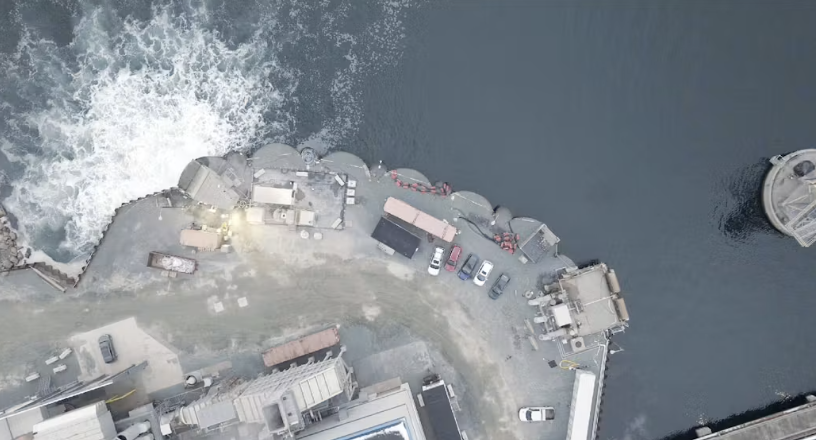
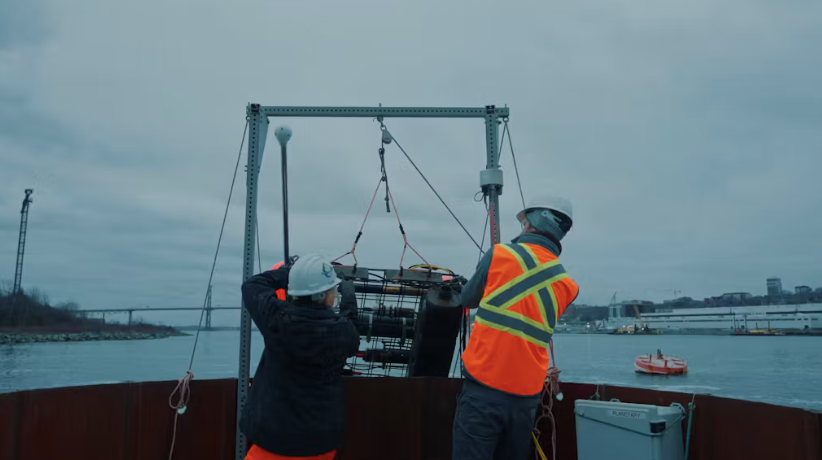
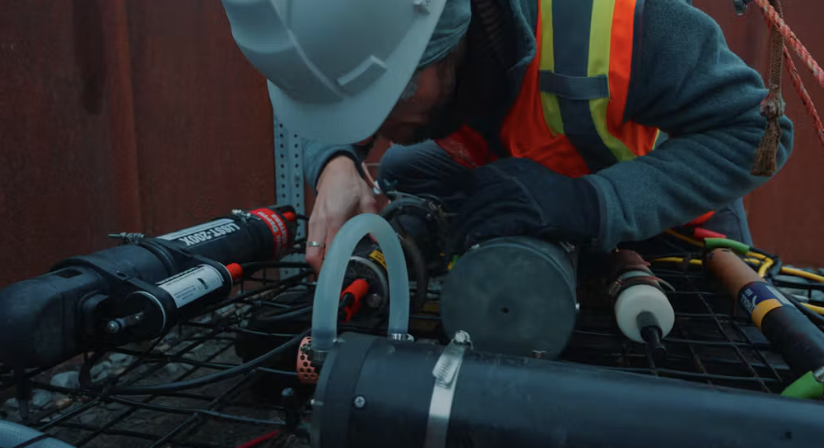
Skeptics reasonably ask whether removal in a dynamic ocean can be measured. It can. In 2025, the first independently verified OAE credits in the world were issued: 625 tonnes generated in Halifax Harbour and delivered to British Airways, Shopify, and Stripe, the first verified credits from any marine carbon removal pathway. The verification combined high-resolution ocean modelling with real-world measurement under a dedicated registry protocol, with conservative discounts applied for uncertainty. Marine carbon removal is no longer unmeasurable. It is measured.
Canada leads the world, and few Canadians know it
That first verification happened at Tufts Cove, Nova Scotia, and it was just the start. Canadian OAE operations have now delivered more than 8,000 tonnes of verified, permanent carbon removal to the registry, more than four times what the entire global direct air capture industry has delivered to date. The demand side has responded in kind: Frontier, the advance market commitment backed by Stripe, Google, Shopify, Meta, and McKinsey, has signed a US$31.3 million offtake for 115,211 tonnes of OAE removals through 2030, one of the strongest demand signals any Canadian climate technology has received.
Consider what Canada brings to this pathway: the world’s longest coastline, abundant alkaline mineral resources, established mining and marine industries, strong environmental regulators, and coastal communities with deep working relationships with the ocean. In a big-tent industry, different countries will anchor different pathways. The United States and Iceland lead in direct air capture. The Nordic countries lead in bioenergy with carbon capture. Canada leads in the ocean, and that lead is an industrial asset we should treat as one.
What comes next
Three things would turn an early lead into a lasting one. First, a clear statement that coastal projects fit within Canada’s sovereign laws and environmental protections, so projects proceed under rigorous oversight rather than regulatory ambiguity. Second, federal procurement: Canada has committed to purchasing carbon removal for government operations, and directing a meaningful share toward domestically verified ocean-based removals would anchor demand at home while supporting the broader portfolio. Third, honesty in how we talk about removal: contracted tonnes are promises, and only verified, delivered tonnes cool the planet.
The Emissions Gap Report’s subtitle is “The point of return,” and that framing is the right one. The question is no longer whether the world overshoots 1.5°C. It is how far we overshoot, and how fast we come back. Coming back means removing hundreds of billions of tonnes of carbon dioxide, permanently, using every pathway humanity can bring to scale. The problem is big enough for all of us. The ocean is the biggest tool we have barely begun to use, and Canada is proving, tonne by verified tonne, that it works.