The Missing Architecture of Agricultural Sustainability

Canada’s agriculture sector has no shortage of promising ideas, committed farmers and sustainability funding, so why do so many of the same challenges persist? Tori Waugh, Co-founder and Executive Director of The Ontario Soil Network, argues that lasting change depends on how well the pieces fit together. Drawing on her work with farmers and partners across the sector, Tori explains why pilots, programs and incentives work best when they are connected, and why farmers should be involved as co-developers from the start. She makes the case for stronger coordination across research, policy, markets and finance, and a systems-level approach that helps promising ideas become lasting change.
Canada has promising ideas, committed farmers, research, technology and sustainability funding galore – but without interconnectivity there is no lasting change.
Agriculture is an innovative industry. Farmers are constantly improving their practices, researchers are developing new knowledge, entrepreneurs are building technologies, governments are investing in programs, and businesses are improving the environmental and general performance of their supply chains. There is a tonne of energy and investment going into innovation and sustainability, yet many of the challenges facing the sector are the same ones we were trying to solve for decades. Across the industry, we’ve become really good at developing promising ideas and demonstrating new approaches, but the challenge is that we’re often hitting the target and missing the point.
We’re very good at starting things.
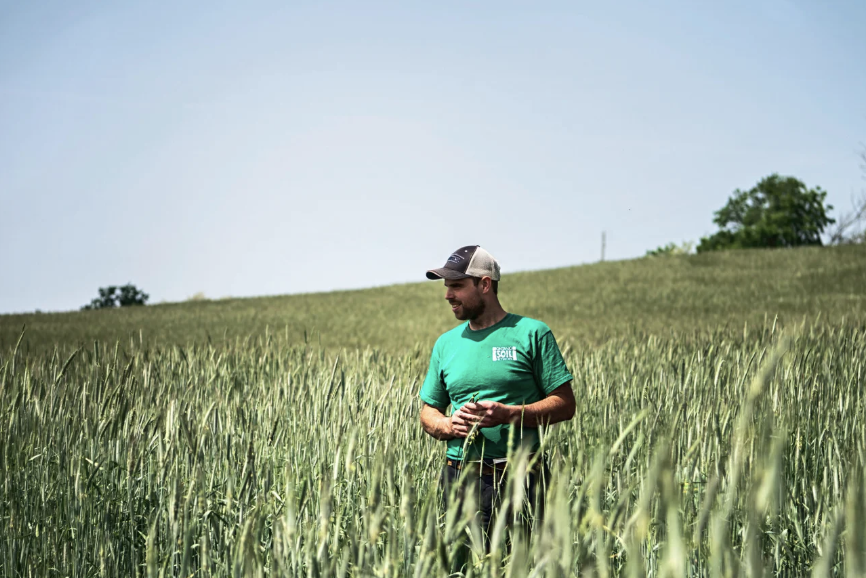
Across the sector, there is no shortage of pilots, demonstration projects, research initiatives, and technology trials, and they are valuable and contribute meaningfully to our understanding of what is possible. But a lot of these innovation and research projects are incented to take a “build it and they will come” approach to innovation adoption. This work is too valuable to leave our success up to chance.
From companies with circular economy solutions failing to make sales because farmers won’t buy their amendment, to robotics companies developing equipment with a battery that lasts only a fraction of a farmer’s day, to researchers with valuable work that only other researchers ever hear about – the common thread to these impact issues is farmer engagement.
What if we stopped treating farmers as recipients, and started treating them as co-developers, innovators and essential actors in the theory of change we invest in when we invest in sustainability and innovation? We need to become much more deliberate about asking what needs to be true for an idea to work and keep working, who will carry it forward and what will remain in place once the original project has run its course. We need to both support and require meaningful farmer engagement. Not token advisory committees and programs open to single farmers, but long-standing, network-building, democratic processes that harness the spectrum of operation types and scales and believe in farmers’ competence and capacity for innovation.
We can’t transform agriculture one program at a time.
Research, financing, policy, market incentives, infrastructure and farmer engagement are frequently designed and delivered through separate initiatives, each with its own people, objectives, timelines and measures of success. As a result, we invest in individual pieces of a much larger puzzle without truly understanding how they need to fit together.
To a certain degree, we have to be building the plane as we fly it and we shouldn’t let perfect be the enemy of good, but programs working in isolation mean our analyses and strategies are built – in the best cases – in consultation, yet still not in conversation with one another. This leaves gaps and missed opportunities, creates openings for redundancy and inefficiencies, and impairs our ability to evaluate our progress – and that’s the low hanging fruit.
These gaps become particularly consequential when interventions encounter the realities of concentrated markets and geographically constrained supply chains, where farmers may have little negotiating power or ability to capture the value of the changes they are being asked to make. Effective implementation requires understanding these interdependencies from the outset, designing interventions around the broader economic and institutional environment in which they will operate, and coordinating the different actors whose decisions ultimately determine whether an intervention succeeds.
The institutions with the greatest capacity to influence markets, mobilize investment and coordinate change therefore have to navigate their own organizational constraints, competing priorities and incentives to preserve existing terms. Making meaningful progress requires an honest assessment of these dynamics including existing antagonizers to change or where resistance to change is likely to emerge and what forms of leadership, accountability and collaboration are needed to overcome it.
We can’t buy our way to sustainable agriculture.
Money matters, of course. Farmers need access to capital, transition support and markets that recognize the value of environmental outcomes, while research, extension, infrastructure and innovation all require sustained investment. The question is how we organize that investment to address the conditions influencing decisions on the farm.
A farmer considering a new management practice is weighing the economics of their operation, the time and labour involved, the equipment they have, the condition of their soils, the weather, the markets they sell into, the risks they are prepared to take, and how much they’re willing to get an earful at the coffee shop. A payment may help address some of those considerations but is known to produce weak results past the initial trial stages of adoption. The barriers to sustained adoption require trusted agronomic advice, reliable markets, better information, peer learning, institutional and operational change and longer-term financial commitments.

It’s easy to see that farmers need more than an isolated financial incentive to reduce their nitrogen rates when their trusted advisors are incentivized to advise them to do otherwise, they carry an average $1.3M in debt and the only strategy that feels like control is to maximize yield – even at the expense of profitability. We’re often looking to farmers to change what they’re doing and solve the problem.
We’re often not looking at this change as a systems change, so we’re not thinking of the ways that market concentration and business as usual will impede that change. It is reasonably harder to implement such intersectional programming and policies to orchestrate the cohesive landscape of supports needed for farmers amongst so many involved supporters, but I don’t think we have too many cooks in this kitchen.
Sustainability at scale is a coordination problem.
No single organization can solve agricultural sustainability, because the work depends on farmers making management decisions, researchers generating evidence, governments shaping policy and investing in public goods, businesses influencing markets and supply chains, financial institutions providing capital, and nonprofits and networks creating opportunities for learning and collective action. Each of these groups has a legitimate role, but they don’t necessarily share the same priorities, timelines or definitions of success.

The challenge facing agricultural sustainability is as much about how we organize ourselves as it is about the solutions we develop. Too often, we fund individual interventions without examining the economic structures, market dynamics and institutional incentives that reproduce the problems we are trying to solve. We underestimate the influence of concentrated markets and entrenched business models, while mistaking program targets and growing participation for meaningful progress. And we too often engage farmers after priorities have been set and solutions designed, missing the opportunity to draw on their experience from the outset.
Making progress requires a more coordinated, systems-level approach. We must define the long-term outcomes we want, work backwards to identify the policy, market, financial and institutional conditions required to achieve them, and confront the incentives and power structures that stand in the way. Farmers must be partners in defining problems, developing solutions and evaluating results, while governments, businesses, researchers and organizations take shared responsibility for turning promising initiatives into lasting change. Ultimately, success will depend on our ability to move beyond funding projects and start building the architecture that allows an entire system to change.