Why Deep Retrofits Should Anchor Canada’s Next Federal Climate Platform

Canada’s climate plans risk moving too slowly unless they focus on the buildings we already live and work in. Emma Norton argues that deep retrofits—holistic, whole-building upgrades—should anchor the next federal climate platform because they cut emissions quickly, create jobs, lower energy bills, improve health, and ease pressure on the electricity grid. Unlike incremental efficiency programs, deep retrofits treat buildings as integrated systems, unlocking far greater economic and social returns. With the technology ready and millions of buildings still locking in emissions, Norton contends the real gap is political will to make deep retrofits a national climate-emergency mission.
We face a climate emergency but many of the proposed solutions are too slow to implement, narrow in focus, or politically fragile to gain large public support.
Deep retrofits of existing buildings provide a strong launch pad for a federal climate emergency plan because they are shovel-ready, create jobs, and benefit the entire economy. Deep retrofits are not a single policy lever. They not only create jobs, but reduce emissions, lower household and business costs, and ease the decarbonization of the electricity system.
The “buildings” problem in Canada, and around the world, is enormous. Even if every new construction project meets Net Zero standards starting today, we would still need to retrofit the majority of Canada’s buildings, otherwise we will be locked into the carbon emissions and energy they currently need to operate. Given this, we would need to retrofit 10 million buildings by 2050 to achieve Canada’s climate goals.[1] Unfortunately, these goals don’t go far enough according to climate scientists, which means we should be aiming to retrofit those buildings even sooner than 2050 – think 2040 or 2035.[2]
At our current rate, it would take more than a century to retrofit all 10 million buildings, which is why we need political leadership to accelerate the deep retrofit industry.[3]
A deep retrofit is a holistic upgrade to a home or building that reduces energy use and greenhouse gas emissions, improves air quality, and increases the resiliency of a building. It often includes upgrades to the building’s insulation, air tightness, heating and cooling systems, and air ventilation system. A deep retrofit aims for at least a 50% reduction in energy use and maximum cost-effective carbon reductions.
Currently, most retrofit programs focus on energy efficiency alone and take an incremental approach to improving the buildings, leaving energy and carbon savings left on the table. Canada’s Green Homes Program provided 605,000 homes with energy efficiency upgrades, but just under 5% of those could be considered a deep energy retrofit.[4]
A key point, often overlooked in discussions about building upgrades, is the difference between a deep energy retrofit and a deep retrofit. Although the terms are frequently used interchangeably, they are not the same. A deep energy retrofit implies that energy performance was the singular focus of the project. In contrast, a deep retrofit is intentionally holistic in scope.
By using a broader lens, deep retrofits ensure that homes and buildings are not only more efficient, but also healthier, more durable, and better suited for a low-carbon future.
Continued investment into incremental retrofits will make deep retrofits more challenging and expensive to accomplish. There are a few reasons for this. The incremental programs often focus on mechanical solutions like installing heat pumps, but if a heat pump is installed before the heat loss in a building’s walls has been addressed, the heat pump will now be wasting heat. It also won’t function properly due to oversizing if those same heat loss issues are later addressed. Further, the incremental programs focus on upgrades with short financial payback. By splitting short-payback measures like heat pumps and lighting upgrades from longer-payback measures such as insulation and envelope improvements, we weaken the business case for undertaking a full deep retrofit. A better strategy is to structure retrofit programs around a phased, whole-building approach, ensuring all components work together and the long-term benefits are captured.The political case for deep retrofits as a launchpad for a climate emergency platform is strongly supported by the same statistics that support investing in energy efficiency:
- Deep retrofits will directly impact everyone in Canada because we spend 80-90% of our time inside buildings, while most other climate policies directly impact only part of Canada’s population.
- Every million invested in “a whole-building energy retrofit” creates 9.5 jobs, more than any other industry.[5]
- For every dollar invested into energy efficiency, $4-$7 will be generated for Canada’s GDP.[6],[7]
- Deep retrofits will reduce household energy insecurity for the 2.1 million energy-poor households in Canada, which lowers energy poverty and in turn, demand for income supports, emergency assistance, and housing interventions.[8]
- Health improvements from warmer, better-ventilated homes reduce pressure on healthcare systems, particularly for respiratory and cardiovascular illnesses.
- There is increasing research to demonstrate that super efficient buildings are more fire safe.[9]
A deep retrofit cuts energy use, improves air quality, lowers costs, and increases safety. . A deep retrofit also plays a critical role in transforming our entire energy system.
As we transition away from fossil fuels, more of our energy use is shifting to electricity. Cars, buses, heat pumps, and industrial systems that used to run on gasoline or natural gas are increasingly powered by the electricity grid. This is a necessary shift but it increases pressure on Canada’s electricity system. Even though about 80% of Canada’s electricity is already renewable, our current generation capacity is not enough to meet the projected surge in clean electricity demand over the coming decades.
Deep retrofits play a critical role in easing this transition. By reducing the energy needs of buildings before electrifying them, we avoid unnecessary strain on the grid. National modelling shows that deep retrofits completed before electrification reduce building electricity demand by about 50 TWh.[10] In contrast, if electrification happens without deep retrofits, electricity demand is expected to rise sharply due to heating loads and vehicle charging.[11] Sustainability Solutions Group and RMI found that combining envelope upgrades with heat pump electrification can reduce winter peak demand by up to 25%, a necessary consideration for system reliability.[12] This avoids billions of dollars in new generation and transmission investments. As researchers Brendan Haley and Ralph Torrie describe, deep efficiency measures “redirect electrons to their most important use” by reducing waste and allowing Canada to reach 100% renewable electricity more affordably and more quickly.[13]
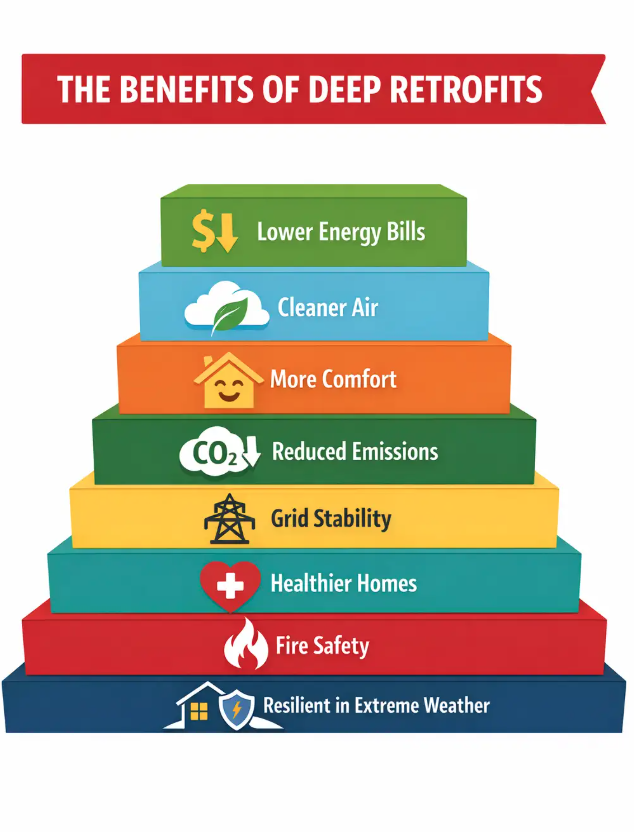
Deep retrofits are a foundational climate strategy hiding in plain sight. They touch every household, every business, every community, and they unlock benefits far beyond emissions reductions. They lower energy bills, strengthen our electricity grid, improve public health, create thousands of good jobs, and make our buildings safer, comfortable to work and live, and more resilient in a world defined by worsening climate extremes. Unlike many climate policies that are slow or abstract, deep retrofits are concrete, visible, and shovel-ready. We already have the technologies, the workforce can be rapidly scaled, and the need is undeniable. What we lack is political will and a coordinated national mission that treats retrofitting 10 million buildings as the climate-emergency priority it is—a central pillar of Canada’s climate response. If we choose to lead with deep retrofits, we can accelerate decarbonization, protect people where they live and work, and build an economy and energy system that are genuinely prepared for the future. This is the kind of bold, practical, and people-centred climate action Canada needs right now.
End Notes
[1] https://www.canada.ca/en/innovation-science-economic-development/news/2024/07/government-of-canadas-new-canada-green-buildings-strategy-to-help-canadians-save-money-on-their-energy-bills.html
[2]https://climateactiontracker.org/countries/canada/#:~:text=Canada’s%20international%20public%20climate%20finance,commitments%20to%20increase%20climate%20finance.
[3] https://deepenergyretrofits.ca/wp-content/uploads/2024/06/RetrofittingCanadasHomes_Final.pdf
[4] https://www.pembina.org/op-ed/canadas-retrofit-momentum-hinges-more-just-heat-pumps
[5] https://www.pembina.org/programs/buildings
[6] Energy Efficiency: The Made-in-Canada Resource, p.6
[7] https://www.pembina.org/programs/buildings
[8] Making Net-Zero Retrofits Work for Energy-Poor Households, p. 4
[9] https://www.passivehousecanada.com/when-wildfire-risk-becomes-routine-designing-homes-for-climate-resilience/
[10] Efficiency Canada, Canada’s Climate Retrofit Mission, 2021
[11] https://www.cer-rec.gc.ca/en/data-analysis/canada-energy-future/2023/results/#:~:text=Total%20energy%20use%20in%20the,zero%20and%20Current%20Measures%20scenarios.
[12] Sustainability Solutions Group/RMI, 2023
[13] Efficiency Canada, Canada’s Climate Retrofit Mission, 2021