Presentation to BuildGreen Atlantic Conference
Canada’s Clean Economy Is Hiding in Plain Sight…
People sometimes see me on the Clean50 stage, speaking off-the-cuff about incoming honourees or projects, and assume I do big audience public speaking all the time. I don’t. The Clean50 Summit is my happy place, the best day of each year – and that room feels like my tribe. Most of my other public speaking engagements are much smaller: university students, young professionals, covering sustainability careers, climate, that sort of thing.
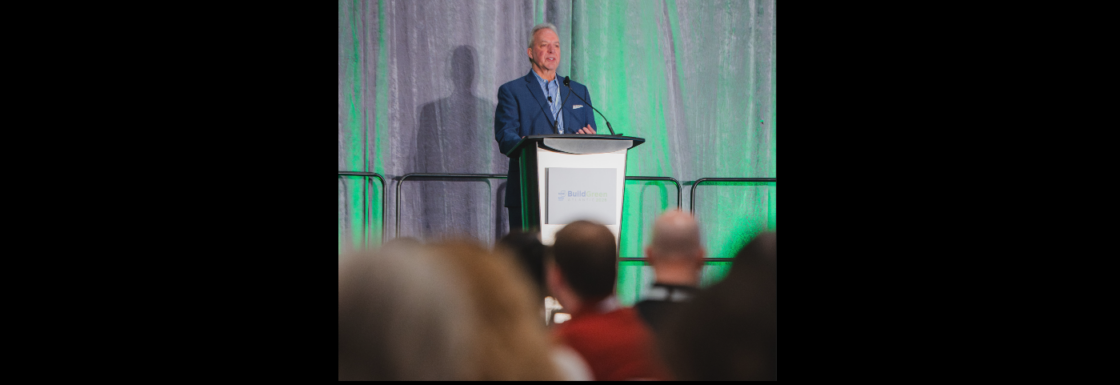
So when one of last year’s winners suggested me for a keynote at BuildGreen Atlantic, (500 people – and a football field sized room), I (gulp) accepted, but with some trepidation — because while it was outside of my comfort zone, there was an important message I really wanted to share.
Bright and early April 28th, I spoke for 27 minutes, feeling prepared, but speaking off-the-cuff. As I spoke, I noticed lots of people taking pictures of the slides, but I didn’t feel much enthusiasm coming back. I got only a single question at the end. So I was disheartened and pretty sure I had bombed.
It turns out I had completely misread the room. (this isn’t about me – I promise!)
I hadn’t bombed (SO much relief!) I learned later, through many messages and emails, that the audience was simply reacting in disbelief to what they heard.
Thanks to the Carney government’s drastically weakening support for climate action, the clean economy is measurably shrinking this year. This will impact thousands of jobs and has already started to do so.
Gavin Pitchford
The numbers I put in front of them simply did not match what many assumed about Canada’s economy. Over 95% of those in the room guessed oil made up 20+, 30+, even 60+% of Canada’s GDP. When they learned the direct petroleum industry number is only 3.4% — about 7% even if you accept the industry’s widest “trickle-down” claims — that’s when the disbelief started.
More disbelief followed when I pointed out just how small steel, aluminum, and auto sectors are compared to the “clean economy” – both the individual components (i.e. “clean tech”, “renewables”) and as a whole. Then (apparently) the audience fact-checked.
Canada’s clean economy is already over $140 billion in direct GDP, well over $200 billion including indirect impacts, and supports about 700,000 jobs. That makes it roughly 33 times the size of steel, 8.2 times the size of auto, and larger overall than the oil industry. Oil, by contrast, supports only about 150,000 jobs (down 3.6% last year and from 215,000 a decade ago, even as production rose 42%).
But here’s the thing: Canada’s clean economy relies on governments that value the environment and send clear signals that pollution will carry a cost. Take those signals away, and industry relaxes. Investment slows. The clean economy shrinks. The green builders in that room? Many are already feeling the slowdown. Thanks to the Carney government’s drastically weakening support for climate action, the clean economy is measurably shrinking this year. This will impact thousands of jobs and has already started to do so. One builder shared that, after years of struggling to find talent, suddenly his in-box is flooded with desirable resumes. Others spoke of shorter project backlogs and weakening demand. Anecdotal, sure, but not one person told me business was up…
Meanwhile, almost every other advanced economy, except the U.S.A., is doubling down on the clean economy. If Canada fails to match that effort, we risk ending up with stranded assets while missing the prosperity the clean economy can offer over the next 50 years.
So we have a clear choice. We can keep pandering to a declining, 100-year-old industry that amidst the Trump missteps is reaping massive profits, yet still asking for – and getting – yet more taxpayer support, while still leaving Canadians with an 99% unfunded estimated $260-billion cleanup bill for abandoned wells.
Or we can invest in the clean economy that is already bigger, already employs 4.5 times as many people, and is set to grow by 300% over the next 10 years.
Or, to put it more simply: we can skate to where the rest of the world already knows the puck has gone.
feel free to download and borrow parts of the presentation, but please credit me if you do so. All stats within it are derived from trusted sources – far and away the most common of which is StatsCan.