Wind Development in Canada
Onshore wind
The renewables discourse is full of misinformation.
Even after their big win in 2018, Wind Concerns Ontario (WCO) and similar groups continue to push that utility-scale wind projects engulf valuable agricultural land, take over rural communities, disrupt local ecosystems and are just not economically viable.
Actors interested in upholding the status quo and groups like WCO go to great lengths to produce and platform a lot of renewables misinformation. These lies, at best, foster doubt and, at worst, derail an entire green energy pathway and industry.
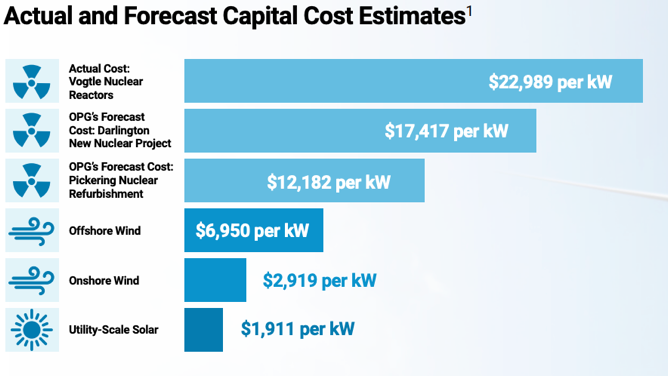
The truth is that renewables are being deployed right now, with battery backup, at a lower cost per kW than either gas or nuclear energy. Wind farms don’t overtake agricultural land or significantly disrupt local ecosystems; in fact, they are time and time again a net benefit to rural communities. A solar- and wind-dependent grid would be more reliable, suffer less downtime, be built faster, and have zero cost overruns or pesky 10,000-year half-life radiation issues.
Clean Air Alliance- High-Cost Nuclear vs. Wind and Solar (2025)
We’ve set out to look at the renewables industry in Canada through a series of articles reviewing small-scale solar (rooftop), large-scale wind and solar (aka utility-scale) and battery development. This multi-part series debuts in segments over the next few weeks with on-the-ground insights from developers/operators of all four forms of renewables in Canada. It explores the current circumstances and the barriers to faster adoption to understand how Canada can, hopefully, catch up to the rest of the world quickly!
See Part I- introduction to the series here; Part II – Onshore Wind – is below.
Let’s start at the beginning…
For developers, the first step is selecting a provincial electricity market where to focus their efforts. This is a key strategy decision as each province has separate and distinct electricity markets, policies and procurement activities. According to representatives from wind energy developer ABO Energy, the decision can be driven by provincial calls to power, grid availability, power prices, and suitable locations. Provinces can incentivize or disincentivize developers through procurement initiatives, easier or more flexible permitting processes, or future commitments to renewables that signal market strength.
Regulated and deregulated energy markets
In Canada, there are two types of energy generation markets: regulated and deregulated. While the electricity market in most provinces is governed by a central Electricity Systems Operator, which procures the electricity directly from the developer, Alberta, one of the three best provinces for wind and solar energy in Canada, has a deregulated market.
Deregulation applies to the energy market itself, project location and type, project power capacity, and rates of return. It’s not a total free-for-all; the Alberta Utilities Commission issues permits and licenses to operate energy projects. This includes considerations related to safety, environmental and design standards, stakeholder and landowner concerns, Indigenous consultation, and projects still undergo public consultation.
Although it is deregulated, provincial policy still shapes who develops what and where, as discussed below and as seen in the Premier’s recent move to require new gas power plants for any new data centre development.
In Alberta, large corporate offtakers (any business that enters an agreement to buy a portion of future electricity generated) drive electricity development by running processes to procure projects already under development. According to the Business Renewables Centre- Canada (BRC-C), these entities “supply the revenue price certainty and credit necessary to secure capital financing.” For large-scale projects, they sign long-term Power Purchase Agreements, committing to buy a specific volume tied to their electrical consumption, typically at fixed rates over a set period of time.
By participating, offtakers benefit both from the electricity purchased for consumption and carbon credits. Independent power producers, merchant developers and financial investors can be other market players that propel renewable energy development in Alberta’s market. The province can also trigger developments through procurement schemes, but has, unfortunately, abandoned this strategy when its last renewables procurement round was cancelled in 2019.
Put simply, renewable energy development in Alberta is triggered by private corporations seeking new electricity sources when starting or expanding their operations. The market determines how much (and what type) of energy generation gets built, unless the province gets in the way.
According to a Canadian wind developer with 25 years of experience, Alberta’s deregulation hasn’t made the wind energy market more or less lucrative; it simply works differently. It changes how profitability is realized, with greater variability of profit on electricity produced outside of long-term contracts.
Despite its market structure, corporate initiatives and interest in pursuing renewable development, wind energy has stalled in Alberta. This derailment is a market reaction to regulatory uncertainty that began with the cancellation of renewable procurement in 2019 and the 2023 moratorium on renewable development. The Pembina Institute, in its 2023 report, declared that the moratorium killed $33 billion in investments, $263 annual revenue for municipalities, and 24,000 job-years of employment. The market uncertainty has grown with subsequent proposed and finalized policies.
Jorden Dye, Director of BRC-C, provided valuable insights into the complexities of Alberta’s renewables market as it is today.
While several overlapping issues now restrict development areas, renewable development in the province is not prohibited. In 2027, the Alberta Electric System Operator is set to launch its Restructured Energy Market (REM). This will review, update, and/or replace the rules and regulations that have governed its energy market for 20 years. Its launch will provide answers to a lot of questions about the future of renewables in Alberta.
According to Dye, the political uncertainty and restrictions on development have put Alberta’s renewables industry at a global competitive disadvantage. Wind development has been particularly vulnerable, with zero wind projects coming online in 2025. Despite recent changes, many corporations have not cancelled their 2030 sustainability commitments, and many are still pursuing participation in renewable energy development to decarbonize their operations. The release of the REM and policy finalization will provide clarity to the market and hopefully begin its improvement, though forever changed.
Ontario’s energy market has a hybrid model, but its project development and generation markets are regulated. The province’s electricity project procurement process begins and ends with the IESO (Independent Electricity System Operator)- the Crown corporation in charge of the electricity system. The energy markets of British Columbia, Quebec, Saskatchewan, Manitoba, the Territories and the Atlantic provinces are fully regulated.
These regulated markets come with centralized planning. The provinces and their Crown corporations initiate the procurement process. Developers and owners of these projects sell their electricity directly to the Crown corporations that regulate them, who, in turn, sell the electricity to consumers large and small.
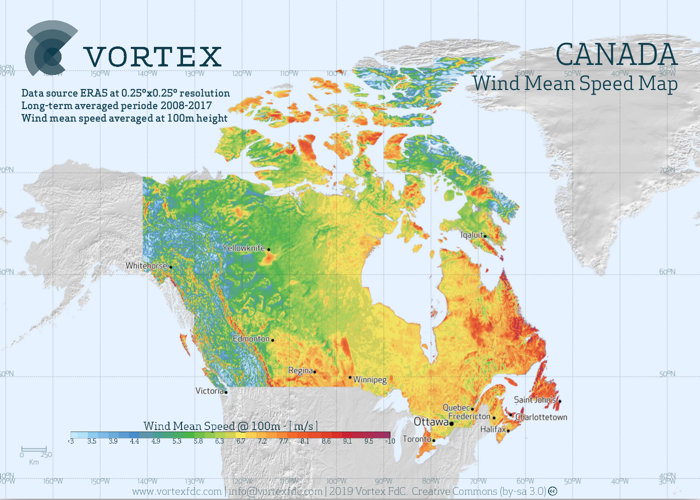
When selecting a province, developers might see Nova Scotia and Newfoundland and Labrador as ideal locations. NL is Canada’s windiest province (see image below), and its future for wind development seems bright. The province has recently prioritized wind-hydrogen production, selecting 4 projects proposed to generate thousands of MW each, alongside the proposed 2,000 MW wind project in Churchill Falls (a project that includes 2,700MW of new hydro) in partnership with Quebec and the federal government.
Nova Scotia is committed to decarbonizing its grid, and a key part of its strategy is both onshore and offshore wind. Canada currently has zero offshore wind capacity, but Nova Scotia could change this and benefit greatly. Offshore winds are stronger, and their wind farms are made up of larger turbines, resulting in more generation capacity than onshore projects. In 2024, the UK, the leader in global offshore wind, had an installed capacity of 16,000MW from 2,878 individual offshore turbines, while Ontario, Quebec, and Alberta (67% of Canada’s 19,000MW wind capacity) had a combined 13,100MW from 5,834 individual onshore turbines. In terms of Canadian home-powering potential, one offshore turbine can cover the electricity needs of up to 15,000 homes while its onshore alternative can power 1,000-3,000 homes annually.
Building out Nova Scotia offshore and onshore wind capacity will require significant investment, infrastructure and provincial commitment. Amidst the all-too-common Atlantic fog, the future of wind energy in Nova Scotia seems brighter than solar.
Canada’s Annual Average Wind Speed
Selecting the site
No two utility-scale wind projects are created equal. Typically, there is no more than 1 turbine per 80 acres due to spacing requirements between them. There are two main reasons for this. As the wind moves past the blades, it slows down, and wind turbines create a “wake” behind them; any turbine downwind of another should be far enough away for the wind to speed up again. The second reason is to avoid possible damage. The distance allows for any part of a blade that may chip off to fall before it hits a nearby turbine.
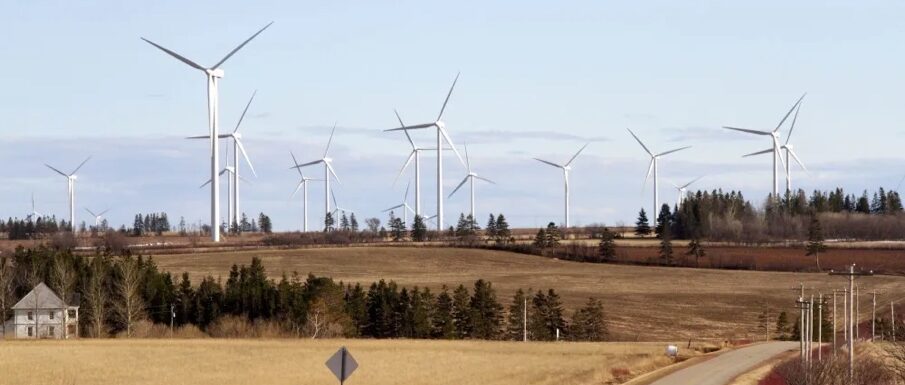
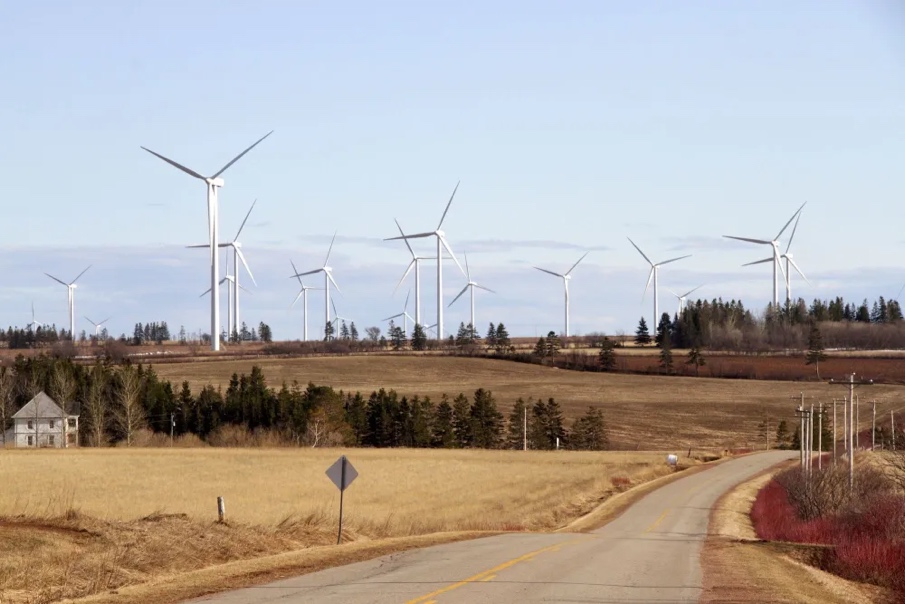
The actual footprint of an individual turbine is under 1 acre (~64×64 meters). If each turbine has a 6-8 MW generation capacity, a 100MW wind project will need between 14 and 17 turbines. Such a project would span 1,000 acres of land, but only 1-2% would be taken up by the turbines, with the remaining area open as shown in the image below. This setup is ideal for both agricultural and energy productivity.
Example of agrivoltaics in PEI
With the wind as the resource, developers need to make sure there is enough of it on site for the project to be worthwhile. While rural areas are prioritized, nearby existing electrical and road infrastructure is a major advantage and, as one of the interviewed developers noted, “the land needs to be constructable”.
The local environment is a significant deciding factor in how big the project can be and how long it will take to permit and construct it. Wind projects will undergo environmental assessments, with developers considering protected species and sensitive lands throughout.
A utility-scale wind project requires concrete foundations that can be 2.5-4 meters deep (depending on the size of the turbine). Roads capable of transporting heavy loads must be available, as must site capacity for underground cable networks and other electrical infrastructure, regardless of what is already nearby. Although developers and construction companies follow strict environmental regulations during construction and implement a wide range of mitigation measures to minimize impacts, these are major infrastructure projects that will change the land.
Investment breakdowns
Most often, investment depends on the developer. Banks, corporate offtakers and federal institutions like the Canada Infrastructure Bank often fill in the gaps as key players, integral to the project’s success and progression. Recently, projects in regulated markets have required Indigenous equity ownership partnerships. BC Hydro’s wind projects awarded under its 2024 and 2025 Calls for Power all included 51% First Nations equity ownership. In Ontario, the IESO’s LT-2 procurement considered wind and solar projects with at least 50% Indigenous equity ownership. Manitoba Hydro’s 2026 Call for Wind Power requires the procurement of projects with majority Indigenous ownership.
The Land
Securing the land for these projects starts early; the process is long and, since the projects are large, requires developer relationships across multiple rightsholders and landowners. If the project is to be on private land, negotiations and agreements are typically between developers and 20-50 individual landowners. The goal is a continuous land base, one area for one project.
Active negotiations between landowners can take 3-6 months and are typically conditional upon site testing and wind measurements. This two-step contract allows landowners to still benefit from on-site testing without requiring developers to go all in on the project without some guarantee of a site that will produce sufficient returns.
If the proposed projects are on a Crown land base, an application is submitted directly to the province, requiring Crown consultation with First Nations. In this case, developers will obtain temporary permits to start testing, the metrics of which will contribute to the Crown’s decision.
Once the land is conditionally secured, on-site wind data collection will begin. The data collected by meteorological towers will be analyzed to understand wind speeds, direction, and atmospheric conditions. This data is integral to determining site viability, calculating estimated power output and deciding where to place the turbines. This tech and its data analysis are essential to ensure the best possible project is developed.
According to ABO Energy, project design will typically evolve throughout the early development processes. From project concept to shovel in the ground, for Canada, it can be 4-6+ years.
Getting turbines on the land
Wind turbines are massive. In an earlier role as a renewable energy workshop facilitator and looking for a way to make sense of the scale for elementary school students, I’d ask a class of about 30 to line up, arms stretched, fingertip to fingertip. For 10-year-olds with an average wingspan of 1.5 meters, that line is roughly the length of a small blade. Students were always struck by its length and more, so when they learned we’d need to triple their line to measure from the ground to the very tip of that small blade. Those who had seen a turbine before had only seen it from a distance or a moving car, so this new perspective often left them starstruck.
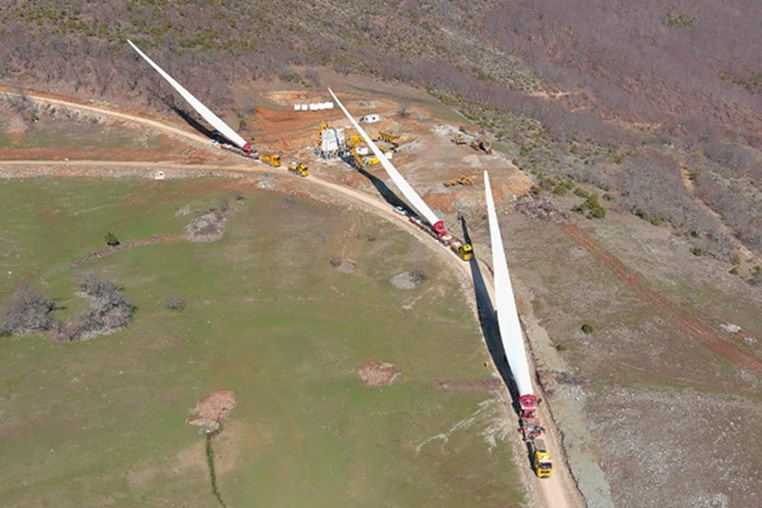
Given their size, shipping and transporting wind turbines is neither easy nor cheap. Transporting blades and towers depends on land and water routes, which makes solid road infrastructure essential for project access across the entire route.
Transporting wind turbine blades
A recently retired former Canadian executive in the wind technology industry provided some insight into the cost of these units. Like Costco’s model, bulk purchasing lowers the cost per unit. A single, unconnected onshore wind turbine can cost in the ballpark of $1-5 million, increasing depending on size and model and decreasing per unit depending on volume purchased.
Its three main parts, the tower, blades and nacelle (where the blades connect and electricity is generated), are most often manufactured separately, with companies like GE Vernova, Vestas, Siemens and Nordex selling the turbines as complete units or by their components. For a developer, the determining factors when choosing between turbine providers are price and performance.
According to the aforementioned Canadian wind developer with 25 years’ experience, the same turbine will perform differently on different sites with different wind regimes, so what might work well on a site in Ontario might not perform as well in BC.
Modelling exercises and data analysis are essential to determine which turbine is best for the project location. The goal, according to ABO Energy, is to select the most reliable turbine to maximize the levelized cost of energy (accounts for the entire lifetime of the asset, capital to build, operating, maintenance, and financing costs) and minimize environmental impacts.
Over time, turbines have become larger and more powerful, while maintaining the same 1-acre footprint, though they then require more space between them. Transporting their parts, particularly the blades, has become more challenging and costly, adding logistical complexity to the process. Turbine pricing varies by manufacturer and changes regularly. Since COVID and the U.S. tariffs, labour, material, and transportation costs have all increased but are not expected to deter developers from pursuing future projects.
The community and the politics of wind
ABO Energy on community resistance:
Any industry or technology change within a region or community will come with questions from local citizens, and it is the responsibility of the government to explain calls for power (as this attracts investment into said area). The responsibility of the developer is to be as open and transparent as possible to respond to these questions. This is no different than other industries such as mining, forestry, oil or gas. Some communities may not have experience yet with renewables, meaning that the developer will place a greater emphasis on education, including providing science-based information to dispel myths. A good developer will take time to listen and learn from those concerns and proactively work to mitigate as much as they can.
Throughout Canada, there have been waves of staunch community opposition to utility-scale wind projects, but nowhere as much as in Ontario. Ontario is the only province with a dedicated organized opposition group. “Wind Concerns Ontario”, among smaller opposition groups, played a significant role in Premier Doug Ford’s early derailment of renewables. Notably, Ford’s recently elected government spent $231 million to cancel its wind and solar projects, one of which (the White Pines Wind Farm) already had turbines in the ground and was close to commissioning.
At the community level, those who directly benefit from these projects and receive monthly or annual cheques from their existence are the landowners and municipalities. According to the Canadian wind developer:
Typically, landowners are excited to have a wind turbine on their land due to the new income source and revenue diversification they bring that they otherwise wouldn’t have. A wind turbine uses a very small amount of land- less than 1 acre per turbine. Wind projects are very good for local landowners- there are no other electricity generation projects where 50 landowners could get a cheque each year.
Wind projects can keep farming communities intact and our agricultural community in Canada strong.
Although they may not see a cheque signed by the developers and owners of the projects, wind also strengthens local communities. According to the BRC-C, in 2025, over $70 million in tax revenues were “paid to Alberta municipalities for solar and wind operations”. This municipal tax revenue is often much needed and sometimes one of its few sources of revenue. The revenue can reduce residents’ property taxes and fund a new community centre or pay for improvements to existing infrastructure.
Community sentiment is critical to wind developers because it can derail current and future development. As such, developers make significant efforts to build quality relationships with landowners and municipalities as well as provide education for the broader community. Consultation and engagement team members who work closely with Project Managers at ABO Energy prioritize early engagement, education and ample opportunities to receive stakeholder feedback on the project design.
It is important to mention and briefly discuss the main concerns that folks will cite when opposing a wind project: wildlife harm, habitat disruption, noise, and the view.
Wildlife harm
Wind turbines can kill birds but nowhere near as much as other human activities and cats. According to a study on a 20-turbine Nova Scotia wind farm, it saw 286 estimated bird deaths in its first year of operation from collisions with its turbines (2011). In its second year, bird deaths from the same farm plummeted to 29 after the farm made changes to its lighting. This is just one extreme example selected to demonstrate one of the many strategies to manage bird deaths. Of course, these numbers depend on location and migration corridors, but there are a multitude of strategies developers and owners employ to reduce or eliminate bird deaths before the project is developed. If a project is deemed to have unacceptably high mortalities, for example, it is often required to reduce activity from mortality-associated turbines during specific times of the year or day. This is just the tip of the iceberg, as there is a lot of work that goes into addressing the issue.
When compared to other power systems, a 2009 study found that wind farms are responsible for 0.3 bird deaths per GWh, while oil and gas power stations account for 5.2 fatalities per GWh. This does not account for the estimated 5,000 annual bird deaths from landing in abandoned tar sands tailings ponds.
Habitat disruption
As previously mentioned, wind farms need space, and if that space is not already sufficiently cleared of trees, the project will have a higher impact on habitats. The most permanent form of habitat loss comes from road development. Displacement of animals can also come from the presence of humans, increased vehicle traffic, and loud noises associated with construction, all of which are temporary or periodic activities. As previously discussed, developers and construction companies employ measures to minimize environmental impacts. Through careful planning, they can avoid sensitive areas, maintain buffer zones and at times restore damaged land.
Noise from wind turbines
Wind turbines do emit noise from the blades in motion and their generators, and some are bothered by it. Most provinces have strict noise emission regulations and, in accordance with the permitting process, developers are required to model noise emissions from the turbines. If, during the modelling, turbines exceed noise limits, their layout is adjusted. Developers will only move forward if the project layout is noise compliant. This takes a lot of time and effort to get right, and the project will continue to undergo post-construction noise measurements. Due largely to this effort, the height of the turbines and their design developments mean the noise goes largely unnoticed. I lived near a wind farm for 6 months and frequently checked in with my surroundings to see if I could hear the noise; I could not. Noise complaints are real and are taken seriously by turbine manufacturers, developers, operators, and provinces.
Cancer
Wind turbines do not cause cancer. Unlike nuclear power, this resource does not emit radiation.
The view
Likely the most cited concern of local wind development, wind turbines disturb the natural scenery. This is largely subjective but can represent a worry about change to one’s community and the feeling of losing tranquillity and peace. Most provinces require visual impact studies as part of the permitting process. This allows landowners and others to better picture the project in their community. Knowledge about the benefits of a local wind farm is key to subsiding concern, which is why developer-driven community education on the project is essential.
Construction & maintenance
Once permits are approved, contracts are signed, and roads are built, the construction and installation time can span 6-18 months. In this phase, foundations will be built alongside a substation and the necessary electrical wiring; turbine assembly itself could last as little as one week (weather and size dependent). After the project has passed necessary safety, performance and energy tests, it becomes commercially operational.
Wind farms bring very well-paying jobs. For its maintenance, a project will typically require about 1 Wind Technician per 3 turbines, plus 1-2 site managers and a substation manager, again, depending on its size. With proper training (most often electrician certifications), sometimes supported by the developer, these workers can come from within the community.
Upfront capital costs are high but operating costs are low, and a wind farm can operate at capacity for over 25 years before needing major upgrades.
The future
Canada currently has enough built wind energy capacity to generate 50,500 GWh (as it did in 2025). Along with solar, it represents just over 9% of Canada’s electricity mix.
The vast majority of our wind potential is untapped, and under the right conditions and with the right grid infrastructure, it could scale to meet all or most of our present needs.
Unlike hydro development, wind does not cause damage from flooding forests or wetlands.
Unlike nuclear, its waste is end-of-life blades, which can be repurposed into many uses- we don’t need to bury them under Lake Huron for the next 10 millennia.
So how do we get there? To conclude this week’s deep dive, I asked the Canadian wind developer (referred to as Developer) and ABO Energy a couple of questions about the future of renewables and wind in Canada.
What could policymakers do to encourage more renewables?
Developer: Ensure they’re putting in smart regulations. Not less, just smart ones. Smart rules for permitting regulatory environments, streamlining the permitting process and introducing more flexibility, prioritizing procurement of renewables, ensuring the industry can see a long-term procurement process. In this case, Ontario is good about announcing requests for proposals (RFPs) over multiple years that give industry a lot of runway.
ABO Energy: Standardized and streamlined regulatory and permitting requirements, streamlined and regular RFP processes, access to financing, grants and subsidies, government investment in and clear mandates for clean energy requirements.
What could communities do to champion more renewables?
Developer: Municipalities should continue to take a more active role in helping educate their community and work with developers to help with issues of misinformation. Ensure that developers are given the opportunity to communicate why it isn’t accurate.
ABO Energy: Local advocacy to encourage municipal regulations that are conducive to renewable energy development, and advocacy with other levels of government with respect to clean energy investment. Government must also be involved to help communities to champion renewables, including education and awareness campaigns to highlight benefits.
Final words
This article introduced the large-scale wind energy development process in Canada, and while it was a long one, it did not seek to cover every step in detail; that would be unreasonable for you, dear reader.
The next article in our Renewables Own the Future series will be a shorter piece on offshore wind development and will refer to this chapter when necessary.
A special thank you to the Canadian wind developer with 25 years of experience, the folks at ABO Energy, BRC-C Director Jorden Dye, and the recently retired wind tech executive who helped provide first-hand accounts and insights. For now, I will leave you with some words from the Developer:
When a wind developer comes knocking on the door of a community, they should open it and be open to learning more.