The Ocean Is Infrastructure. Canada Should Start Keeping the Books on It.
What if we treated the ocean like the vital infrastructure it is? Emily Charry Tissier, Co-founder and CEO of Whale Seeker and a 2027 Clean50 honouree, argues that Canada’s oceans underpin billions in economic activity, yet we do far too little to track and protect their health. Drawing on two decades of experience in marine monitoring, Emily explains how fragmented environmental data leaves us blind to the cumulative impacts of shipping, development, and climate change. With Canada beginning to account for the economic value of nature, she makes the case for treating ocean ecosystems like other critical infrastructure: regularly monitoring their condition, accounting for their value, and investing in their long-term health. She outlines practical steps to improve marine monitoring, hold developers accountable, and work with Indigenous governments to ensure Canada’s growing blue economy doesn’t come at the expense of the oceans it depends on.
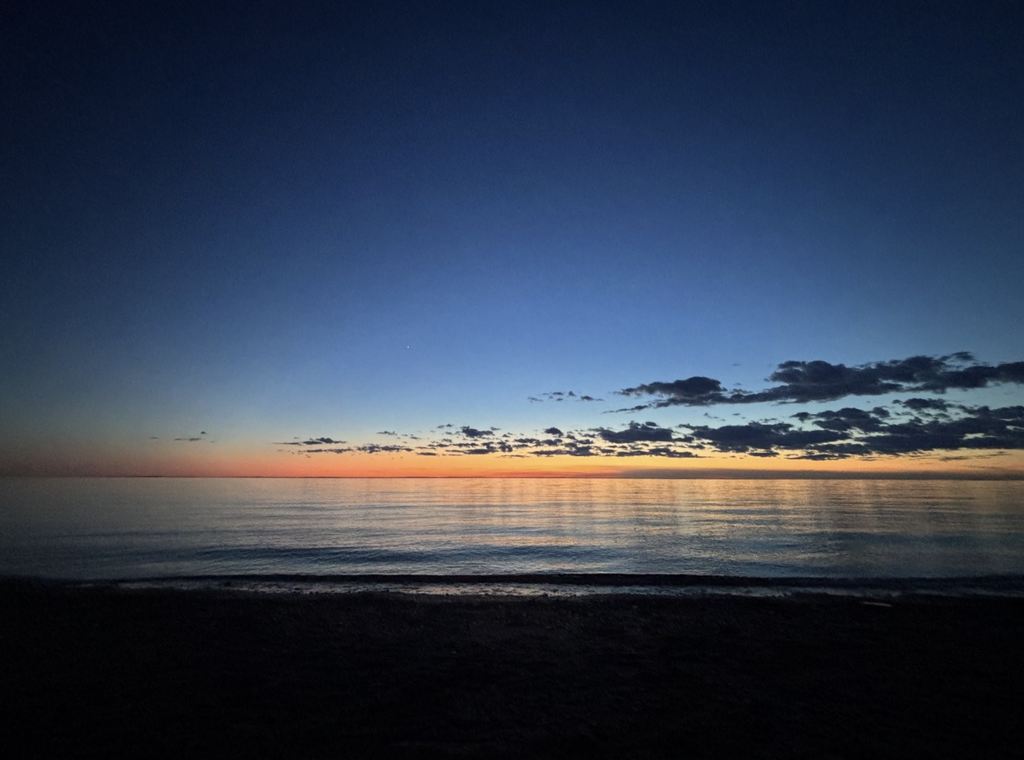
Photo: Emily Charry Tissier.
From my house in Rimouski I look out over the St. Lawrence estuary. It looks the same most mornings. It is not. In the deep waters of the lower estuary, below about 295 metres, oxygen levels have fallen by more than half since 1971, and those waters have been in a near permanent state of severe hypoxia since the mid 1980s. In 2023, their pH hit a record low. No one standing on the shore would know. You only know because someone has been measuring, year after year.
I have spent about 20 years working in coastal and Arctic waters, and that is the lesson I keep coming back to. What we measure consistently, we can manage. What we do not, we lose without noticing. Canada is now trying to put a value on nature. The ocean needs to be part of that, and the most useful way I know to think about it is as infrastructure.
What rides on the water
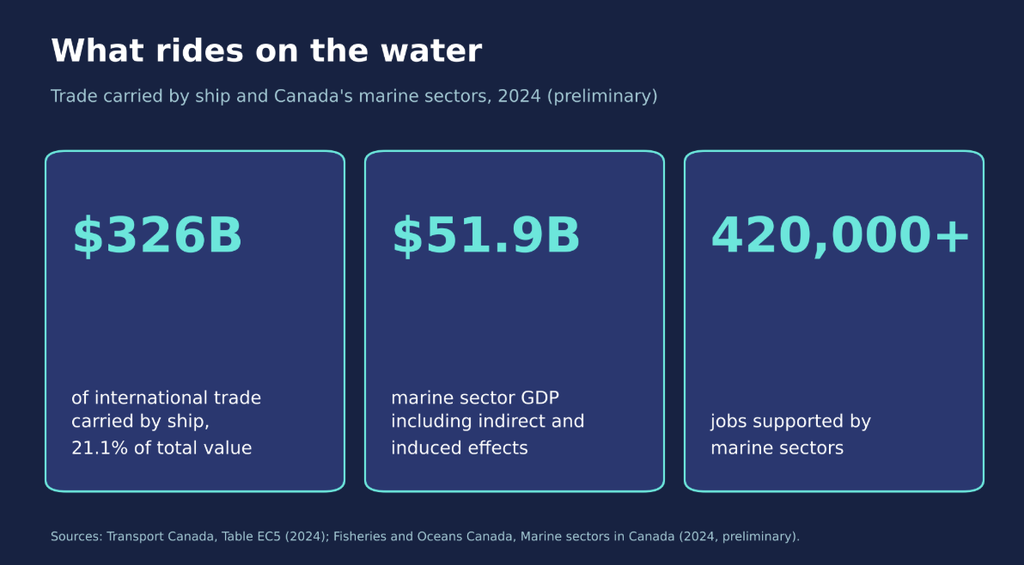
A lot depends on the water. In 2024, ships carried $326 billion of Canada’s international trade, 21.1% of its total value, according to Transport Canada. If a single bridge carried a fifth of Canada’s trade, we would know exactly what condition it was in. We would inspect it on a schedule, budget for its upkeep and report on it every year. For the ocean, we mostly do not. Fisheries and Oceans Canada’s preliminary figures put the marine economy at $51.9 billion in GDP once indirect and induced effects are counted, supporting more than 420,000 jobs. Those figures include offshore oil and gas as well as tourism, fishing and shipping, and they measure something very different from the ecological value of the ocean. But they make one point clearly: a large part of the economy assumes a working ocean, and ecological condition already shapes how that economy runs. In the Gulf of St. Lawrence, when a North Atlantic right whale is detected in a dynamic shipping zone, Transport Canada imposes a 10 knot speed limit on vessels longer than 13 metres for at least 15 days.
Graphic: Emily Charry Tissier. Data: Transport Canada, Table EC5; Fisheries and Oceans Canada, Marine sectors in Canada (2024, preliminary).
What is missing from the books
In January 2026, Statistics Canada published experimental values for selected ocean and coastal ecosystem services: $7.1 billion in 2023, mostly carbon sequestration ($5.5 billion, valued at the federal industrial carbon price), harvested wild fish and seafood ($1.2 billion) and nature based tourism ($458 million). It is a real step, and the agency is careful to say it covers only a subset of services. It reports a few condition indicators, but it does not value wildlife habitat or the condition of marine ecosystems, and its carbon estimates do not account for impacts from human disturbances.
To be fair, Canada does monitor its ocean. Federal impact assessments of major projects must describe baseline conditions, and approvals come with legally binding conditions that include follow up programs. Federal scientists track ocean conditions, as the estuary data shows. The Canadian Integrated Ocean Observing System was funded as an open access national system that brings ocean observations together and makes data discoverable. The problem is not that nothing is measured. It is that what we measure is fragmented: project by project, often in formats that cannot be compared or added up, and rarely connected to the accounts and budgets where decisions get made.
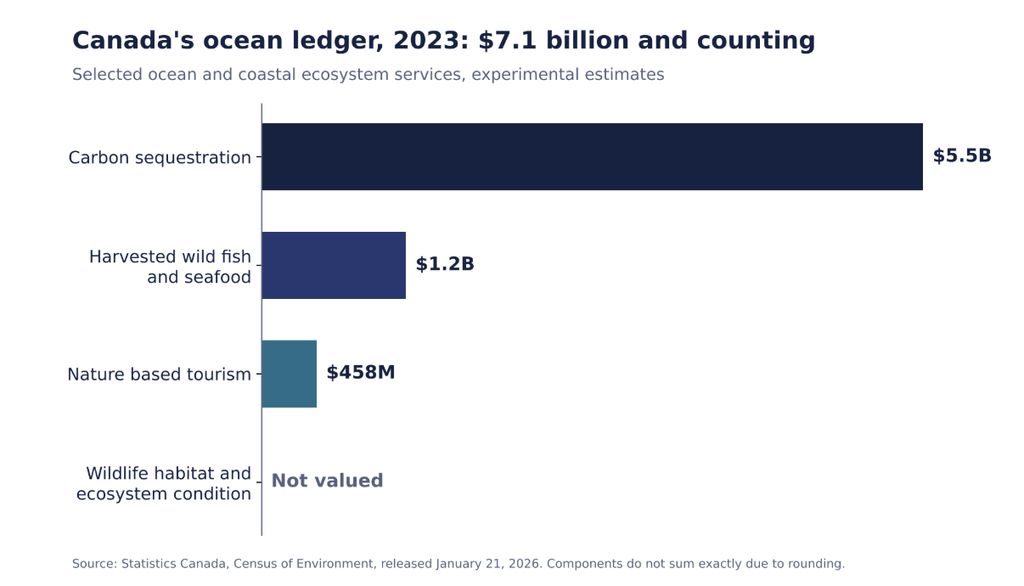
Chart: Emily Charry Tissier. Data: Statistics Canada, Census of Environment (January 2026).
Why infrastructure, and where the metaphor stops
Canadian municipalities have shown what happens when nature goes on the asset register. When the Town of Gibsons, B.C. inventoried its infrastructure, it counted an aquifer, creeks and ponds that manage stormwater, and a foreshore that protects against storm surge. It valued the stormwater services of one pond system at $3.5 to $4.0 million, the cost of replacing them with engineered systems, and now funds monitoring and maintenance of its natural assets in its budgets. That work grew into the Natural Assets Initiative, which reports working with more than 100 local governments, professional associations and other jurisdictions.
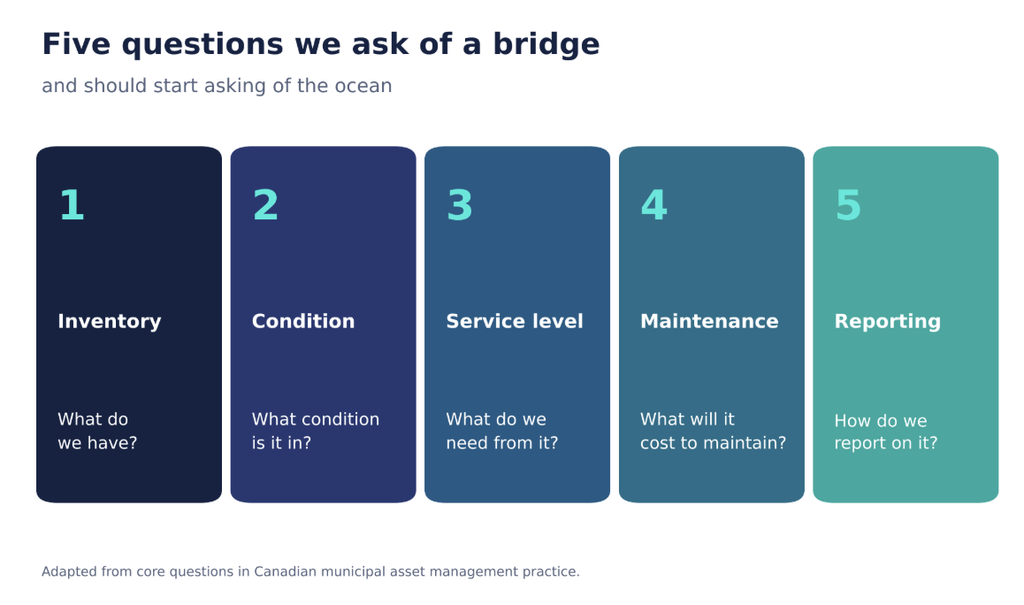
The ocean is not a town pond, and it is not a bridge. Nobody built it, there is no replacement cost, and you cannot schedule maintenance on a whale population. It does not exist to serve shipping, and many Indigenous Peoples would describe their relationship to it in very different terms. I use the infrastructure frame for a narrower reason: it is how governments decide what gets inventoried, monitored, budgeted and reported every year. Municipal asset management in Canada is built around a few core questions about each asset. Five matter most here. What do we have? What condition is it in? What level of service do we need from it? What will it cost to maintain? How do we report on it? For Canada’s ocean, the answer to most of them is “partly” or “not yet”.
Graphic: Emily Charry Tissier.
What I would ask for
A Force of Nature, Canada’s nature strategy released in March 2026, commits to designing infrastructure projects that work with nature and to valuing nature and mobilizing capital, noting that “Public funds alone will not suffice.” In August, the government launched an Expert Taskforce on Natural Capital Accounting and Nature Financing. At its first in person working session in October, members explored priority areas with an eye to opportunities that connect conservation outcomes with economic development, infrastructure investments and major projects. Four practical steps would help.
- Make marine baselines comparable and cumulative. Projects already collect baseline data. Canada should set common national methods so that data can be compared across projects and added up across a region, and require it to be published in open platforms such as the Canadian Integrated Ocean Observing System. The goal is to see the cumulative picture that no single assessment can.
- Make proponents pay for ongoing monitoring, not just the baseline. For major marine projects, condition monitoring should be a standing licence condition funded by the proponent for the life of the asset, the way we expect owners to inspect a bridge. In my experience, monitoring is too often funded as short term science that ends when the grant does.
- Build ocean condition into the national accounts. Statistics Canada is the natural home. Its accounts should grow from the services we can already price to the condition of marine ecosystems and the pressures on them, including warming, acidification, deoxygenation and fishing, alongside shipping and development. Only then can Canada see whether its blue capital is growing or being drawn down.
- Build it with Indigenous governments, on their terms. First Nations on all three coasts and Inuit already monitor and govern marine areas, and A Force of Nature commits more than $230 million to expand the Indigenous Guardians Program, including a new Arctic program. Baselines and monitoring should be designed with Indigenous governments and guardians, and Indigenous data should be governed by principles such as the First Nations principles of OCAP® (ownership, control, access and possession).
Photo: Emily Charry Tissier.
Why it matters
Canada is entering a decade of building: ports, energy terminals, northern corridors. Much of it runs through the water. If we account for the steel and concrete but not the ocean they rely on, we will keep learning the cost of a degraded marine environment the expensive way, through delays, conflict and lost licence to operate. And we will keep finding out, decades late, about changes like the ones in the water outside my window.
Full disclosure: I lead a company that works in marine monitoring, so I have a stake in this argument. I would rather say so than leave you to find out. The case stands or falls on its merits, and on whether Canada decides to put its ocean on the books.
Emily Charry Tissier is cofounder and CEO of Whale Seeker and a Canada’s Clean50 honouree.
Sources
Canada Water Agency, Deoxygenation and acidification in the St. Lawrence Estuary (December 2025). https://www.canada.ca/en/canada-water-agency/freshwater-ecosystem-initiatives/st-lawrence-river/publications/deoxygenation-acidification-st-lawrence-estuary.html
Transport Canada, Table EC5: Modal shares in Canada’s international trade, 2015 to 2024. https://tdih-cdit.tc.canada.ca/en/addendum-tables-2024/EC5
Fisheries and Oceans Canada, Marine sectors in Canada: GDP by sector, 2024. https://www.dfo-mpo.gc.ca/stats/maritime/tab/mar-tab3-eng.htm
Fisheries and Oceans Canada, Gross Domestic Product and employment by industry, 2024. https://www.dfo-mpo.gc.ca/stats/maritime/tab/mar-tab5-eng.htm
Transport Canada, Protecting North Atlantic right whales from collisions with vessels in the Gulf of St. Lawrence. https://tc.canada.ca/en/marine-transportation/navigation-marine-conditions/protecting-north-atlantic-right-whales-collisions-vessels-gulf-st-lawrence
Statistics Canada, The value of selected ocean and coastal ecosystem services, 2023 (January 21, 2026). https://www150.statcan.gc.ca/daily-quotidien/260121/dq260121d-eng.htm
Statistics Canada, Ecosystem spotlight: oceans (January 2026). https://www150.statcan.gc.ca/n1/pub/16-002-x/2026001/article/00001-eng.htm
Impact Assessment Agency of Canada, Generic requirements for impact statements. https://www.canada.ca/en/impact-assessment-agency/services/policy-guidance/practitioners-guide-impact-assessment-act/generic-requirements-impact-statements.html
Impact Assessment Agency of Canada, Developing, evaluating and reporting on follow up programs. https://www.canada.ca/en/impact-assessment-agency/services/policy-guidance/practitioners-guide-impact-assessment-act/developing-evaluating-reporting-follow-up-programs.html
Fisheries and Oceans Canada, Government of Canada invests in national ocean observation system (January 2021). https://www.canada.ca/en/fisheries-oceans/news/2021/01/government-of-canada-invests-in-national-ocean-observation-system-for-improved-ocean-monitoring.html
Town of Gibsons, Natural assets. https://gibsons.ca/sustainability/natural-assets/
Natural Assets Initiative, Town of Gibsons case study. https://naturalassetsinitiative.ca/wp-content/uploads/2024/09/NAI-gibsons_CaseStudy.pdf
Clean50, Municipal Natural Assets Initiative project. https://clean50.com/projects/municipal-natural-assets-initiative-municipal-natural-asset-management/
Natural Assets Initiative, About. https://naturalassetsinitiative.ca/about-nai/
Government of Canada, A Force of Nature: Canada’s Strategy to Protect Nature. https://www.canada.ca/en/services/environment/nature/nature-strategy.html
Prime Minister of Canada, Prime Minister Carney launches new nature strategy (March 31, 2026). https://www.pm.gc.ca/en/news/news-releases/2026/03/31/prime-minister-carney-launches-new-nature-strategy-protect-canadas
ECCC, Canada launches new Expert Taskforce on Natural Capital Accounting and Nature Financing (August 7, 2026). https://www.canada.ca/en/environment-climate-change/news/2026/08/canada-launches-new-expert-taskforce-on-natural-capital-accounting-and-nature-financing.html
ECCC, Readout: first in person working session of the Taskforce (October 13, 2026). https://www.canada.ca/en/environment-climate-change/news/2026/10/secretary-of-state-nature-joins-first-in-person-working-session-of-the-expert-taskforce-on-natural-capital-accounting-and-nature-financing.html
First Nations Information Governance Centre, The First Nations Principles of OCAP®. https://fnigc.ca/ocap-training/