Wind Development in Canada II

Offshore Wind
Up until recently, if someone were to ask which jurisdiction could lead among the provinces as an energy superpower, one might immediately point to Alberta’s oil and gas, maybe Ontario’s nuclear power or perhaps Quebec’s hydro capacity; Nova Scotia may not have been on your RADAR.
“Right now, Nova Scotia is on the edge of a clean energy breakthrough… We’ve been handed a golden ticket,” said Premier Tim Houston in his province’s Wind West promotional video.
This article, the third installment of our Renewables Own the Future series, moves the conversation offshore, into waters that remain almost entirely untouched by wind developers, despite undisputed energy potential. Our series has one main goal: to convey clear information about how developers have developed and continue to develop renewable energy projects across Canada.
Unfortunately, in this edition, I have missed the mark.
I can’t offer a step-by-step explainer of how offshore wind projects get developed in Canada, simply because no project has made it that far. This isn’t for a lack of effort or interest on the industry’s part. Over the years, several offshore wind projects have been proposed for development in the Great Lakes and Canada’s coastal waters, only to be halted by provincial moratoriums or sidelined in favour of lower up-front-cost energy alternatives.
To better understand offshore wind development in Canada, I had valuable conversations with folks in the industry who have been a part of or are currently contributing to its Canadian development in various capacities.
See Part I- Introduction to the series here; Part II – Onshore Wind here; Part III – Offshore Wind is below.
Lessons from international projects
Looking at international examples helps explain how these projects are developed, their timelines, challenges, and estimated costs. Canada can gain significant benefits from understanding global offshore wind development in terms of regulatory norms, technological approaches, and community engagement “best practices”.
To better understand this global industry, the lessons learned and the processes required, I spoke to David Timm, Partner and Energy Practice Lead at Sussex Strategy Group, who has a deep background working on successful developments in Europe, the UK and Asia Pacific.
Timeline
Internationally, these projects have an average timeline from concept to commissioning of 8-10 years. Like onshore wind, its timeline is dependent on the size of the project and the characteristics of its site.
Most time is spent in the permitting phase, which requires environmental assessments and impact studies on marine life, birds, sensitive areas, fisheries, and competing resources (like offshore oil). Through the permitting process, developers will make decisions on project engineering, including how best to lay underwater cables connecting to existing nearby coastal transmission lines, where to build the offshore substation and how to best orient the turbines to maximize output from prevailing winds.
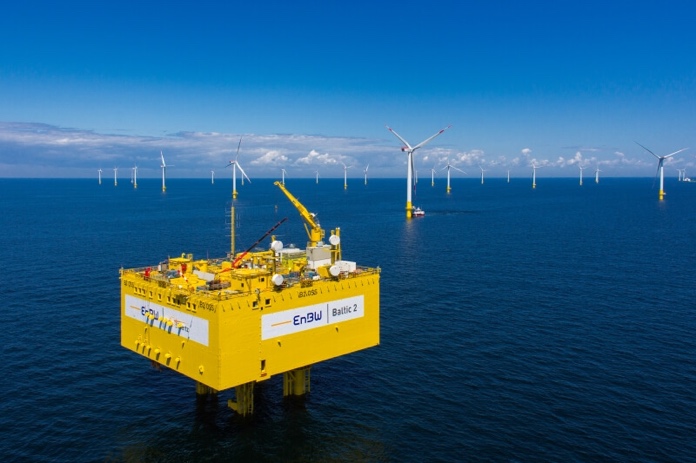
If no adequate transmission lines exist nearby, their development will be essential alongside the wind farm itself.
Like onshore wind, the offshore wind developer will collect data from seasonal wind patterns during the early stages of development. They will also conduct visualization studies to present what the future project will look like from its neighbouring shore once completed.
When constructing offshore projects, the weather is a significant consideration. Seasonal weather patterns determine ideal construction times. Bad weather unique to the geography leads to delays. As noted by Timm, due to differing weather conditions, offshore projects in Europe may take 2 years of construction while projects in Asia could take 3.
Building the offshore wind farm
Once sufficient permitting is complete, developers will order the turbines and their components. Like nearly every industry, this stage has not escaped COVID’s lasting impact on global supply chains. While conditions are improving, delays in manufacturing and shipping have remained common in recent years.
Transporting
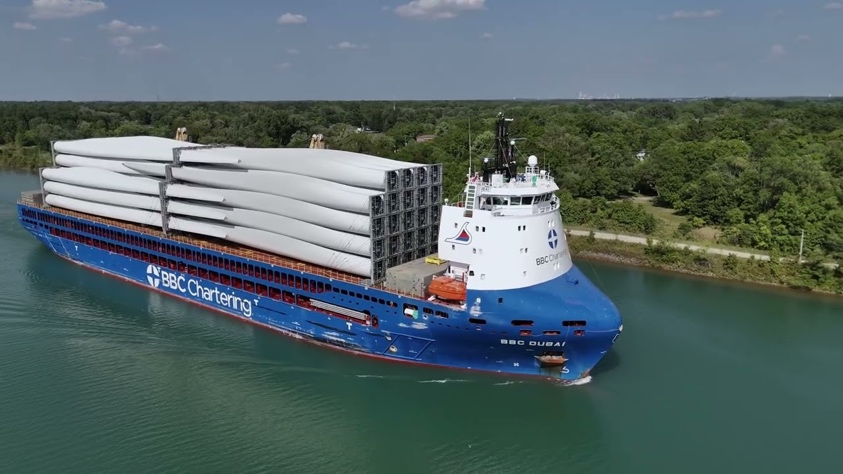
Shipping these turbines is highly complex, though require much less road travel than onshore turbine transport. Multiple ships transport oversized blades, the towers, nacelles (the hub of the wind turbine) and other specialized equipment from manufacturing facilities to a port near the project site.
76-meter offshore blade shipment
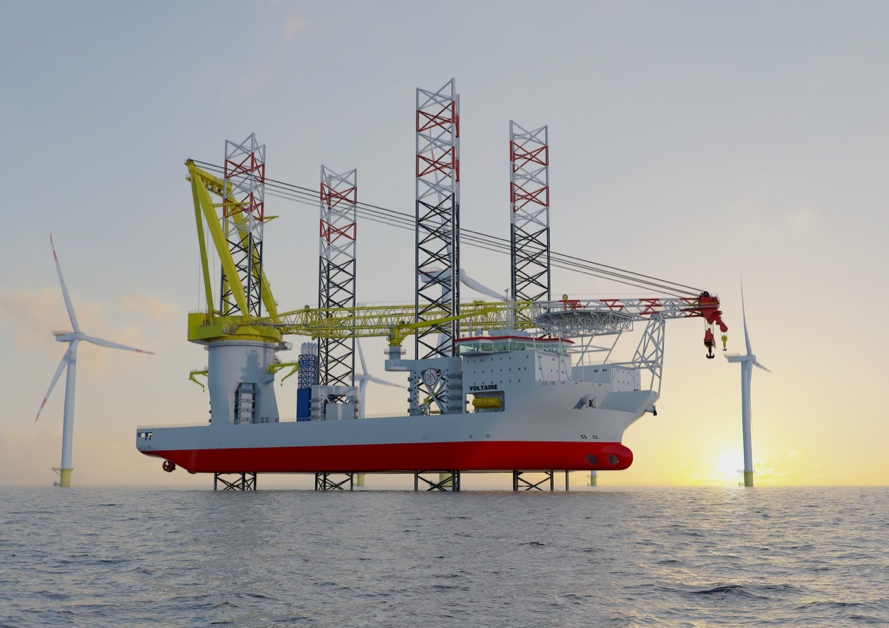
The machine is then partially assembled on land and transported to the project site via installation vessels. The type of vessel used will depend on the turbine size and platform characteristics. Shown below is a jack-up vessel with a crane capacity of 800-1500 tonnes. This type of vessel is preferred for harsher weather and high waves, they can hold multiple turbines at a time and has the height capacity required to build modern turbines. The jack-up vessel is a common choice for these projects.
Assembly starts at the bottom…
Before an offshore turbine can be installed, it needs a platform. The choice of this foundational platform is overwhelmingly dependent upon the site’s sea depth. Information collected before and during the permitting phase will guide developers in selecting the exact site and the ideal foundation for the turbines. The industry rule of thumb is that for any project site under 60 meters from the water surface to the seabed, a fixed foundation is preferred. For anything over 60 meters, developers often opt for a floating foundation.
This decision is also dependent on factors like cost. A fixed offshore turbine in the European market is likely to cost $4.8-6.7 million/MW CAD. For a floating turbine, the range is much larger, $8.3-13.8 million/MW. These numbers are expected to continue changing, though fixed-foundation turbines will likely remain less expensive than floating for the foreseeable future.
Other factors like soft clay vs. hard rock seabed, reclamation expectations, and underwater habitats will contribute to this decision.
For shallow waters, there are multiple fixed foundation types to choose from.
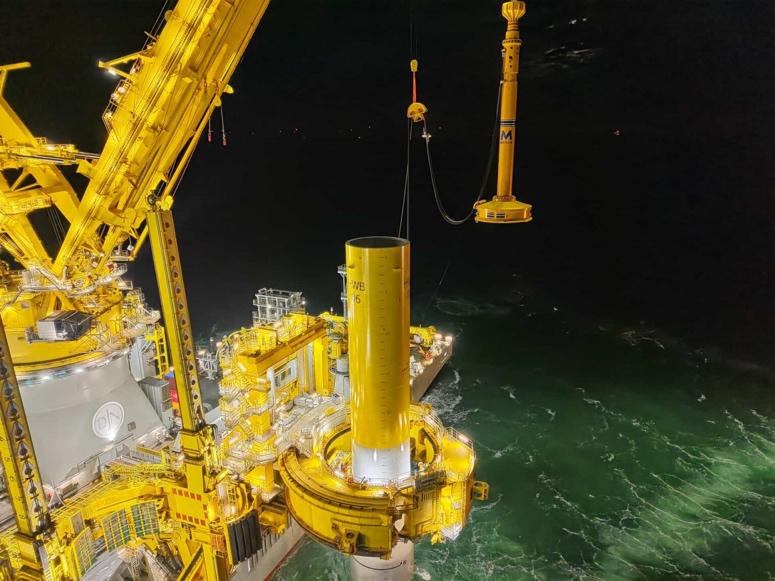
Monopiles are the most common choice for offshore wind. In water depths under 50 meters, a single steel pile (ranging from 6 to 10 meters in diameter) is driven roughly 30 meters into the seabed to support the tower above. Monopiles are the least expensive of the foundation options, but they come with trade-offs: they’re limited to relatively shallow waters and are not ideal for turbines with more than 15MW capacity due to the increased force on the foundation.
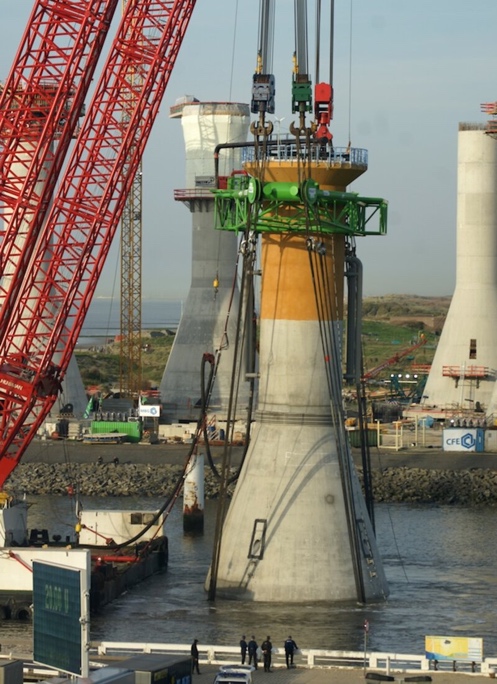
Gravity-based foundations rely on gravity and sit atop the seabed. They’re extremely heavy (6,000+ tonnes once installed), ranging between 15 and 30 meters in diameter, and are best suitable for hard or rocky seabeds. Like monopiles, they are limited to shallow water depths (approximately 10 meters). These are less common due to their complexity of transport, cost and required seabed clearing for installation.
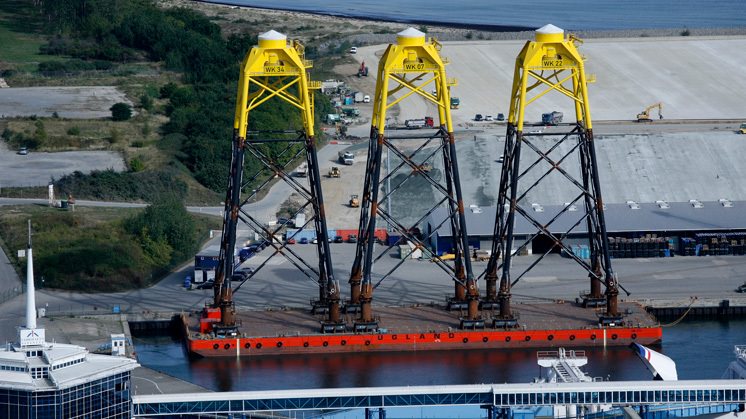
Three- and four-legged foundations, better known as tripod and jacket, are tubular metallic structures that can work for up to 100 meters of water depth with a footprint of 20×20 to 40×40 meters at their widest base. These structures are the second most common choice for offshore turbine foundations, and while they allow for development in deeper waters than monopiles, they’re complex and expensive to manufacture, not suitable for harder seabeds and bring with them longer installation times.
Floating foundations
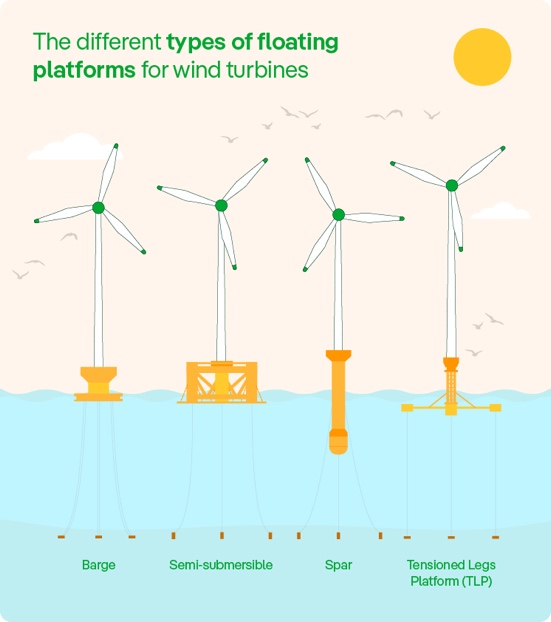
Finding offshore turbines on floating platforms is much less common, though they have significant benefits, chief among them: more site options in deeper waters. Three main types of floating structures allow for development in deep water: tension-leg platform (submerged platform held by vertical anchored tension cables), Spar (long hollow cylinder weighed down by ballast at the bottom), and semi-submersible (wide, shallow floating raft).
Floating platforms side by side
Footprint in the sea
Regardless of floating or fixed platform type, these turbines’ footprint is relatively negligible.
The average active offshore wind turbine has a max generating capacity of 15MW. According to a report by the Clean Air Alliance, a 15,730 MW project in Lake Ontario would require a total turbine footprint of 0.32 km2 (0.0032% of the Lake).
1,049 15MW turbines would be required to match this 15,730 MW project, each taking up about 300m2 (a bit more than a doubles tennis court). The total footprint of the project would be about the same as the Calgary Zoo and, according to Marine Renewables Canada, 1 offshore turbine can power 15,000 homes/year. Hypothetically, this project would be enough to power nearly 16 million homes/ year.
While their footprint is relatively negligible, offshore turbines do require significant space between each other to maximize output and minimize potential damage. The distance is based on their rotor diameters, with the rule of thumb being 500-900 meters apart downwind, and 300-500 meters apart crosswind. During the installation process, the turbines are connected by cables, laid along the seabed for fixed platform projects.
For the Seagreen Offshore Wind Farm in the UK, its 144 turbines and its substations are connected by 326 km of submarine cable.
Policy and regulatory development
This 8-10 year concept-to-construction timeline does not include the years of pre-proposal regulations and legislation. Timm from Sussex Strategy Group emphasized that the policy and regulation phase, which can start long before developers get involved, is a key piece of these types of projects. This is the stage at which we find ourselves in Canada, with the Nova Scotia and federal governments and regulators working out the details that will become the foundation of our offshore wind industry.
According to Dr. Chad Walker, Assistant Professor at Dalhousie University, Premier Tim Houston’s government has been very enthusiastic; it’s creating hugely ambitious 60 GW+ wind capacity targets for the next decade plus. The government is moving as quickly as it currently can and working to build interest from international developers that can help the province get there.
So why is Nova Scotia at this stage now? Why not 10 years ago?
Well, offshore wind was still maturing 10 years ago, even globally. It comes with the realization that if we are going to lean deeper into the energy transition and increase Canadian energy security, expanding into offshore wind will be key to getting there.
A symptom of the energy transition is the uncertain future of oil and gas in the Atlantic provinces. According to Timm, this uncertainty has, too, been a driver in Europe, with offshore wind acting as a quasi-replacement for offshore oil workers in the UK and the war in Ukraine forcing EU states to diversify their energy sources.
Another question you may be asking is why Nova Scotia is so much further ahead than British Columbia? The answer is that Nova Scotia had a regulatory and legislative head start, thanks to offshore oil and gas.
The Atlantic Accord Acts laid the jurisdictional groundwork for how Newfoundland and Labrador (1987) and Nova Scotia (1988) would participate in the management of offshore resources like petroleum. This joint management scheme created a Canada-Nova Scotia Offshore Petroleum Board and a joint regulator that managed the seabed.
This legislation evolved in 2024 with Bill C-49, updating the regulatory boards’ mandate to include offshore wind. These entities are now called Offshore Energy Regulators. According to Timm and a recently retired Canadian former executive in the wind technology industry, the regulatory framework continues to evolve, though provincial and federal processes mirror those of pipelines, LNG terminals and ports.
According to Jorden Dye from Business Renewables Centre Canada (BRC-C), the past two years have resulted in a lot of market changes for Nova Scotia energy development. These changes led to accelerations in energy offtake models, though not specific to offshore wind. The province is working to de-risk their energy market and harness demand in a way that is leaps and bounds ahead of other larger provinces.
Wind West
Wind West is the project at the end of the Nova Scotian regulatory and legislative tunnel. There are two main sides of this project: the offshore wind generation itself and the transmission infrastructure it requires. Currently, the mega-project has 4 designated sites with an estimated total capacity of 62,000 MW:
- Sydney Bight up to 6,400 MW- fixed foundation
- Middle Bank up to 11,400 MW- fixed foundation
- Sable Island Bank up to 28,200 MW- fixed foundation
- French Bank up to 15,600 MW- floating foundation (60m+)
Considering the Nova Scotia grid has a peak demand of 2,500 MW, the majority of offshore electricity will need to be transmitted either westward or southwards.
Who will use the electricity?
According to Timm and the former wind tech executive, electricity offtake will be a significant challenge for this project. These conversations are currently underway to determine where the transmission is going, who will be buying the power and who, beyond Nova Scotia, will benefit from hosting transmission lines; provinces that haven’t always seen eye-to-eye will need to be partners.
Many transmission options exist for the project. The electricity could go through New Brunswick, or under it, into Quebec and then Ontario. It could also move south, exported into northeastern U.S. states.
To make it work, “governments will really need to get along; there’s going to have to be a good amount of cooperation to make things happen. The project will come with a high cost, and its sheer scale will, and Nova Scotia does not have the capacity to get things done on its own,” explained Dr. Walker.
What does the public think?
“Curiosity and recognition of opportunity”. That’s how Timm from Sussex Strategy Group describes public sentiment on the project. There is real opportunity for Nova Scotians to be a significant part of the energy transition, benefiting from job creation through project development and its eventual operation.
The UK provides unique guidelines in ensuring best practices for developers and communities. If legislators choose to mirror these voluntary guidelines, with industry support, coastal communities could reap benefits from annual payments, increasing public support.
If you look to social media to see how the Nova Scotia public feels about these projects, like Dr. Walker and his team did, you’re likely to see a lot of negativity. This, of course, is not a totally representative population sample. When looking into public sentiment from those who wrote into a preliminary regional assessment process, 50% of comments fell into what could be described as a neutral-unsure-ambivalent category.
Existing offshore projects don’t have the same impact on communities that onshore wind farms do. Most projects are situated 10-60 km away from shorelines; this reduces their visibility to coastal residents and grants more general community ambivalence.
A piece unique to Canadian energy development is Indigenous rights and reconciliation. While engagement with Mi’kmaq nations is emphasized in the Wind West strategic plan, we will have to wait and see what it looks like in practice and to what extent this project can push reconciliation forward. Overall, there seems to be curiosity and recognition of opportunity by nations and their leaders that could turn into support.
Canada does not have a pattern of keeping its truth and reconciliation commitments when it comes to large, nation-building projects. Indigenous fishing rights are particularly at risk and have been in the region long before offshore came into the scene, as noted by Dr. Walker. There are signs that the federal and provincial governments are taking their responsibility here seriously so far, but there is still a long way to go.
As emphasized by Dr. Walker, fishers across the shores of Nova Scotia are likely to be one of the most opposed and impacted groups. This group is particularly concerned about the lack of access to the waters during the projects’ construction phases and how marine species return to the areas once the projects are operational.
Seeing as the early proposed projects will mostly rely on fixed foundations, drilling and disturbances to the seabed will be unavoidable.
2033
2033 is the current published estimated power delivery year, though Dye’s, media and industry contacts perhaps more accurately predict 2035, and Dr. Walker agrees. I asked Timm if he thought 2033 was a reasonable timeline; his response: it’s not impossible, but we must move pretty quickly, especially on the transmission side of the project.
Timm worked on some of the first offshore projects in Poland and Taiwan; they required about 4 years of policy development. Poland started its offshore wind journey in 2017, already having adequate transmission infrastructure; its project will come online in 2027. Taiwan wasn’t much different, with its offshore development requiring over 10 years. Again, Nova Scotia is not starting from scratch, but its offshore development will be a significant challenge.
In 2025, the Canada-Nova Scotia Offshore Energy Regulator announced its initiation of the Call for Bids process, which closed in August, 2026. According to Dye, we should learn about the selected Atlantic projects in early to mid-2027.
Lessons from the Great Lakes
According to Dye, the Nova Scotia government has taken a thorough and measured approach to developing the offshore wind industry. The province has put in the time to build a proper system that reduces risk for industry, the environment and the community, likely having learned from the failures of other proposed offshore projects in Canada.
Long before Nova Scotia started taking offshore wind seriously, Ontario nearly became Canada’s first province to benefit from this type of project. Lake Ontario and Lake Erie were the jewels of offshore development in the mid-to-late 2000s.
After years of work and securing lakebed rights in Lake Ontario, Toronto Hydro Energy Services obtained approval to begin meteorological monitoring in 2009 for its proposed offshore wind project just off the coast of Toronto. The selected site would have sat at a maximum distance of 5 km from the shoreline. In the world of offshore wind, this is quite close, and its proximity drove a lot of NIMBY-ism from the project’s would-be neighbours.
At the time, a fixed turbine foundation was the only good option for this type of project due to the lake’s depth. The most economical depth to install 60 offshore turbines in the lake at the time was 15 meters, forcing the project to stay close.
The project pursued by Wasatch Wind Inc. in Lake Erie was very different. Lake Erie has a much shallower average depth of 19 meters and a maximum depth of 62 meters, meaning that the cost of installing a wind farm would have stayed relatively the same no matter its exact site.
According to Mark Rudolph, CEO of Just Environment, who worked on the project at the time, the proposed 4,400 MW Lake Erie project would have been barely visible, with its maximum turbine distances of 30km off the coastline. As he said when speaking about why the proposed project would, or should, have been a slam-dunk, “You can’t see it, you can’t feel it, and it’s in nobody’s riding”.
Another important benefit of developing offshore wind in Lake Erie at the time was its proximity to the shuttered Nanticoke Generating Station. Once Canada and North America’s largest coal-fired power plant, its retired infrastructure could have transported all of the energy from the offshore project to Greater Toronto, with no new transmission corridor required.
By 2011, Ontario had 5 offshore wind energy project applications. These projects’ development could begin to tap into the estimated 35,000MW wind energy potential of the Great Lakes. According to Rudolph, by February of that year the Lake Erie project had cleared its major hurdles. Its backers met with Premier Dalton McGuinty’s office, and by all accounts, the government was supportive and ready to proceed.
Days later, that support vanished, and the province pulled the plug.
“We received over 1,400 comments, and those comments raised more questions than answers, so unless we can take a cautious, scientific approach, we had to declare a moratorium,” said the press secretary for the Minister of Environment to the CBC a few months after the province’s February 2011 moratorium on offshore wind.
The province cited the need for further scientific study given that freshwater offshore wind had never been developed anywhere. Developers and proponents did not accept this reasoning.
Trillium Power Wind Corp., which had four Great Lakes projects in development, including in Lake Ontario, sued the province for damages, alleging the moratorium was announced for political reasons ahead of the 2011 election, timed to appease voters in ridings near the shoreline rather than in response to any genuine environmental concern.
Windstream Energy, another developer whose project was also killed by the moratorium, pursued a NAFTA arbitration claim in 2016 and won. The tribunal found that Ontario had done little to substantiate the scientific uncertainty it cited as justification, and the province was ordered to pay roughly $28 million in damages.
The future of offshore wind in Ontario
The 2011 moratorium on offshore wind in Ontario remains in place, although conversations from opponents and ENGOs are starting to ramp up again. Advancements in offshore wind technology and the decrease in the cost of turbines and their components have made offshore development more lucrative than in the late 2000s, and it was already very lucrative.
Clean Air Alliance- High-Cost Nuclear vs. Wind and Solar (2025)
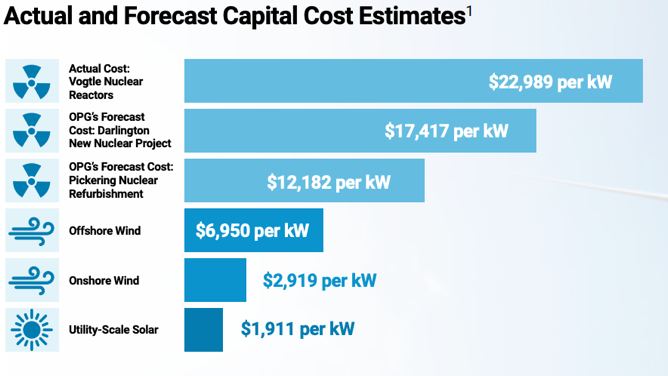
According to a report by the Clean Air Alliance and information from the Independent Electricity System Operator, hydroelectric advancements will generate 39.6 TWh of electricity annually in 2050, while “Great Lakes offshore wind could produce 151 TWh annually” in the same year.
Lifting the offshore wind moratorium in Ontario would make it possible for the province to keep up with its growing electricity demand without burning a hole in the ratepayer’s pocket. But this cannot be successful unless the province learns from its mistakes. The Green Energy Act, which pushed a lot of renewable energy development forward, also led to significant opposition from the public. Hopefully, the future of offshore wind development in Ontario is measured and thoughtful.
Final words
I asked David Timm what policymakers need to be doing better to ensure the success of offshore wind adoption; his response:
“For the most effective development, policymakers and governments must look at these projects holistically, with regulatory regimes that address the sum of their parts” (generation, transmission, demand, infrastructure).
Projects like offshore wind farms are highly complex and multi-faceted but, once operational, could open a world of electrification and decarbonization potential across Canada.
The next article in our Renewables Own the Future series will be a piece on solar.
A special thank you to David Timm from Sussex Strategy Group, BRC-C Director Jorden Dye, Mark Rudolph, CEO of Just Environment, the recently retired wind tech executive, and Dr. Chad Walker, Assistant Professor at Dalhousie University, who helped provide first-hand accounts and insights.