Solar Development in Canada II


Rooftop Solar
To the list of world-changing and critical inventions by Canadians: the zipper, the Robertson screw, insulin, standard time, basketball, the pacemaker, now add perhaps the most consequential: the solar panel!
The story of the solar panel is far from Banting and Best shouting “eureka” whilst burrowed away in a U of T lab. Think a plot more aligned with the Murdock Mysteries: an early 20th century tale of kidnapping, intrigue, and ultimately a successful conspiracy to prevent the invention from ever seeing the light of day.
In 2023, Dr. Sugandha Srivastav brought attention to the largely forgotten history of the world’s first rooftop solar system, known as a Solar Electric Generator (pictured below). Around the time the lightbulb first became popular, a system was created in 1905 by George Cove, a Nova Scotian renewable energy inventor and entrepreneur. His invention went viral in early-1900s terms, gaining global recognition with early magazines reporting optimism for the technology to “liberate people from poverty, bringing them cheap light, heat and power”.
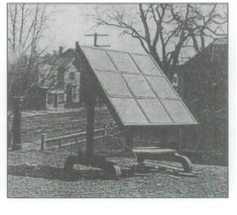
For Cove, business was booming, and recognition for his many renewable energy inventions was growing. That is, until his kidnapping in 1909! It’s unclear who was responsible, and his release was conditional on giving up his solar patent and closing his company, with his kidnappers offering $25,000 and a new home in return for his cooperation. Seemingly, Cove refused but was released soon after regardless.
While the perpetrators of this crime remain unknown, a long history of foul play among individuals in the coal and oil industry suggests the move was made to eliminate their competition.
Today, the 1954 Bell Solar Battery is commonly considered the world’s first practical solar cell and the global introduction of this technology.
Dr. Srivastav calls the 45 years between the Solar Electric Generator and Bell Labs’ solar battery “the four lost decades”. Four decades where solar development could have gotten a head start, stating:
“I wager that avoiding a 40-year break in solar power’s development could have spared the world huge amounts of carbon emissions.”
Dr. Srivastav covers the kidnapping and the context under which it happened in more detail here. It’s a short, entertaining and enlightening read.
Aiming to answer the question: what does it take to develop renewables in Canada?, this introduces the fifth installment of our Renewables Own the Future series.
Our piece continues the conversation on the Sun, focusing only on grid-tied solar photovoltaics (PV) and how they get on our rooftops.
See Part I – Introduction to the series here; Part II – Onshore Wind here; Part III – Offshore Wind here; Part IV – Ground-Mounted Solar here; Part V – Rooftop Solar is below.
Rooftop solar is different
Rooftop solar projects are unlike any of the others we have covered in this series. These projects are considered small-scale (under 5MW), much smaller in size and generation capacity.
Across Canada, from BC to Saskatchewan, Ontario and Nova Scotia, the average single-family home can host about 8 to 10 kW solar arrays using 12-20 panels at ~500 W per panel on south-, east-, or west-facing roofs.
The performance of a rooftop system depends on multiple factors, most importantly, how sunny (irradiance) it is. The map below helps visualize the average annual distribution of sunlight across Canada.
Annual Photovoltaic Potential of Canada – NRCan
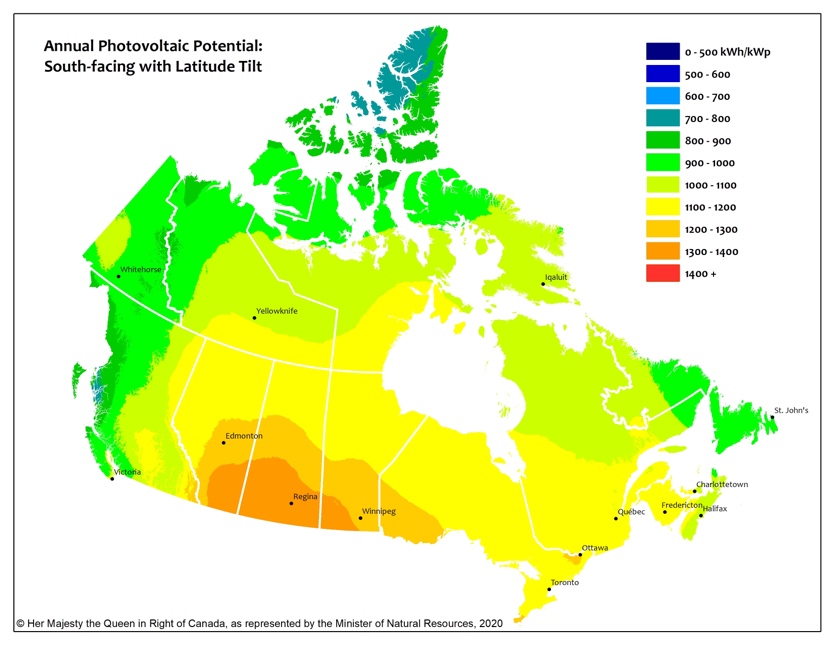
Clearly, the Prairie provinces receive the most annual sunlight, resulting in more potential for generation compared to similarly sized systems elsewhere. This is not to say that rooftop solar systems won’t be lucrative in St. John’s or Whitehorse. Northern, western and eastern projects are and will continue to be key sources of energy in the transition. These projects will, however, come with overall lower output expectations and, depending on electricity rates and subsidies, could take longer to pay back the investment.
Check out our article on ground-mounted solar for a more detailed discussion of solar potential across the country.
Of course, the ideal place to build solar is dependent on more than just average annual irradiance. According to Jake Kubiski, CEO of Kuby Renewable Energy, Alberta is near the top of the list of the best places to build because:
“Alberta combines excellent solar resource, significant electricity consumption, relatively high electricity prices compared with many jurisdictions, a strong culture of private energy investment and a large amount of available rooftop area. Southern Alberta is particularly strong from a solar-resource perspective, but Edmonton and central Alberta also have very good economics.”
The very first step
Unlike typical large-scale renewable energy projects, the development of rooftop solar is triggered by the owners of the rooftop, whether it be residential or commercial. Since these projects are pursued on an individual level, provincial and federal subsidies are often essential, especially for residential projects.
Incentives
According to Kubiski, economics is frequently the main driver of both commercial and residential solar adoption.
“Emissions reduction can become the deciding factor for organizations with ESG, procurement or corporate sustainability requirements, but a strong financial case makes the decision much easier.”
Overall, this is a sign of progress: homeowners and business owners no longer buy solar panels just because it’s good for the climate. Solar panels can be a legitimate infrastructure investment with significant financial return.
That’s why subsidies (or the lack of them) can make or break one’s decision to go solar.
Through the Canada Greener Homes Grant, which is now, unfortunately, closed, solar became the top retrofit tool for PEI, Nunavut and Yukon. A total of 38,634 residential solar projects were completed because of the grant across the country. While the exact amount of GHG emissions avoided from these solar projects is not reported, the entire program (which included other retrofit initiatives) resulted in nearly 800,000 tonnes of GHG emission reductions.
Though this industry-changing grant for residential solar projects has ended, commercial rooftop solar projects can still rely on federal incentives through the Clean Technology Investment Tax Credit that provides a 30% refundable credit on solar and battery equipment.
The federal government is not the sole entity that can incentivize rooftop solar. Each province and territory employs unique subsidy/incentive measures; most have a 1:1 net metering protocol where solar panel owners are credited for excess electricity destined for the grid. CanREA (the Canadian Renewable Energy Association) has a fantastic list of incentives for solar broken down by province; check it out here.
When it comes to progress, one thing is for certain: even in rooftop solar (commercial or residential), policy predictability is an incentive in and of itself. As discussed in our Onshore Wind article, provinces like Alberta have driven away investments in renewables due to policy unpredictability and rapid changes to the rules.
Does using tax revenue to create incentives make sense?
Absolutely! For some obvious and less obvious reasons. When governments contribute 25% of the cost of a solar installation, there are numerous returns for government funds in the form of added employment taxes, HST on the panels and the services, taxes paid by the installer, the panel distributor, and, critically, governments avoid building other, more expensive energy infrastructure.
- New nuclear reactor – 31c/kWh
- New gas-fired peaker plant – 27.4c/kWh
- New Solar & Wind – 8.9c/kWh
Governments can add many gigawatts of energy to the grid, at a fraction of the cost of a new nuclear generator, without taking on responsibility for day-to-day operations.
Consumer incentive programs for solar (and for energy efficiency retrofits) require proof of purchase, which pushes installation work out of the underground economy. Cash discounts disappear, profits get taxed, and workers get paid on the books instead of under the table. Industry estimates suggest the resulting tax revenue can substantially offset and sometimes exceed the cost of the subsidy itself.
I’ve been incentivized; what’s next?…
Potential customers will connect with single-contractor entities who will manage the project from start to finish or multiple contractors that oversee the project’s individual parts. Developers like Kubiski operate a single-contractor model as an EPC (engineering, procurement and construction) firm. EPCs run the project from start to finish, working directly with the client to meet their needs and desires.
According to Kubiski, the first step after initiating a project is understanding a customer’s electricity use and objective. Solar contractors need to know the historical electrical consumption, how the building operates, what the customer is trying to accomplish (bill reduction, energy independence, emissions reduction, backup power or a combination of all) and then evaluate the site.
As with all renewable energy projects, siting is everything, and for a rooftop project, the condition of the roof is critical. Contractors will assess the condition, structural capacity, orientation, shading and available area. This assessment is essential for a quality rooftop project.
Initial screenings will use provincial or municipal maps and calculators to estimate annual sunlight and analyze shading and orientation. Tech like drones, LiDAR, satellites, irradiance meters, and more all have valuable uses in roof assessment.
Putting panels on our roofs
Once roof assessments are underway, the size of the array will be determined. Residential systems will average 6-12kW in capacity, while commercial projects have a larger span of 10+ kW to 1+ MW.
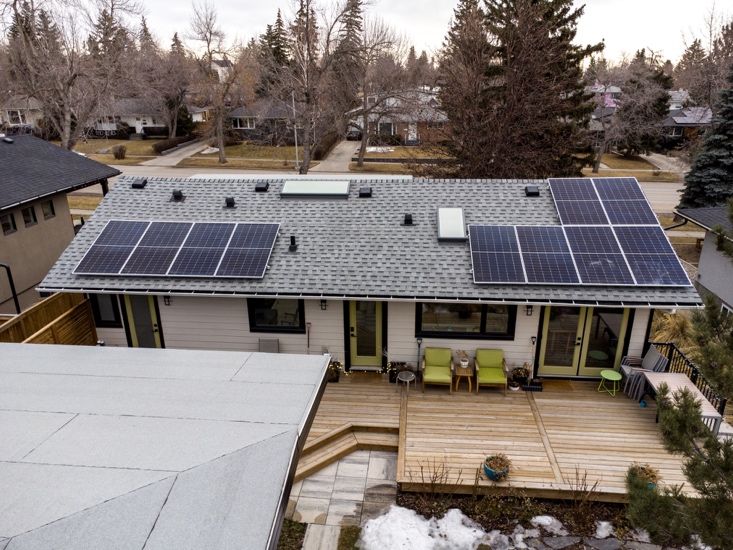
Most roofs are not designed for solar (as shown below), meaning that every centimetre of the roof will rarely be covered in panels, and their placement and orientation will need to be optimized to avoid obstacles and shadows. Contractors will prioritize optimization over quantity of panels. According to Kubiski, a 10kW system is made up of about 20 500w panels, each measuring roughly 2 m2 (commercial and residential panels have a range capacity of 440-650w).
A roughly 5 kW system in Calgary
What will it cost?
Prices for a residential rooftop solar project will vary across Canada, though the number normally sits somewhere between $2 and 3.5 /W before incentives (the 5kW project pictured above may have cost between $10,000 and $17,500). This includes the cost of panels along with associated labour and material costs of installation.
The cost, of course, will increase or decrease depending on the location of the project (remote = harder to get to = higher costs), any infrastructural or electrical upgrades and the project’s capacity. Like at Costco, the more you buy of a product, the less you pay for each unit. The same applies to rooftop solar, meaning that for commercial projects, the cost per Watt is usually lower.
All in all, owners can usually expect a payback period of 6 to 20 years for a residential solar investment. This period will largely depend on electricity rates and provincial rebates. Nova Scotia currently has the shortest payback period, while Manitoba and Quebec have the longest.
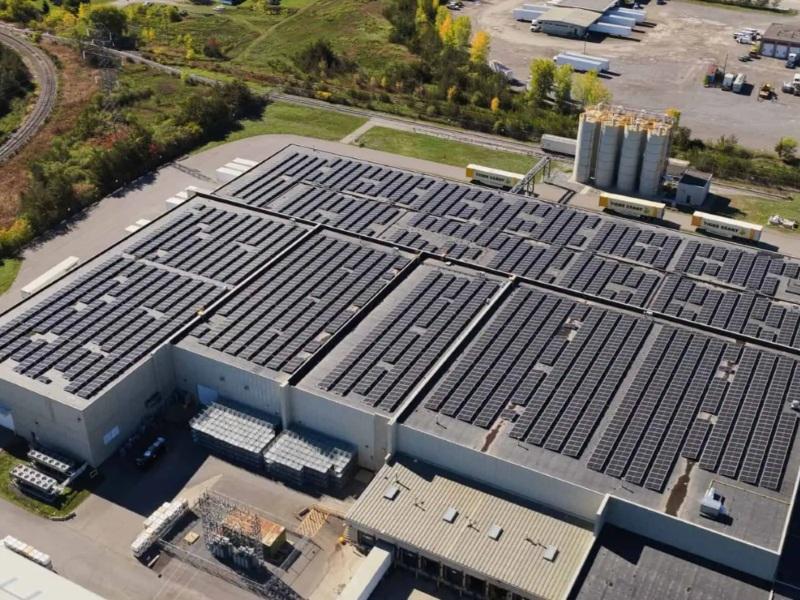
For commercial projects, the payback period can be much shorter. The 1.5 MW Schutz Canada commercial solar project, built by Otter Energy in Ontario, has an estimated payback period of only 3 years (total project cost ~$300,000)! A 33% guaranteed ROI is substantially better than anything the market is offering elsewhere.
Schutz Canada 1.5MW rooftop solar project
Like many worthwhile investments, one shouldn’t expect to reach breakeven immediately on their 25-30 year asset but should expect to see meaningful annual returns.
Costs are also dependent on global trends, and the global decrease in the cost of solar panels has completely changed the industry in Canada. According to Kubiski, “solar modules have become a much smaller portion of the total project cost, which means the economics are increasingly driven by labour, electrical infrastructure, permitting, engineering, customer acquisition, financing and the value of the electricity produced”.
Timeline
For residential projects, a typical timeline from conception to starting construction will be about 1-4 months. For commercial projects, this timeline increases to 3-12 months. Overall, the timeline of permitting and interconnection depends on the municipality, utility company, and complexity of the project. Kubiski emphasized the importance of transparency for customers during this period, building trust in the process by providing consistent and clear updates on how their project is moving forward.
Once permitting and assessment are completed, actual installation of the project is quite short. For typical residential projects, it will take a small crew of 3 about 1-3 days, while commercial projects are much larger and more complicated. Their installation often takes a crew of 5-20 several weeks to complete.
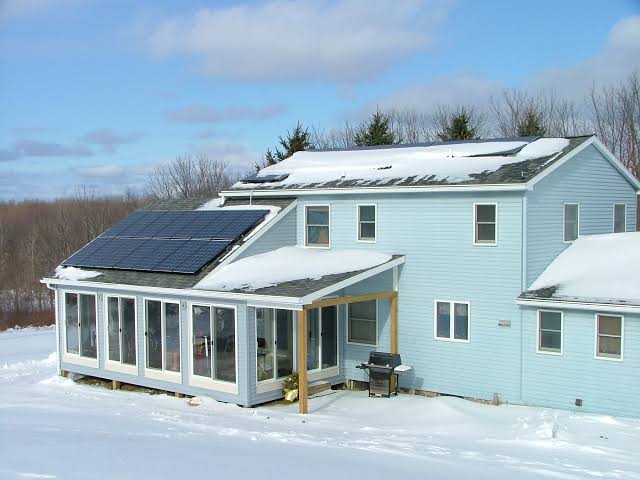
Once the project is constructed, it will take under a week for a residential project to come online. Once it comes online, their maintenance is relatively low. Visual performance and electrical checks will happen when necessary, along with managing any vegetation shading. Thanks to their angled placement and design, manual snow removal won’t typically be necessary.
Residential rooftop solar in the snow
What happens after 30 years?
The average peak lifetime of solar panels is 25-30 years, often outliving other project components like inverters. While panels continue to generate electricity beyond that, their output gradually declines.
So, what can be done with them? Per Kubiski, “if a panel is still functional but is being removed for an upgrade, it may be reused, sold or donated. If it is damaged or at end of life, recycling is the preferred route where an economical recycling option exists. The industry is still developing better end-of-life infrastructure, particularly as the number of panels reaching retirement age increases”.
In a seemingly noble effort, Alberta will be launching a first-of-its-kind solar panel recycling program on October 1, 2026. Which, in principle, sounds like a step forward that is net-positive for the future of solar. But if you look closely, this program is likely to increase the financial barriers to solar adoption, working against global trends by increasing the price of the panels themselves. As Kubiski stated:
“The [province’s] proposed $14 recycling fee per solar panel is difficult to reconcile with the economics of the material being recycled. A solar panel is largely glass and aluminum, along with other recoverable materials, so there is meaningful residual value in the product. To put that into perspective, Alberta currently charges $2.75 to recycle a television with a screen 30 inches or larger, despite televisions also containing glass, metals, plastics and electronics that require processing. The fact that a solar panel would carry a $14 recycling fee, roughly five times the fee for a large TV, raises a legitimate question about whether the fee reflects the actual cost of recycling or whether the renewable-energy industry is being asked to carry an unnecessarily high regulatory burden to align more favourably with the Alberta Premier’s agenda on renewables.”
What could be…
While solar adoption across Canada is growing, it is nowhere near countries like Australia and even the US.
Canada currently has a total installed solar capacity of about 5 GW, including rooftop and ground-mounted panels. In Australia, the global leader in residential rooftop solar per capita, the capacity reaches 28.3 GW, and that’s only counting rooftop. The adoption of solar in Queensland is so vast that hovering over any neighbourhood of Brisbane on MapQuest, it won’t take you long to easily spot 10 solar arrays.
If this built capacity were in Canada, rooftop solar could power about 20 million homes.
Australian rooftop solar capacity now outshines coal power capacity, shining so bright that residents in New South Wales, Queensland, Victoria and South Australia can enjoy three hours daily of free electricity during peak generation times.
In the US, California’s famous generation duck curve (shown below) is a result of similar conditions in Australia. With a rooftop solar capacity of 43 GW, solar is increasingly pushing natural gas out of its generation mix, but peak solar generation is mid-day, outside of peak electricity demand hours. Because of this, solar energy is at risk of being wasted.
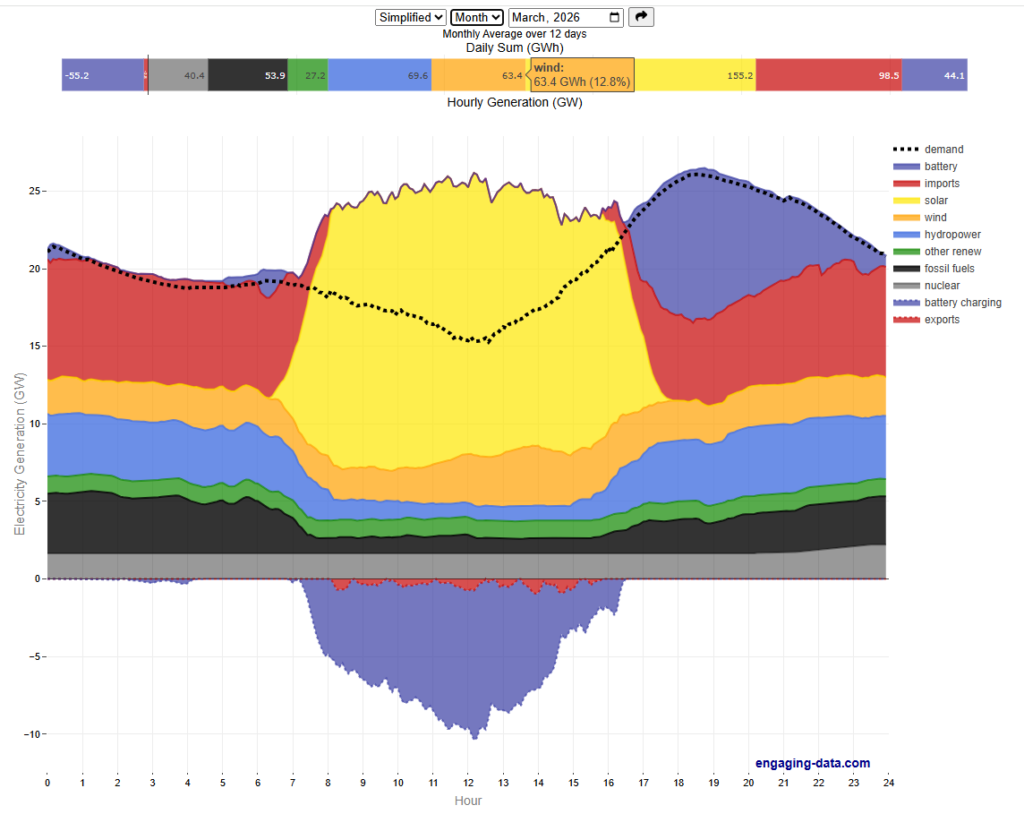
This graph shows solar far surpassing all other resources and energy demand between 8:00 am and approx. 5:00 pm; charging batteries during that production peak supports the grid once solar generation decreases. The duck curve gets deeper as solar power increases.
To avoid wasting this energy, governments can incentivize higher electricity consumption by providing free electricity and/or avoid waste by investing in battery storage. A combination of solar and battery storage will be key for the continued widespread adoption of solar and wind, and essential for keeping rates low. More on this in a future deep dive on battery storage.
Can we catch up?
In theory, yes. Canada has not yet come anywhere near its solar potential. CanREA has estimated that we will achieve 17-26 GW of installed solar capacity by 2035 (ground-mounted and rooftop combined). This, of course, will not only be dependent on demand and investment in larger projects, but the provinces will determine if and how quickly we reach this number.
Some provinces, like Alberta, have created such regulatory uncertainty and introduced such meaningful disincentives for renewables adoption that investors have abandoned the province in droves. The Pembina Institute, in its 2023 report, declared that the province’s 2023 moratorium on renewables killed $33 billion in investments, $263 million in annual revenue for municipalities, and 24,000 job-years of employment. Industry professionals interviewed for our Renewables Own the Future series agree: Alberta’s once-booming renewables industry has been forever changed.
In many ways, Alberta’s renewables policies since 2023 are doing to the industry what George Cove’s kidnapping once did, slowing progress and leaving many behind.
Looking to the future
To conclude this week’s deep dive, I asked Jake Kubiski, CEO of Kuby Renewable Energy, questions about the future of renewables and solar in Canada.
1. What could policymakers do to encourage more renewables?
Predictability is number one. Policymakers should establish long-term, technology-neutral rules for customer generation, make interconnection processes faster and more transparent, and avoid unnecessary administrative barriers. For commercial and industrial projects, accelerated depreciation, tax incentives and clear treatment of clean-energy investments can be very effective. I would also encourage policies that recognize the value of distributed generation and storage to the grid rather than treating customer-owned generation only as a cost.
2. What could communities do to champion more renewables?
Communities can make solar easier to build by streamlining permits, educating residents, supporting local trades and recognizing the economic development that comes with renewable energy. Solar creates local construction, electrical, engineering, manufacturing and maintenance work. The strongest community support comes when people see renewable energy as local infrastructure and economic development, not just an environmental initiative.
3. Is there anything you see over the horizon as a game changer for rooftop solar?
The biggest change will not be a single breakthrough solar panel. It will be the combination of solar, batteries, smart electrical loads, EVs and increasingly intelligent energy management. Solar on its own produces electricity when the sun is shining. Add batteries and flexible loads, and the customer can use much more of that energy when it has the highest value. I also think AI-driven monitoring and energy management will become a major part of the industry. The future rooftop system is less likely to be viewed as “a bunch of panels” and more like a distributed energy asset that actively manages how a building produces, stores and consumes electricity.
Final Words
Rooftop solar projects are complex and extremely diverse across the country, and their development will be instrumental for Canada’s energy transition and its growing electricity demand. Jurisdictions that do not embrace their adoption will not reap their multifaceted advantages.
The next article in our Renewables Own the Future series will be on Tidal energy.
A special thank you to Jake Kubiski, CEO of Kuby Renewable Energy, who helped provide first-hand accounts and insights as a solar developer.