Is the tide finally turning for tidal energy in Canada
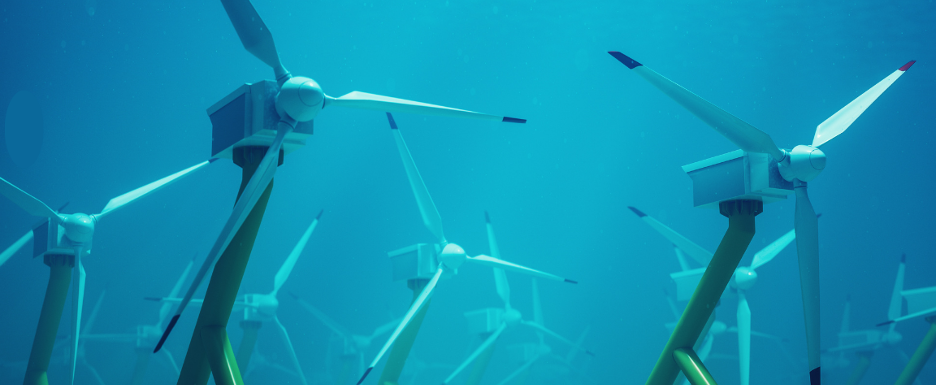

Tidal Energy
Canada’s industrial power didn’t begin with the striking of oil in southern Ontario (1858) or hydroelectricity from Chaudière Falls (1881) or with the completion of the Canadian Pacific Railway (1885). It predates all these events by 240 years, with tidal energy used in grain mills in the Bay of Fundy.
Although it had a head start, tidal energy is woefully underutilized in Canada today, though not for a lack of trying. The Annapolis Tidal Generating Station, commissioned in 1984, had a daily output of 80-100 MWh; it was North America’s first source of tidal power and, at the time of its commissioning, only one of three worldwide (the other two in Russia and France). But this barrage technology brought some of the same impacts a hydroelectric dam does, particularly on fish and was retired in 2021 after maintenance costs were deemed too great and infrastructural repairs too drastic.
So as it stands, despite access to the single most powerful tides in the world, Canada does not have any active commercial tidal energy systems.
Much like our article on Offshore Wind, this episode was set up to fail before my research even began. I cannot produce a piece on how tidal energy is currently developed in Canada because it hasn’t happened since 1984. So, this, our sixth edition of the Renewables Own the Future series, focuses on the current state of tidal and what Canada can expect in the future.
There is no better organization to ask about the story and future of tidal than the folks at FORCE (Fundy Ocean Research Centre for Energy). FORCE has been at the forefront of marine renewables development since its establishment in 2009 and has provided primary first-hand accounts of the industry for the research of this article.
While other sites like the Western shore of Vancouver and the St. Lawrence River have been identified as potential sites for tidal power projects, most development activity is in the Bay of Fundy, making it the focus of this article.
What does it take to develop renewables in Canada? See Part I – Introduction to the series here; Part II – Onshore Wind here; Part III – Offshore Wind here; Part IV – Ground-Mounted Solar here; Part V – Rooftop Solar here; Part VI – Tidal Energy is below.
Background on the Bay of Fundy
The Bay, about 3 times the size of PEI in area (16,000km2), is home to the world’s largest tides. With about 160 billion tonnes of water flowing through twice a day in near-perfect resonance, a rhythm akin to the push of someone on a swing at the exact right time – as a FORCE representative put it. Thanks to its length, this rhythm matches perfectly with the ocean tides, and thanks to its shape, the water is pushed higher up shore as it rushes through the narrowing Minas Passage (shown below). The total flow in and out of the Bay of Fundy is – and let this sink in – greater than the flow of ALL of the world’s rivers combined.
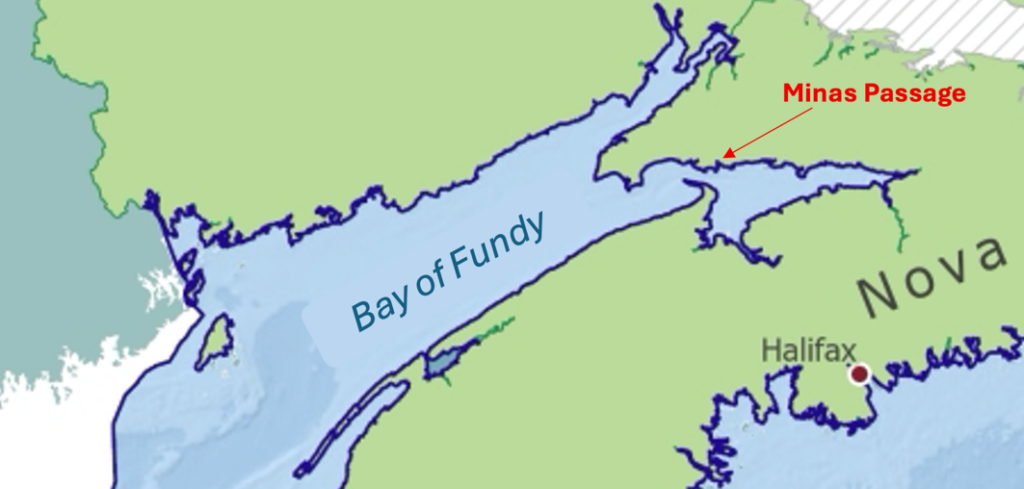
For tidal energy, the Minas Passage is the jackpot. In 2012, a study conducted by Acadia University revealed that the one site with the highest maximum extractable power is the Minas Passage, with a 7200 MW power potential. For context, Ontario’s largest nuclear power plant, the Bruce Generating Station, has a total installed capacity of 6,232 MW, and Nova Scotia’s entire power capacity is currently about 3,000 MW.
In the same 2012 report, Acadia highlighted five other top sites with a combined maximum extractable power of 235.8 MW. While it is difficult to fathom, the Minas Passage is beyond extraordinary, and while its maximum power is not likely to be extracted anytime soon, utilizing any percentage of that maximum will be industry-changing.
“It’s a staggering resource,”
Says Lindsay Bennett, FORCE’s executive director. FORCE is Canada’s leading research and development facility for tidal energy technology, located on the fast-moving waters of Minas Passage. Funded by the Province of Nova Scotia and the Government of Canada to advance tidal as a shared clean energy priority, FORCE offers a grid-connected site to host tidal devices that includes 11km of subsea power cables, conducts research and monitoring, shares its results with the public, and connects regulators, Rights Holders, government, scientists, communities and other partners to help tidal projects succeed.
“Right now, FORCE is designed to deliver about 30 MW of power to the grid, as projects move from one-off demonstrations into larger arrays,” says Bennett. “That’s less than half of one per cent of the total estimated power potential here. It’s still enough to power over 20,000 homes.”
A motivated province
Tidal can give Nova Scotia what it needs: consistent, reliable, baseload power. Like hydro, tidal is less intermittent than solar and wind.
Beyond the sheer geographic potential of the Bay, tidal has been making strides, pushed by industry and, overwhelmingly, the province’s desire. Our Offshore Wind article discusses Nova Scotia’s drive to develop renewable energy in more depth. To summarize, a representative from FORCE characterized their motivations as being pushed by two key factors:
- Unlike any other jurisdiction in Canada, transportation is not the main source of GHG emissions; it’s energy (electricity and heating). A majority share of the province’s electricity is generated with coal (solar and wind are presently at the front of the province’s decarbonization strategy, while tidal could solidify the region as a true energy superpower).
- Nova Scotia imports its coal from the U.S. and South America. Even before the threat of tariffs, trade uncertainty with the U.S., the invasion of Ukraine and now the invasion of Iran led to significant price spikes (of both coal and fuel oil).
Like many jurisdictions, the province is seeking energy sovereignty, and tidal can help it get there.
The tech
Although they both use the energy of bodies of water, the technology used to generate tidal and hydro electricity is different, but that didn’t used to be the case. The aforementioned Annapolis Generating Station was built like a hydroelectric dam – this is called a Tidal Range. As a basin filled with water from the high tide, the dam stopped its retreat, redirecting the water down through a narrowing passage and turbines.
As a representative from FORCE highlighted, tidal range and hydroelectric dams are high-impact means to generate electricity. Hydroelectricity is clean in the sense that its generation does not depend on burning fossil fuels but, like nuclear, it has significant impacts on habitats and marine life, as the infrastructure’s development and function depend on altering lake and river systems.
Hydroelectric development across Canada has largely come at the expense of Indigenous nations, and the Annapolis Generating Station was no exception. Its development and operation impacted the livelihoods of Mi’kmaq fishers who witnessed firsthand the depletion of Annapolis River Striped Bass.
“The Bay of Fundy is an enormous energy resource, but it’s also a complex ecosystem and a sacred Mi’kmaw watershed,” says Bennett. “We operate in Mi’kma’ki, the unceded territory of the Mi’kmaq, and that brings an obligation to pursue tidal energy in partnership and collaboration with Rights Holders. It’s about respect.”
Tidal stream
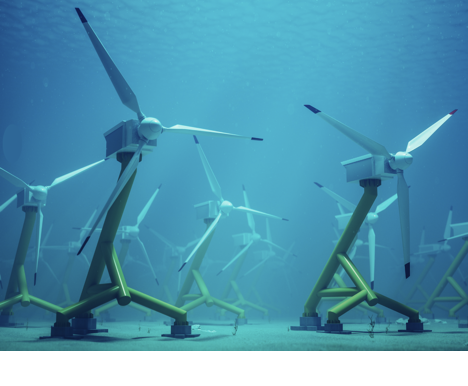
Over the last 25 years, a completely different global approach to harnessing the power of the tide has emerged: tidal stream. This renewable energy technology resembles underwater wind turbines. Worldwide, tidal energy developers have moved toward building fixed and floating underwater turbines (read more on the differences between foundation types in our Offshore Wind article). Modern technology typically now uses the movement of the tides as they exist naturally, eliminating the large infrastructure that manipulates their flow.
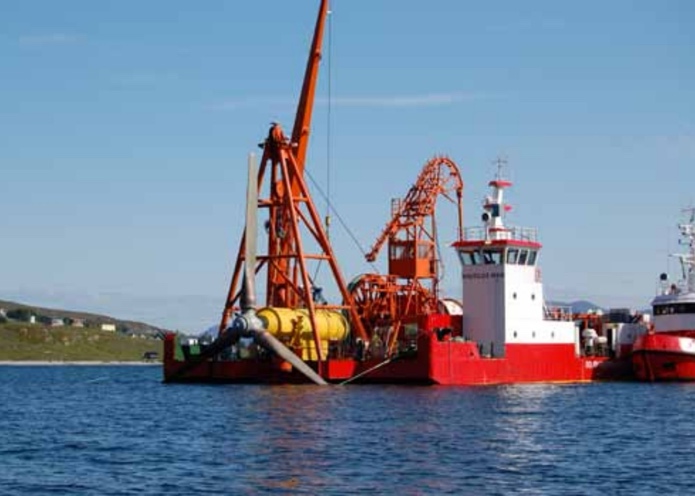
The first tidal turbine was deployed as a prototype in 2004 in Norway and had a power capacity of 0.3 MW (pictured below). Very clearly modelled after horizontal-axis wind turbines, the structure was fully submerged and supported by a fixed gravity-based foundation. This type of structure is called tidal stream, beneficial for its ease of installation and removal, and like offshore wind, multiple turbines can be installed nearby.
Norwegian Tidal Turbine Prototype
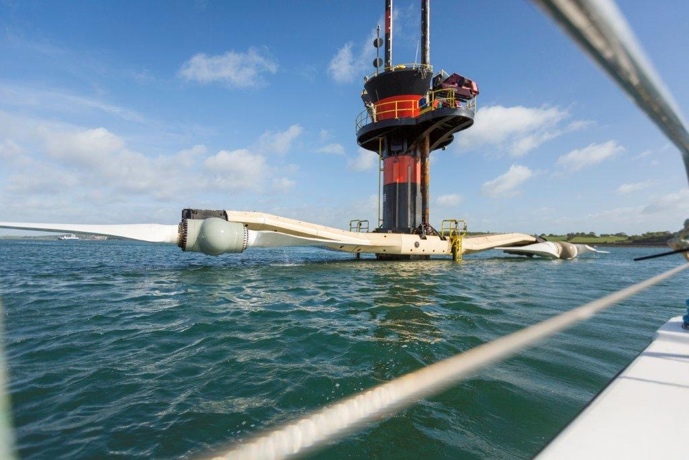
In 2008, the UK achieved the milestone of commissioning the first commercial tidal energy project; it reached its full 1.2 MW capacity and was decommissioned in 2019. This structure functioned as a hybrid hydro-electric/wind turbine, designed to be raised above the water for maintenance.
First commercial tidal project
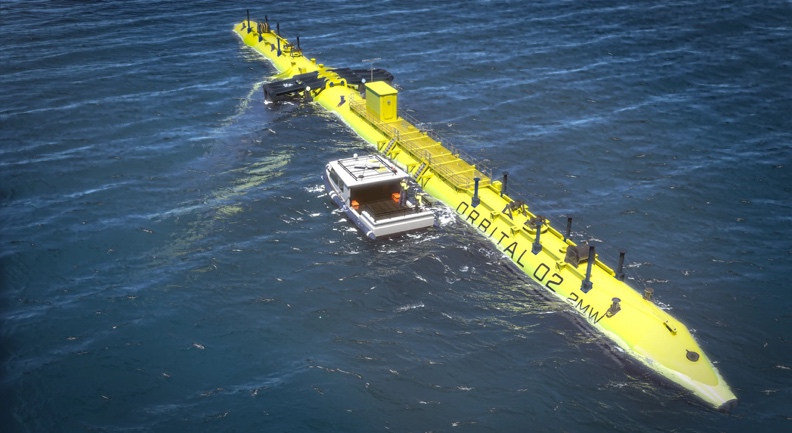
Tidal stream, like offshore wind, can also be constructed to float. The UK remains a leader in tidal innovation and hosts the industry’s most recent development, a 2 MW “floating steel superstructure”. While not commercially operational, the structure is grid-connected at the European Marine Energy Centre tidal test site.
Orbital’s floating steel superstructure
What will Canada use?
We’re still figuring that out, although the picture is clearer now than it was 15 years ago. Together with government, community and Mi’kmaq partners, FORCE has led the exploration of what tidal power will look like in the region. According to a FORCE representative, in the past 15 years, the Bay has seen 7 different devices built for Nova Scotia, each building on the technical, operational, financial, and regulatory expertise needed to succeed in the world’s highest tides.
Committed to marine research, FORCE has been deploying and testing monitoring equipment since 2009; in 2022, they increased their efforts by deploying an acoustic “listening fence” across the Minas Passage that records marine life as it passes. The same year, a floating in-stream 420kW tidal energy platform was installed in the Bay of Fundy and connected to the grid.
Most recently, Eauclaire Tidal, a Canadian company, in partnership with Orbital Marine Power, made international headlines after being awarded additional sites at FORCE. The award allows the deployment of up to six Orbital turbines in Minas Passage and includes tidal energy licences from the Province as well as power purchase agreements with the provincial utility.
Though they have had significant funding support from Natural Resources Canada and other sources, none of this has been easy. The power for which the Bay and Minas Passage are renowned is also what makes it so difficult to install infrastructure and monitoring technology; in earlier years, some – very expensive – instruments washed away to the other side of the Atlantic.
Despite tides that rise 16 meters and currents that reach 6 meters per second, the site is now equipped with optical, acoustic and sonar equipment and will soon launch its first-ever autonomous floating platform in Minas Passage. A representative from FORCE said:
“This work is allowing us to use next-generation monitoring equipment to better understand the environment – we post all our reports online; that transparency supports informed decisions by regulators, industry, Rights Holders, and communities as tidal energy grows.”
Most recently, in 2025, Fisheries and Oceans Canada issued a Fisheries Authorization “to deploy up to three Orbital Marine Power Ltd O2-X tidal energy devices at the FORCE” (in the Minas Passage). All three of the O2 structures could power about 2,000 homes and offset ~15,000 coal emissions/year (based on adding 1 MW of renewables in 2025). This is a massive step for the industry and news that folks at FORCE have worked diligently to achieve.
The regulatory piece
Like offshore wind, the development of tidal comes with the need for regulatory clarity. This has become FORCE’s key focus, working with Fisheries and Oceans Canada, Natural Resources Canada, the Province, Mi’kmaq leaders and researchers.
“Regulatory clarity is about ensuring we keep environmental protections in place and – at the same time – investors see a path to grow from one device to more,” says Bennett. “If tidal is to contribute to our clean energy mix, we need confidence in both sides of that equation.”
One thing remains true across all renewable energy development: investors need clear, consistent regulations that allow for project approvals; otherwise, they will go elsewhere. The current lack of regulatory clarity, though improving, creates difficulty for those ready to push the industry forward in Canada.
That’s why Canada’s federal Task Force on Tidal Energy made waves around the world by introducing a new regulatory framework that allows for project developers to move from single devices to arrays.
Just last year, Fisheries and Oceans Canada issued the first Fisheries Act authorization under the new approach “to deploy up to three Orbital Marine Power Ltd O2-X tidal energy devices at the FORCE” (in the Minas Passage). This is a massive step forward for the Canadian industry and signalled to the international sector that Canada was serious about becoming a clean energy superpower
What industry and investors can count on now?
Along with monitoring and research capacity, FORCE has equipped the Minas Passage with $30 million worth of electrical sub-sea cabling, an onshore substation and 10km of overhead transmission. Altogether, existing electrical infrastructure has 30MW of capacity, which, for now, is plenty.
This existing infrastructure reduces the risk for investors; it shows international companies like Orbital that Canada is serious about tidal and streamlining the testing process.
Environmental and community concerns
“They’re [FORCE and the province] starting to catch up with what the fishermen know” as said Darren Porter, a fisherman interviewed by the CBC. While not included in the quote, traditional Indigenous ecological knowledge is also essential to understanding the Bay and the potential effects of tidal development.
The global evidence so far is encouraging: in over 15 years of international research, the few observed fish interactions have not resulted in obvious harm, and marine mammals appear to have adapted without harm to a turbine installation. But these findings must be tested in the Bay of Fundy
Four years of active marine life tracking in the Minas Passage has helped better understand habitats, migration patterns and the species most at risk from project development. Community concerns are real and are not ignored by researchers, which is why FORCE has taken a robust multi-partner approach to development, relying on local experts across Nova Scotia, not limited to PhDs.
Unsurprisingly, the risks to marine life are very similar to those of offshore wind:
- Noise
- Disturbance to habitat during installation
- Changes to the seafloor
- Collision risks
- Displacement of marine life
While mitigation methods exist, impacts are highest during construction and installation and diminish once the structure is operational. The next deployment of floating tidal energy structures in the Minas Passage will be essential to understand how exactly marine life could be impacted, for how long, and to what extent.
Another key question from community members is cost. While exact estimates are not publicly available, Orbital has targeted a Levelized Cost of Energy (LCOE) (which accounts for the asset’s entire lifetime, including capital, operating, maintenance, and financing costs) at £200/MWh for its projects in the UK. For comparison, the LCOE of offshore wind in the UK is £165-185/MWh. This comparison is not totally applicable to Canada, but it shows that the global trend projects similar costs for both renewable resources.
A representative from FORCE indicated that the provincial purchase rate for tidal power is around 50c/kWh (at the site’s current capacity, 30 MW), which makes it the highest rate in the province; beyond that amount, tidal technology will need to bring costs down to become commercially competitive.
Current exact projections of the future cost of tidal are unavailable but international examples offer some indication. As of 2023, the cost of tidal in the UK sat at the CAD equivalent of 33c/kWh (converted from GBP to CAD); we can expect to see something similar as the industry grows in Canada.
The future
While tidal is not the backbone of any global energy mix, its cost is projected to plummet by 2035, which will lead to its international growth as a reliable energy resource. FORCE projects significant global tidal contribution by the mid-2030s, with its representative stating: “It’s never going to be a magic bullet, but it will be a part of the energy mix in a meaningful way”.
Overall, while Canada and Nova Scotia have made meaningful strides in tidal energy development, the resource is still in its early stages of becoming a vital maritime industry.
Final words
Tidal projects are unique, highly complex and innovative, with the potential to revolutionize baseload energy sources for the Atlantic provinces.
The next article in our Renewables Own the Future series will be on battery storage.
A special thank you to the representatives from Fundy Ocean Research Centre for Energy (FORCE) who were integral to the success of the article and are working daily to make sure tidal energy in Canada is developed sustainably.